


Multisensory integration in children: a preliminary ERP study
- PMID: 18495092
- PMCID: PMC6390285
- DOI: 10.1016/j.brainres.2008.03.090
Multisensory integration in children: a preliminary ERP study
Abstract
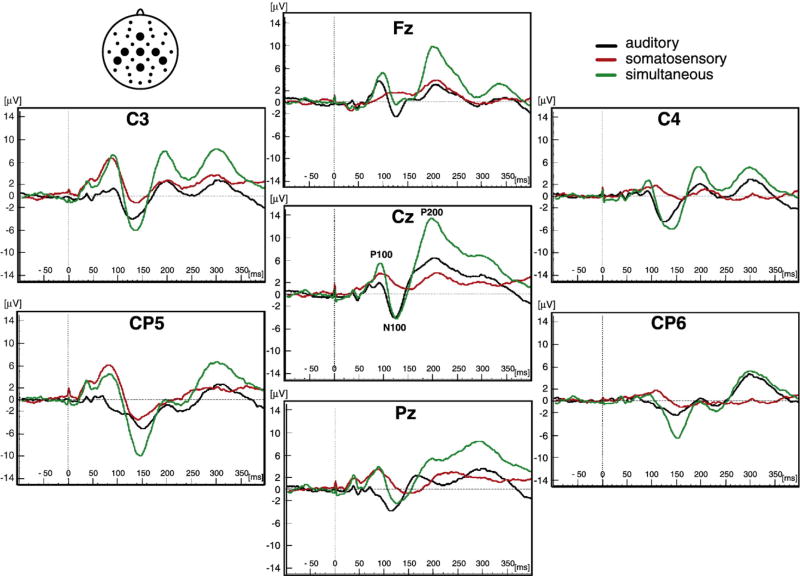
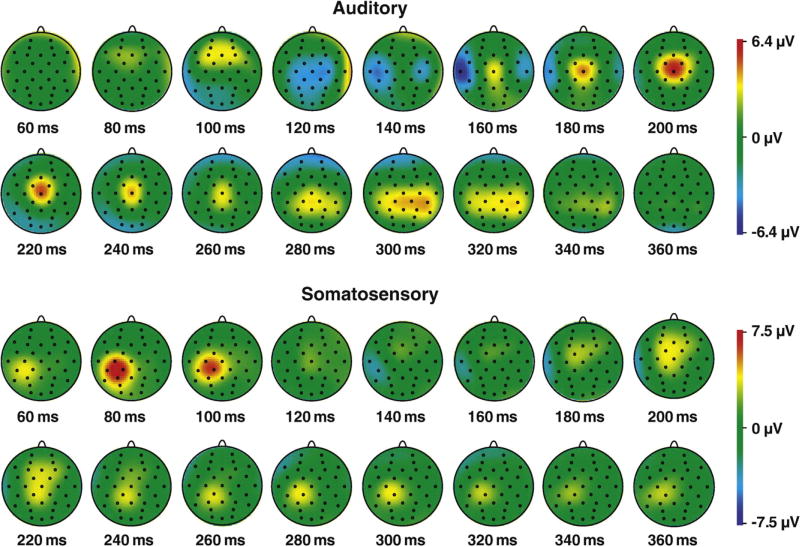
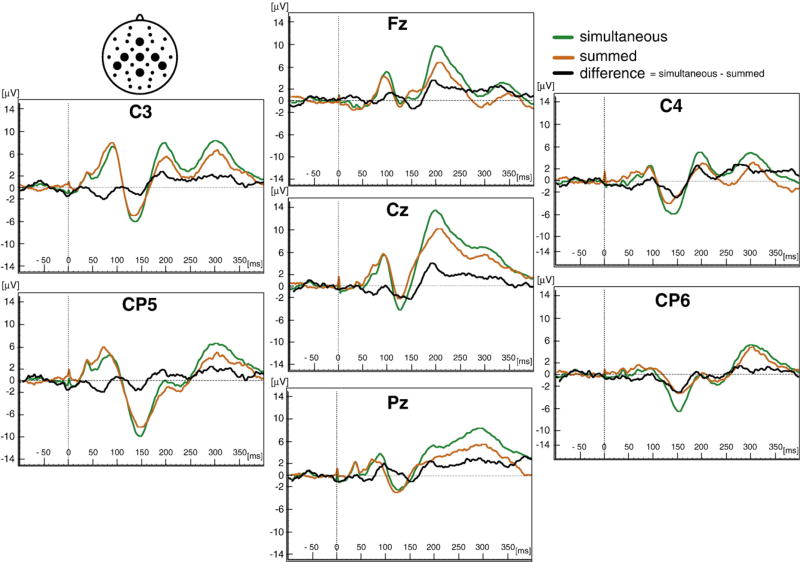
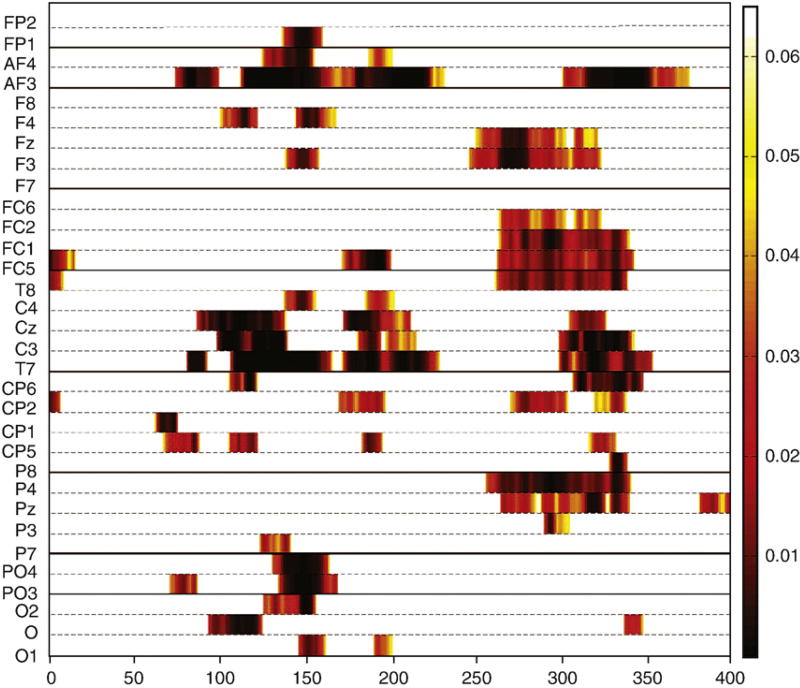
The spatio-temporal scalp distribution of multisensory auditory-somatosensory integration was investigated in typically developing children ages 6-13. Event-related potentials were recorded from 32 scalp electrodes while participants watched a silent cartoon. Three types of sensory stimulation were presented pseudo-randomly: auditory clicks, somatosensory median nerve electrical pulses, or simultaneous auditory and somatosensory stimuli. No behavioral responses were required of the participant. To examine integration, responses to simultaneous auditory and somatosensory stimulation were compared to the sum of unisensory auditory plus unisensory somatosensory responses for four time-windows: (60-80 ms, 80-110 ms, 110-150 ms and 180-220 ms). Results indicated significant multisensory integration occurred in central/post-central scalp regions between 60-80 ms in the hemisphere contralateral to the side of somatosensory stimulation and between 110-150 ms in the hemisphere ipsilateral to the side of somatosensory stimulation. Between 180-220 ms, significant multisensory integration was evident in central/post-central regions in both hemispheres as well as midline scalp regions. This study suggests that children exhibit differential processing of multisensory compared to unisensory stimuli, as has previously been reported in adults.
Figures
References
-
- Bruneau N, Roux S, Guerin P, Barthelemy C, Lelord G. Temporal prominence of auditory evoked potentials (N1 wave) in 4–8-year-old children. Psychophysiology. 1997;34(1):32–38. - PubMed
-
- Calvert GA, Thesen T. Multisensory integration: methodological approaches and emerging principles in the human brain. J. Physiol. Paris. 2004;98(1–3):191–205. - PubMed
-
- Di S, Brett B, Barth DS. Polysensory evoked potentials in rat parietotemporal cortex: Combined auditory and somatosensory responses. Brain Res. 1994;642(1–2):267–280. - PubMed
-
- Fort A, Delpuech C, Pernier J, Giard MH. Dynamics of cortico-subcortical cross-modal operations involved in audio-visual object detection in humans. Cereb. Cortex. 2002;12:1031–1039. - PubMed
-
- Foxe JJ, Morocz IA, Murray MM, Higgins BA, Javitt DC, Schroeder CE. Multisensory auditory-somatosensory interactions in early cortical processing revealed by high-density electrical mapping. Cogn. Brain Res. 2000;10(1–2):77–83. - PubMed
Publication types
MeSH terms
Grants and funding
LinkOut - more resources
Full Text Sources
