. 2008 Jun;4(2):4-25.
doi: 10.1151/ascp08424.

Challenges in using opioids to treat pain in persons with substance use disorders

Affiliations

Challenges in using opioids to treat pain in persons with substance use disorders

Seddon R Savage et al. Addict Sci Clin Pract. 2008 Jun.

Abstract

Pain and substance abuse co-occur frequently, and each can make the other more difficult to treat. A knowledge of pain and its interrelationships with addiction enhances the addiction specialist's efficacy with many patients, both in the substance abuse setting and in collaboration with pain specialists. This article discusses the neurobiology and clinical presentation of pain and its synergies with substance use disorders, presents methodical approaches to the evaluation and treatment of pain that co-occurs with substance use disorders, and provides practical guidelines for the use of opioids to treat pain in individuals with histories of addiction. The authors consider that every pain complaint deserves careful investigation and every patient in pain has a right to effective treatment.


Figures
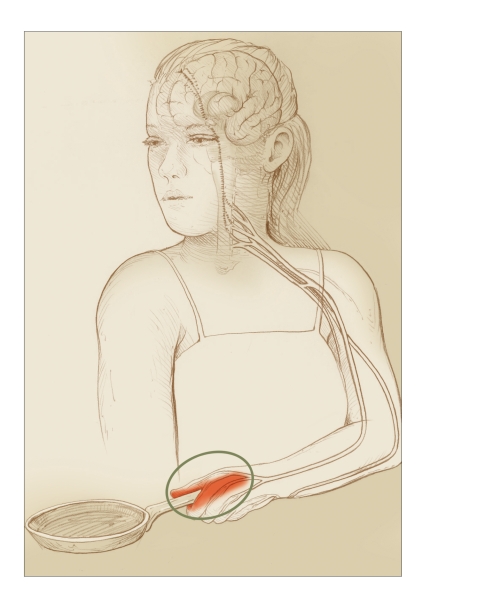
FIGURE 1
FIGURE 1
Nociceptive Pain In nociceptive pain, sensory nerves function normally. The place where pain signals originate and the place that hurts are the same—in this case, a hand that has come into contact with a hot object.
FIGURE 2
FIGURE 2
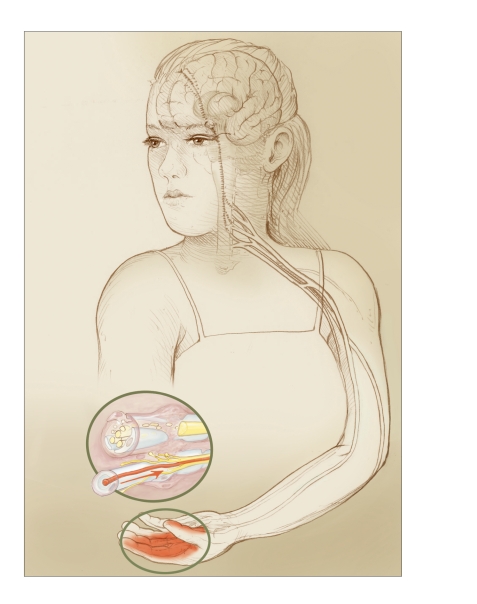
Neuropathic Pain In neuropathic pain, injury to nerves (inset) or changes in processing of nerve signals may spontaneously generate pain signals, though no fresh injury or insult is occurring. Here, changes in nerve processing at different points along the pain pathways may cause the woman’s hand to hurt even after her tissues have otherwise healed.
FIGURE 3
FIGURE 3
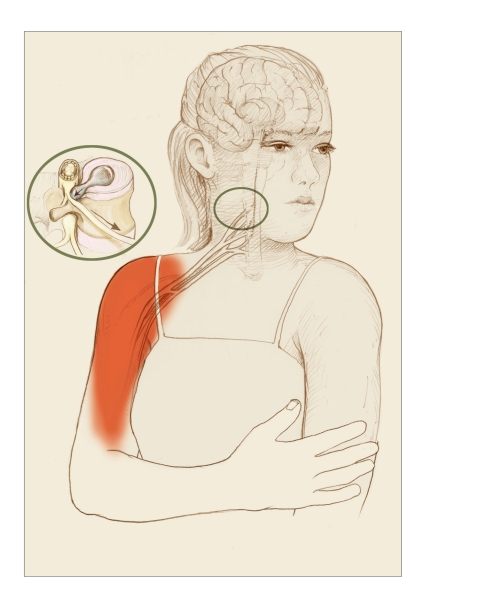
Displaced Sensation of Neuropathic Pain In some types of neuropathic pain, the source of the pain and the sensation of hurt occur in different locations. In this example, one of the spongy discs that alternate with the spinal vertebrae has ruptured, leaking material that presses on an adjacent large nerve fiber (inset). Pain signals travel from the pinched fiber to the brain, which interprets them as coming from the peripheral tissues served by the fiber.
FIGURE 4
FIGURE 4
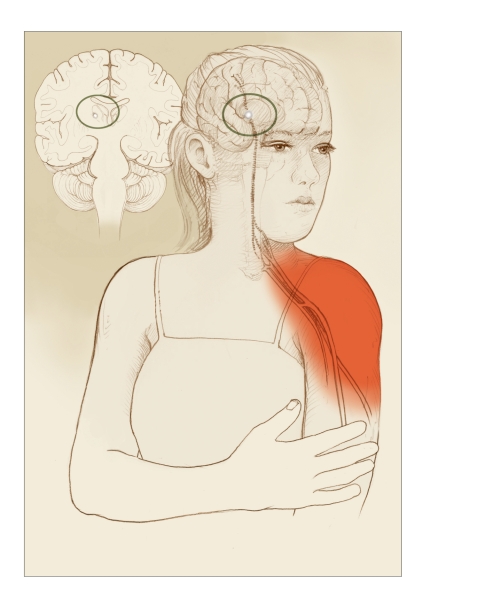
Neuropathic Pain With Damaged Pain-Processing Areas of the Brain Damage to pain-processing areas in the brain also can result in neuropathic pain that is “referred”—that is, felt elsewhere. In this example, an injury to the thalamus (inset) causes pain in a shoulder.
FIGURE 5
FIGURE 5
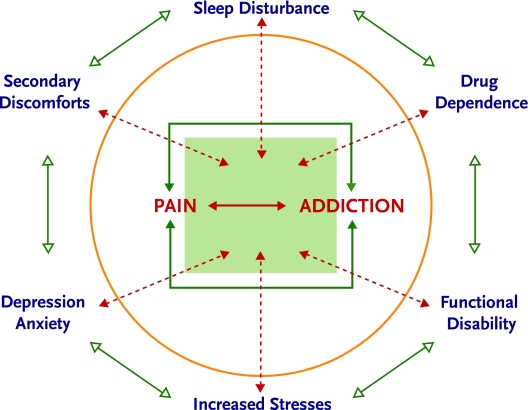
Synergy of Pain and Addiction
FIGURE 6
FIGURE 6
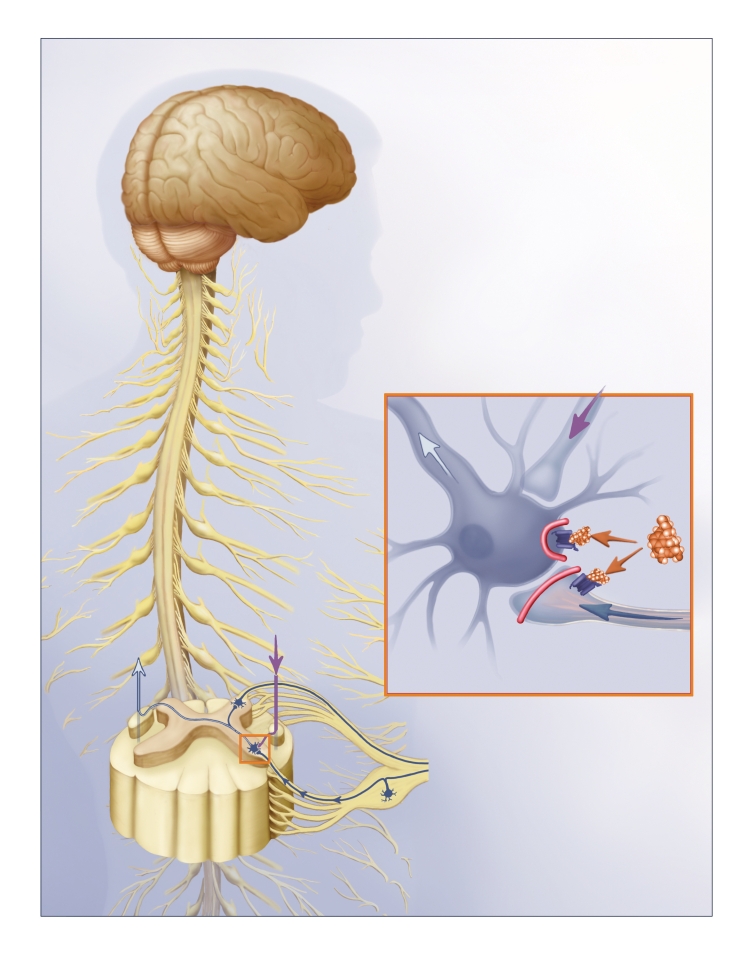
Opioids’ Analgesic Activity Mu opioids block pain mainly by activating mu opioid receptors. An important site of opioid pain suppression is the dorsal horn (inset). Here, mu opioids (shown in gold) attach to receptors (dark blue), inhibiting peripheral fibers from transmitting incoming pain signals (blue arrow), and spinal neurons from receiving them. Simultaneously, signals (purple arrow) triggered by mu opioid activation in the brain further inhibit the responsiveness of spinal neurons. As a result of these actions, pain signals relayed up the spine (white arrow) are weakened or abolished.
FIGURE 7
FIGURE 7
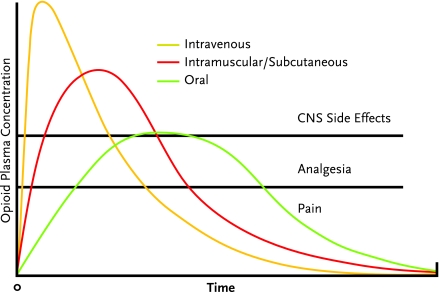
Routes of Opioid Administration The appropriate route of opioid administration depends on the clinical goal. The intravenous route yields the swiftest but briefest pain control, compared with oral and intramuscular/subcutaneous administration, and has the most central nervous system (CNS) side effects. Oral administration maximizes the duration of analgesia and minimizes CNS side effects, but has the longest time to onset of relief.
FIGURE 8
FIGURE 8
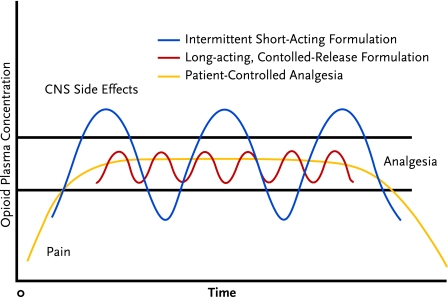
Schedule of Opioid Administration Both controlled-release opioids and patient-controlled opioid analgesia (PCA) can avoid the central nervous system (CNS) side effects and periods of breakthrough pain that may occur during cycles of intermittent short-acting opioid administration. PCA provides the steadiest level of pain control.

Comment in

  • Response: providing relief, avoiding euphoria.
    Paul D, Sullivan MA, Weiss RD. Paul D, et al. Addict Sci Clin Pract. 2008 Jun;4(2):26-7. doi: 10.1151/ascp084226. Addict Sci Clin Pract. 2008. PMID: 18497714 Free PMC article. No abstract available.

References

    1. Acosta M, Haller DL. Psychiatric and substance abuse comorbidity influences treatment outcomes in opioid-abusing patients. Paper presented at the College on Problems of Drug Dependency annual meeting; Scottsdale, AZ. 2006.
    1. Adams NJ, et al. Opioids and the treatment of chronic pain in a primary care sample. Journal of Pain and Symptom Management. 2001;22(3):791–796. - PubMed
    1. Akbik H, et al. Validation and clinical application of the Screener and Opioid Assessment for Patients with Pain (SOAPP) Journal of Pain and Symptom Management. 2006;32(3):287–293. - PubMed
    1. Amabile CM, Bowman BJ. Overview of oral modified-release opioid products for the management of chronic pain. The Annals of Pharmacotherapy. 2006;40(7–8):1327–1335. - PubMed
    1. American Psychiatric Association. Diagnostic and Statistical Manual of Mental Disorders. 4th ed., Text Revision. Washington, DC: American Psychiatric Association; 2000. DSM-IV-TR.

MeSH terms

Substances