Review
. 2008 Jun;8(6):860-4.
doi: 10.1039/b717423c. Epub 2008 Apr 8.

Managing evaporation for more robust microscale assays. Part 2. Characterization of convection and diffusion for cell biology

Affiliations
Review

Managing evaporation for more robust microscale assays. Part 2. Characterization of convection and diffusion for cell biology

Erwin Berthier et al. Lab Chip. 2008 Jun.

Abstract

Cell based microassays allow the screening of a multitude of culture conditions in parallel, which can be used for various applications from drug screening to fundamental cell biology research. Tubeless microfluidic devices based on passive pumping are a step towards accessible high throughput microassays, however they are vulnerable to evaporation. In addition to volume loss, evaporation can lead to the generation of small flows. Here, we focus on issues of convection and diffusion for cell culture in microchannels and particularly the transport of soluble factors secreted by cells. We find that even for humidity levels as high as 95%, convection in a passive pumping channel can significantly alter distributions of these factors and that appropriate system design can prevent convection.


Figures
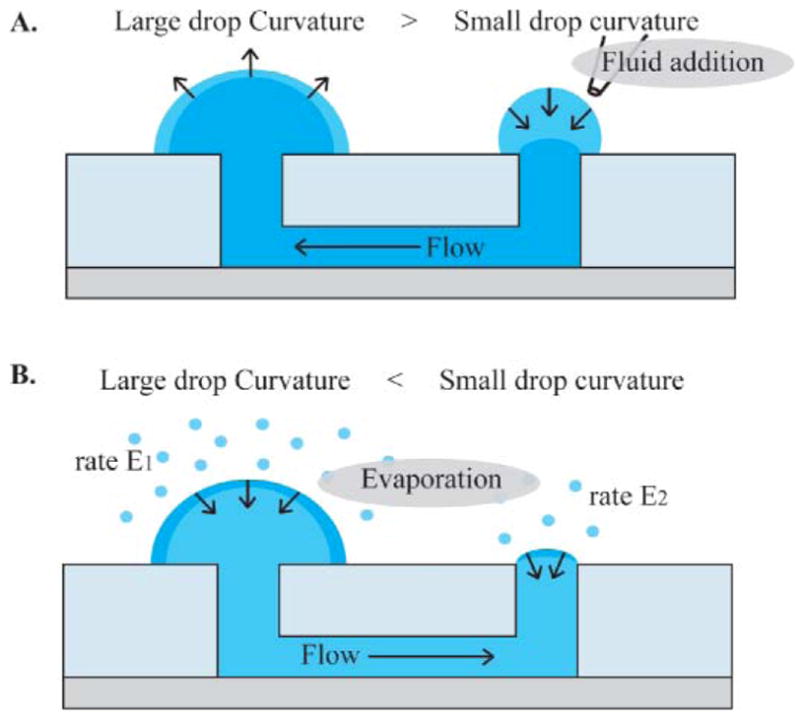
Fig. 1
Fig. 1
Schematic of a passive pumping device. A. Flowing fluid in the channel is effectuated by adding a drop to the port opposing the large drop. The subsequent increase of pressure due to the small curvature of the added drop provokes its flow towards the large drop until curvatures match. This happens in seconds to minutes. B. During the storage of the channel, as evaporation occurs both at the large and small drop, a decrease in volume will provoke more decrease in curvature in the small drop, and thus an unbalance of pressure in its favor. A flow will be generated from the large to the small drop, thus ensuring constant wetting of the port.
Fig. 2
Fig. 2
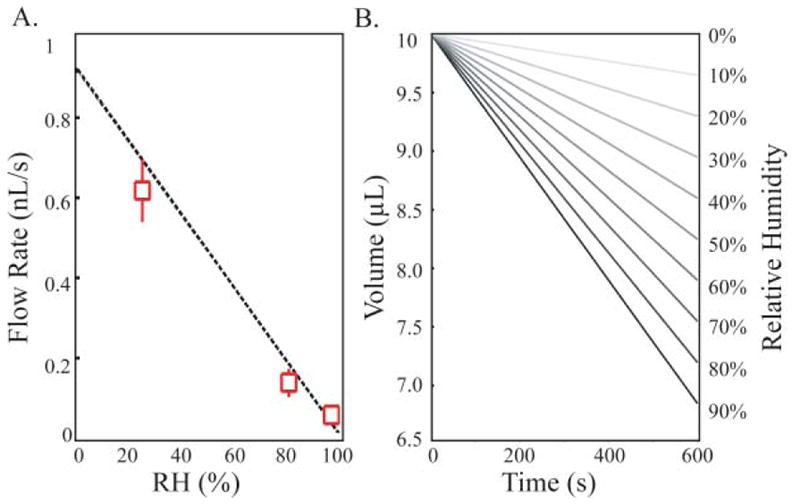
A. Flow rate in a passive pumping channel as a function of the relative humidity calculated using eqn (1) and experimental measures (crosses). B. Variation of volume of the large drop during evaporation for relative humidity (RH) varying from 10% to 100% (shades of grey). At 100% no loss of volume or flow occurs.
Fig. 3
Fig. 3
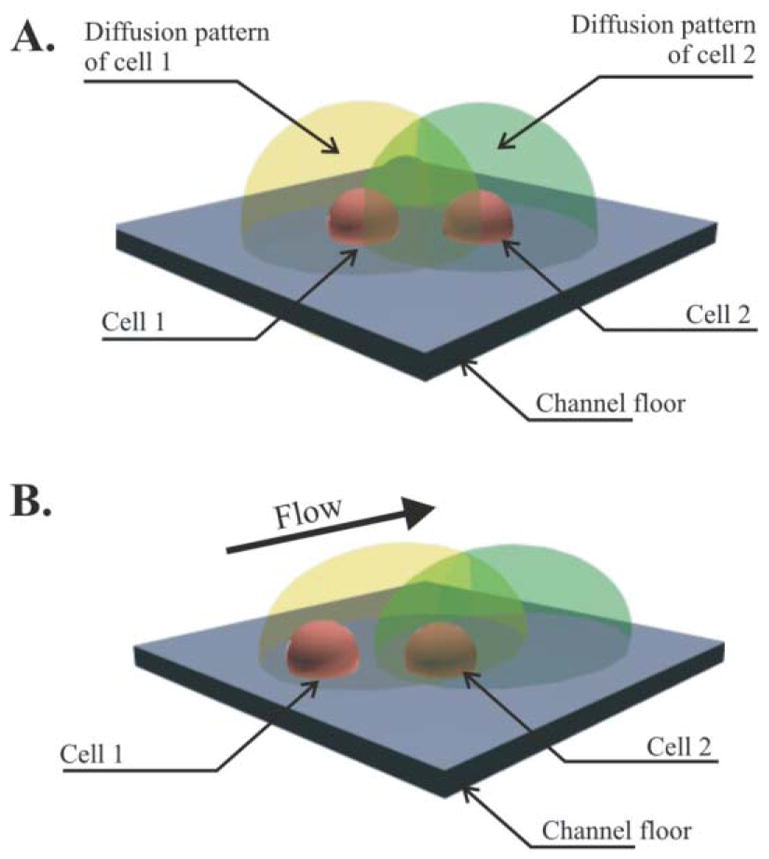
Cell culture in different situations. A: Diffusion dominates exchanges and cell 1 and 2 can interact. B: Convection is larger than diffusion and cell 1 and 2 are not in mutual interaction.
Fig. 4
Fig. 4
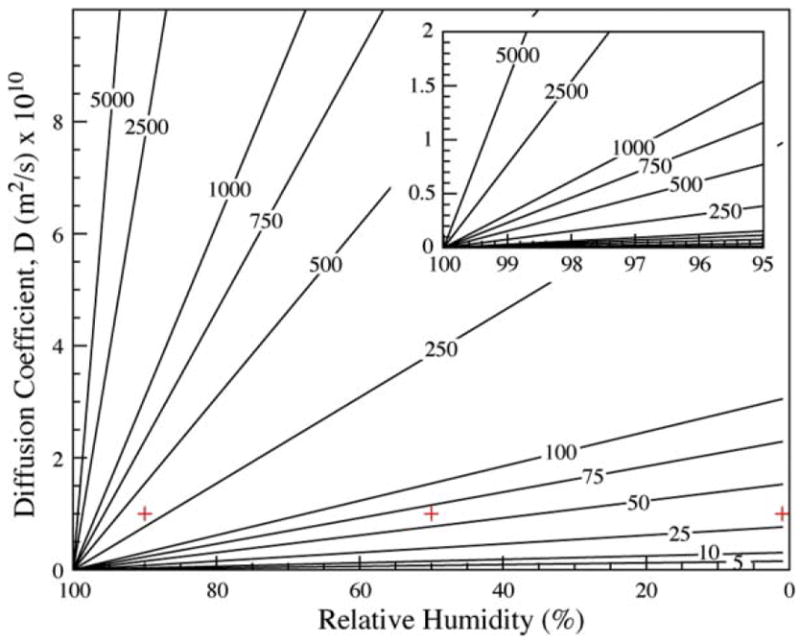
Diffusion radius, or achievable diffusion length, L, in micrometres around a cell secreting a signaling protein of diffusion constant Dp when the channel is placed in a relative humidity RH. High humidity (to the left) signifies low flow; therefore proteins diffuse far around the secreting cell. Large proteins (to the bottom) however diffuse slowly and therefore will not diffuse as far. Crosses indicate conditions simulated in Fig. 5.
Fig. 5
Fig. 5
Concentration of a secreted protein (Dp = 10−10 m2 s−1) in a channel viewed sideways around a 20 μm source cell. The modeling was effectuated on COMSOL for different values of the flow rate in a channel, corresponding to the different humidity conditions the device is placed in. Low humidity environment causes enhanced evaporation, thus strong flows, effectively washing secreted protein away. The channel is 150 μm tall, 750 μm wide and 5 mm long in total and only partially represented here.
Fig. 6
Fig. 6
Experimental setup for diffusion/convection measurements. Evaporation is controlled by leaving on or removing the lid.

References

    1. Khandurina J, Guttman A. J Chromatogr, A. 2002;943:159–183. - PubMed
    1. Mere L, Bennett T, Coassin P, England P, Hamman B, Rink T, Zimmerman S, Negulescu P. Drug Discov Today. 1999;4:363–369. - PubMed
    1. Sia SK, Linder V, Parviz BA, Siegel A, Whitesides GM. Angew Chem, Int Ed. 2004;43:498–502. - PubMed
    1. Silverman L, Campbell R, Broach JR. Curr Opin Chem Biol. 1998;2:397–403. - PubMed
    1. Beebe DJ, Mensing GA, Walker GM. Annu Rev Biomed Eng. 2002;4:261–286. - PubMed

Publication types