. 2008 Sep;90(3):481-91.
doi: 10.1016/j.pbb.2008.04.007. Epub 2008 Apr 15.

Hippocampal regulation of contextual cue-induced reinstatement of cocaine-seeking behavior

Affiliations

Hippocampal regulation of contextual cue-induced reinstatement of cocaine-seeking behavior

Alison L Atkins et al. Pharmacol Biochem Behav. 2008 Sep.

Abstract

Associations between cocaine and cues facilitate development and maintenance of addiction. We hypothesized that the ventral hippocampus is important for acquisition of these associations. Rats were trained to self-administer cocaine, with or without pre-exposure to distinct sets of cocaine- and saline-paired contextual cues. Next, rats were conditioned for 3 days with the distinct sets of contextual cues paired with cocaine and saline along with distinct discrete cues. Vehicle or lidocaine was infused into the ventral hippocampus prior to conditioning sessions. Following extinction, reinstatement of cocaine-seeking behavior was examined following exposure to contextual cues, discrete cues, or their combination. Inactivation of the ventral hippocampus during conditioning blocked acquisition of the association between cocaine and cocaine-paired contextual cues in that only lidocaine-treated rats with short-term cue exposure failed to reinstate responding in the presence of cocaine-paired contextual cues. Lidocaine also prevented rats in both cue exposure groups from discriminating between cocaine- and saline-paired contextual cues during reinstatement tests. Reinstatement induced by cocaine-paired discrete cues or by contextual and discrete cues together was not impaired for either cue exposure condition. The hippocampus is important for acquisition of the association between cocaine and context and in maintaining discrimination between cocaine-relevant and -irrelevant contextual cues.


Figures
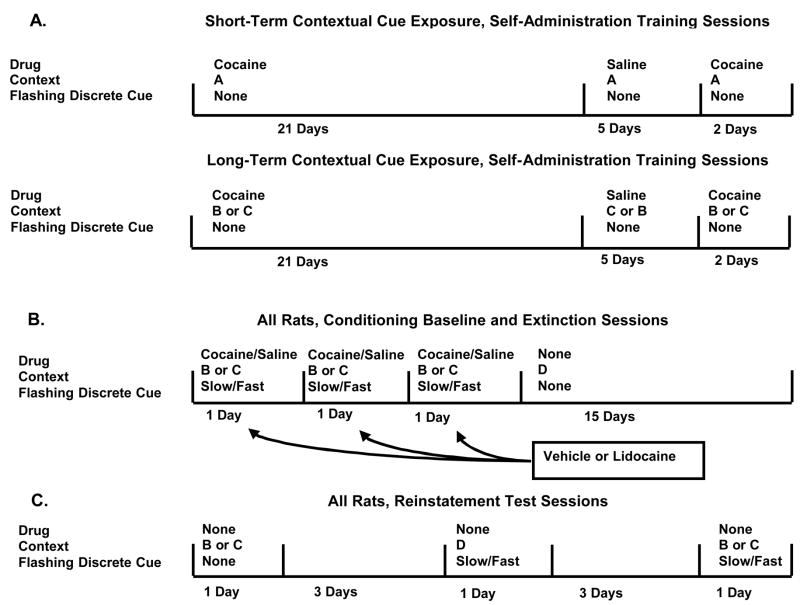
Figure 1
Figure 1
Timeline of experimental procedures during self-administration training sessions (A), self-administration conditioning baseline sessions and extinction sessions (B), and reinstatement test sessions (C).
Figure 2
Figure 2
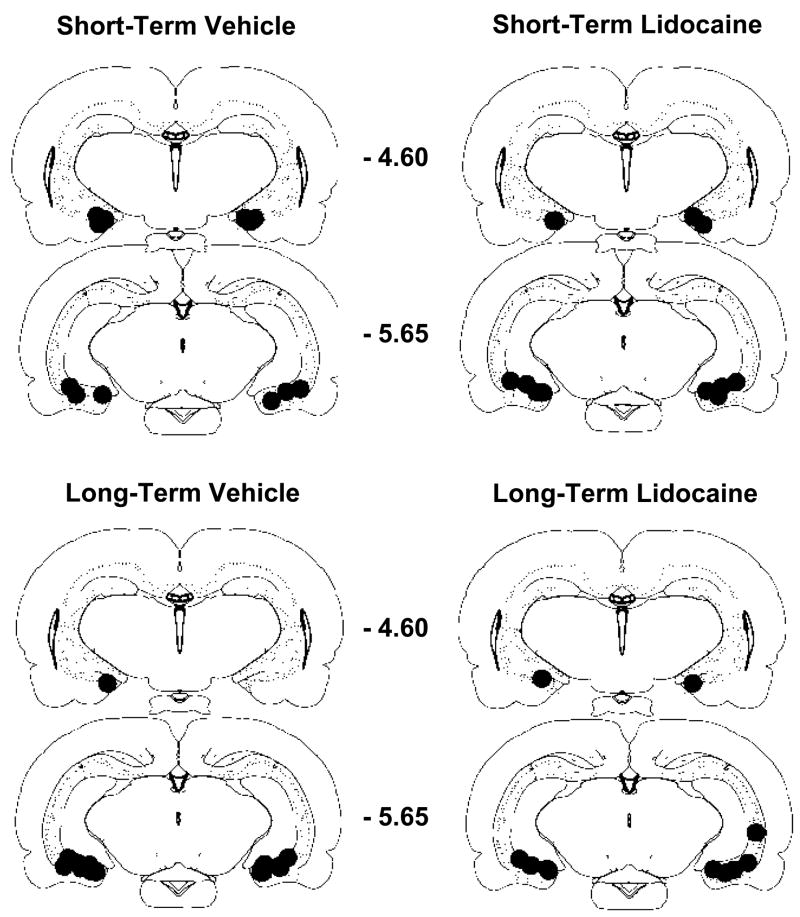
Cannulae placements and functional spread of lidocaine and vehicle (circles with a 0.50 mm radius) in short-term and long-term cue exposure groups at AP levels −4.60 and −5.65 mm from bregma. The volume of lidocaine required to inactivate >90% of neurons within a particular radius from the infusion site is specified by the spherical volume equation, V=4/3Πr3 (Tehovnik and Sommer, 1997). Based on the spherical volume equation, the radius of the functional spread of 0.5 μL lidocaine, the volume used in the present study, is estimated to be 0.50 mm from the infusion site.
Figure 3
Figure 3
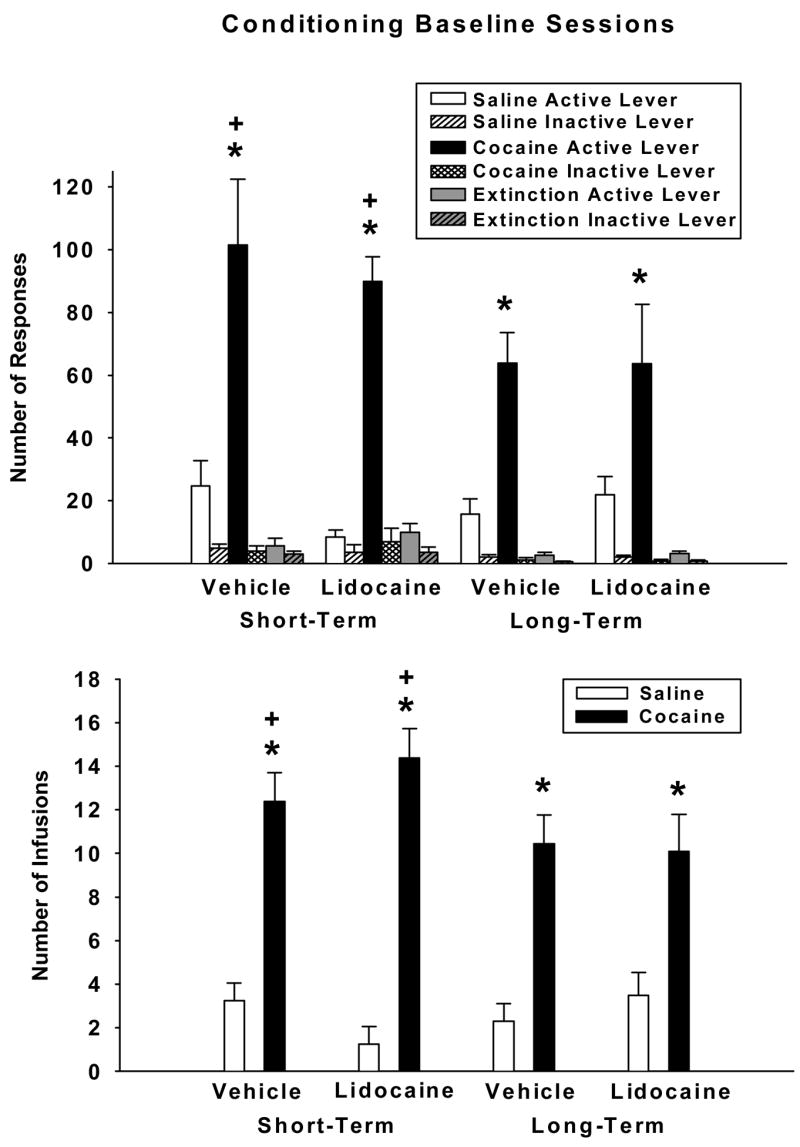
Mean ± S.E.M. active and inactive lever responses during cocaine, saline and extinction sessions (top panel) and infusions during cocaine and saline sessions (bottom panel) for the last 2 days of the 3-day conditioning procedure and the last day of extinction in rats with short-term or long-term exposure to contextual cues. Prior to each session, animals received bilateral infusions of either lidocaine or vehicle into the ventral hippocampus. * p≤0.05 compared to all other conditions within the same treatment and cue exposure group; and + p≤0.05 compared to the corresponding long-term cue exposure condition within the same treatment group.
Figure 4
Figure 4
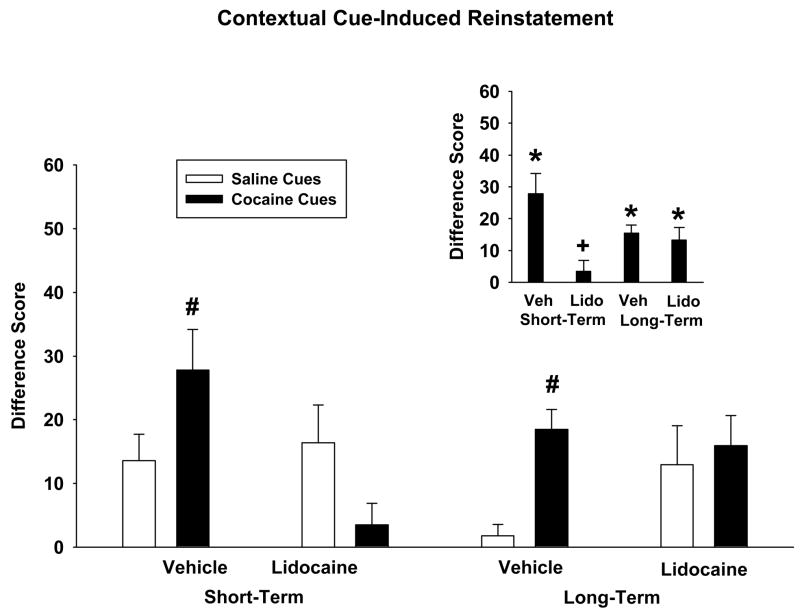
Mean ± S.E.M. active lever response difference scores during cue-induced reinstatement tests with saline-paired and cocaine-paired contextual cues in rats with short-term and long-term exposure to the contextual cues. Inset shows active lever responses during cocaine-paired contextual cue sessions only. Raw score means for cocaine sessions were as follows: short-term vehicle=33.4±5.5, short-term lidocaine=13.4±3.6, long-term vehicle=18.0±2.6, long-term lidocaine=16.5±4.1. Inset: * p≤0.05 compared to zero, which indicates no increase in responding above extinction levels; + p≤0.05 compared to the other three groups. Main graph: # p≤0.05 compared to saline responses within treatment group.
Figure 5
Figure 5
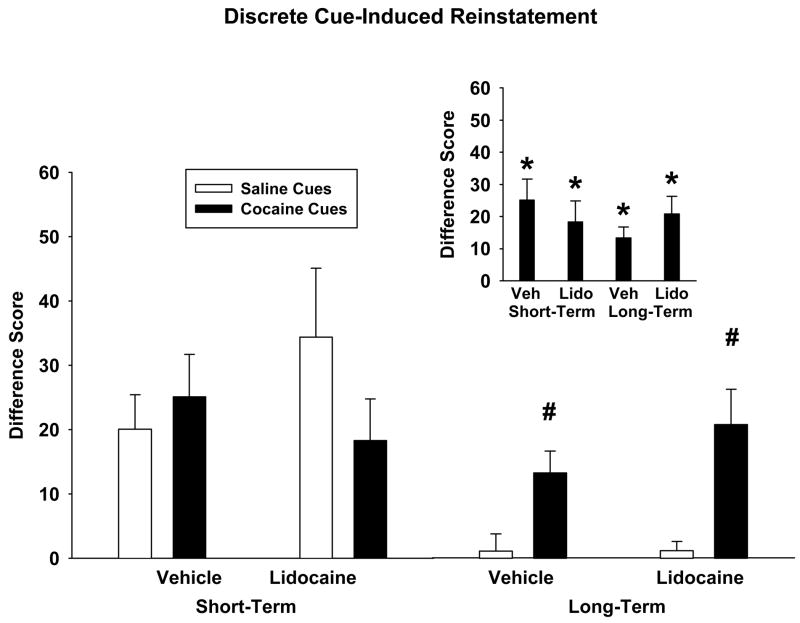
Mean ± S.E.M. active lever response difference scores during cue-induced reinstatement tests with saline-paired and cocaine-paired discrete cues in rats with short-term and long-term exposure to the contextual cues. Inset shows active lever responses during cocaine-paired discrete cue sessions only. Raw score means for cocaine sessions were as follows: short-term vehicle=30.8±7.0, short-term lidocaine=28.1±8.1, long-term vehicle=15.9±3.7, long-term lidocaine=24.0±5.8. Inset: * p≤0.05 compared to zero, which indicates no increase in responding above extinction levels. Main graph: # p≤0.05 compared to saline responses within treatment group.
Figure 6
Figure 6
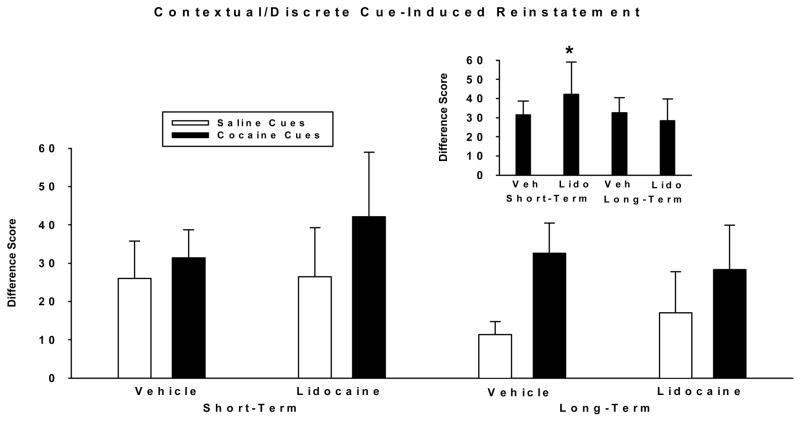
Mean ± S.E.M. active lever response difference scores during cue-induced reinstatement tests with saline-paired and cocaine-paired contextual/discrete cues in rats with short-term and long-term exposure to the contextual cues. Inset shows active lever responses during cocaine-paired contextual/discrete cue sessions only. Raw score means for cocaine sessions were as follows: short-term vehicle=37.0±7.6, short-term lidocaine=52.0±14.9, long-term vehicle=35.3±8.4, long-term lidocaine=31.5±11.8. Inset: * p≤ 0.05 compared to zero, which indicates no increase in responding above extinction levels.

References

    1. Alvarez P, Squire LR. Memory consolidation and the medial temporal lobe: A simple network model. Proc Natl Acad Sci U S A. 1994;91:7041–7045. - PMC - PubMed
    1. Bardgett ME, Henry JD. Locomotor activity and accumbens Fos expression driven by ventral hippocampal stimulation require D1 and D2 receptors. Neuroscience. 1999;94(1):59–70. - PubMed
    1. Bast T, Zhang WN, Feldon J. The ventral hippocampus and fear conditioning in rats. Different anterograde amnesias of fear after tetrodotoxin inactivation and infusion of the GABA(A) agonist muscimol. Exp Brain Res. 2001;139(1):39–52. - PubMed
    1. Bertaina-Anglade V, Tramu G, Destrade C. Differential learning-stage dependent patterns of c-Fos protein expression in brain regions during the acquisition and memory consolidation of an operant task in mice. Eur J Neurosci. 2000;12:3803–3812. - PubMed
    1. Besheer J, Jensen HC, Bevins RA. Dopamine antagonism in a novel-object recognition and a novel-object place conditioning preparation with rats. Behav Brain Res. 1999;103:35–44. - PubMed

Publication types