Pharmacological targeting of the KIT growth factor receptor: a therapeutic consideration for mast cell disorders
- PMID: 18500355
- PMCID: PMC2518463
- DOI: 10.1038/bjp.2008.204
Pharmacological targeting of the KIT growth factor receptor: a therapeutic consideration for mast cell disorders
Abstract
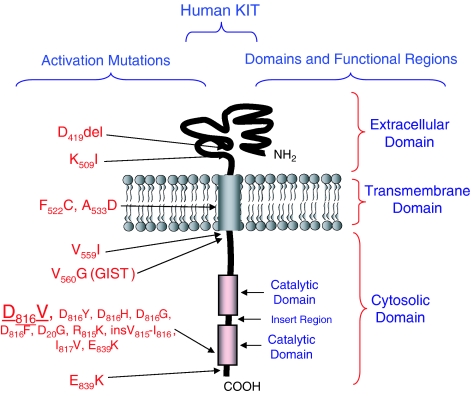
KIT is a member of the tyrosine kinase family of growth factor receptors which is expressed on a variety of haematopoietic cells including mast cells. Stem cell factor (SCF)-dependent activation of KIT is critical for mast cell homeostasis and function. However, when KIT is inappropriately activated, accumulation of mast cells in tissues results in mastocytosis. Such dysregulated KIT activation is a manifestation of specific activating point mutations within KIT, with the human D816V mutation considered as a hallmark of human systemic mastocytosis. A number of other activating mutations in KIT have recently been identified and these mutations may also contribute to aberrant mast cell growth. In addition to its role in mast cell growth, differentiation and survival, localized concentration gradients of SCF may control the targeting of mast cells to specific tissues and, once resident within these tissues, mast cell activation by antigen may also be amplified by SCF. Thus, KIT inhibitors may have potential application in multiple conditions linked to mast cells including systemic mastocytosis, anaphylaxis, and asthma. In this review, we discuss the role of KIT in the context of mast cells in these disease states and how recent advances in the development of inhibitors of KIT activity and function may offer novel therapies for the treatment of these disorders.
Figures

References
-
- Aichberger KJ, Mayerhofer M, Gleixner KV, Krauth MT, Gruze A, Pickl WF, et al. Identification of MCL1 as a novel target in neoplastic mast cells in systemic mastocytosis: inhibition of mast cell survival by MCL1 antisense oligonucleotides and synergism with PKC412. Blood. 2007;109:3031–3041. - PubMed
-
- Akin C, Brockow K, D'Ambrosio C, Kirshenbaum AS, Ma Y, Longley BJ, et al. Effects of tyrosine kinase inhibitor STI571 on human mast cells bearing wild-type or mutated c-kit. Exp Hematol. 2003;31:686–692. - PubMed
-
- Akin C, Fumo G, Yavuz AS, Lipsky PE, Neckers L, Metcalfe DD. A novel form of mastocytosis associated with a transmembrane c-kit mutation and response to imatinib. Blood. 2004;103:3222–3225. - PubMed
-
- Akin C, Metcalfe DD. The biology of Kit in disease and the application of pharmacogenetics. J Allergy Clin Immunol. 2004;114:13–19. - PubMed
Publication types
MeSH terms
Substances
Grants and funding
LinkOut - more resources
Full Text Sources
Other Literature Sources