Review
. 2008 Jun;154(3):557-68.
doi: 10.1038/bjp.2008.153.

Regulation of muscle mass by growth hormone and IGF-I

Affiliations
Review

Regulation of muscle mass by growth hormone and IGF-I

C P Velloso. Br J Pharmacol. 2008 Jun.

Abstract

Growth hormone (GH) is widely used as a performance-enhancing drug. One of its best-characterized effects is increasing levels of circulating insulin-like growth factor I (IGF-I), which is primarily of hepatic origin. It also induces synthesis of IGF-I in most non-hepatic tissues. The effects of GH in promoting postnatal body growth are IGF-I dependent, but IGF-I-independent functions are beginning to be elucidated. Although benefits of GH administration have been reported for those who suffer from GH deficiency, there is currently very little evidence to support an anabolic role for supraphysiological levels of systemic GH or IGF-I in skeletal muscle of healthy individuals. There may be other performance-enhancing effects of GH. In contrast, the hypertrophic effects of muscle-specific IGF-I infusion are well documented in animal models and muscle cell culture systems. Studies examining the molecular responses to hypertrophic stimuli in animals and humans frequently cite upregulation of IGF-I messenger RNA or immunoreactivity. The circulatory/systemic (endocrine) and local (autocrine/paracrine) effects of GH and IGF-I may have distinct effects on muscle mass regulation.


Figures
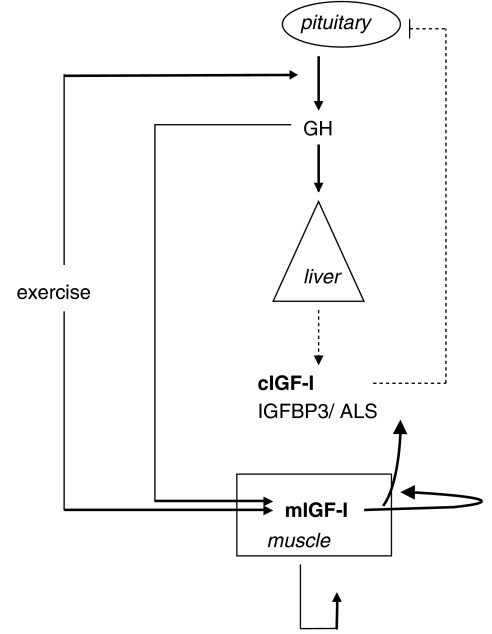
Figure 1
Figure 1
Schematic representation of the growth hormone (GH)/insulin-like growth factor I (IGF-I) axis. GH is synthesized in the pituitary and induces synthesis of IGF-I in most tissues (liver and muscle). The liver is the main source of circulating IGF-I (cIGF-I) although some cIGF-I comes from other tissues, including muscle. cIGF-I is part of a negative feedback loop regulating GH release. IGF-I synthesized in muscle (mIGF-I) in response to exercise or GH acts in an autocrine/paracrine way to stimulate hypertrophy.
Figure 2
Figure 2
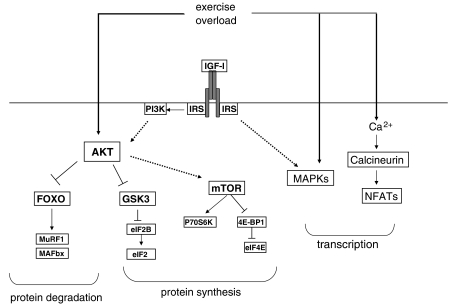
Signalling pathways regulated by insulin-like growth factor I (IGF-I) and/or exercise. Exercise has been shown to activate several different pathways in muscle. They include AKT, MAPK (ERK1, ERK2) and calcineurin. Exercise also induces synthesis of IGF-I in muscle. IGF-IR signals through many of the same pathways as exercise. Signalling through phosphatidylinositol 3 kinase (PI3K)/AKT is of particular importance as this increases protein synthesis and inhibits protein degradation via inactivation of FOXO transcription factors. Interestingly, although exercise activates AKT and induces increased protein synthesis, it also increases protein degradation (not illustrated), probably as a result of increased protein remodelling. If net protein synthesis results, this will lead to muscle hypertrophy. Thus, exercise and IGF-I have overlapping but distinct effects on muscle.
Figure 3
Figure 3
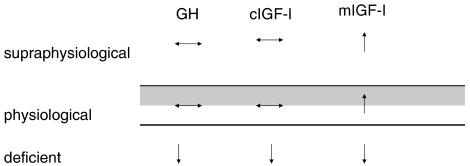
Overview of the effects of different levels of growth hormone (GH), circulating IGF-I (cIGF-I) and IGF-I synthesized in muscle (mIGF-I) on muscle mass and/or performance. In healthy subjects, supraphysiological GH and cIGF-I have no effect on muscle mass. In contrast, supraphysiological levels of mIGF-I increase muscle mass and may play a role in the hypertrophic adaptation to exercise. Deficiency in GH or IGF-I results in reduction in muscle mass.
Figure 4
Figure 4
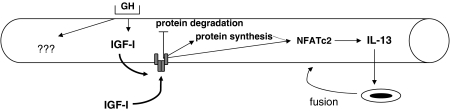
Effects of growth hormone (GH) and circulating IGF-I (IGF-I) on cultured myotubes. Both GH and IGF-I induce myotube hypertrophy. IGF-I increases protein synthesis and inhibits protein degradation. In addition, it induces fusion of myoblasts by upregulating synthesis of interleukin (IL)-13. It is possible that the IL-13 response is secondary to protein synthesis, with new nuclei being recruited only when required to maximize growth. Indeed treatment of cultures with rapamycin, inhibitor of mTOR, inhibits both hypertrophy and increase in fusion index of IGF-I-treated myotubes (Jacquemin et al., 2007). Cotreatment of cultures with GH and IGF-I induces greater hypertrophic gains than either treatment alone. Thus, the hormones have distinct and overlapping effects on cells.

References

    1. Adams GR, Haddad F. The relationships among IGF-1, DNA content, and protein accumulation during skeletal muscle hypertrophy. J Appl Physiol. 1996;81:2509–2516. - PubMed
    1. Adams GR, McCue SA. Localized infusion of IGF-I results in skeletal muscle hypertrophy in rats. J Appl Physiol. 1998;84:1716–1722. - PubMed
    1. Antonio J, Gonyea WJ. Progressive stretch overload of skeletal muscle results in hypertrophy before hyperplasia. J Appl Physiol. 1993;75:1263–1271. - PubMed
    1. Aperghis M, Hameed M, Bouloux P, Goldspink G, Harridge S. Two weeks of GH administration does not increase the expression of insulin-like growth factor-I mRNA splice variants in the skeletal muscle of young men. J Physiol. 2004;558P:C4.
    1. Araki E, Lipes MA, Patti ME, Bruning JC, Haag B, III, Johnson RS, et al. Alternative pathway of insulin signalling in mice with targeted disruption of the IRS-1 gene. Nature. 1994;372:186–190. - PubMed

Publication types

Substances