


Cancer chemotherapy with indole-3-carbinol, bis(3'-indolyl)methane and synthetic analogs
- PMID: 18501502
- PMCID: PMC2574232
- DOI: 10.1016/j.canlet.2008.04.021
Cancer chemotherapy with indole-3-carbinol, bis(3'-indolyl)methane and synthetic analogs
Abstract
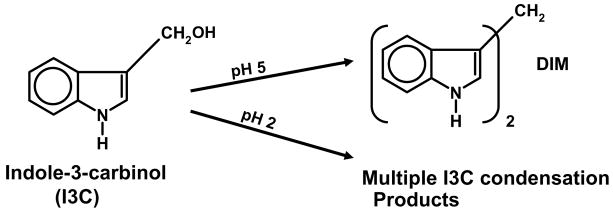
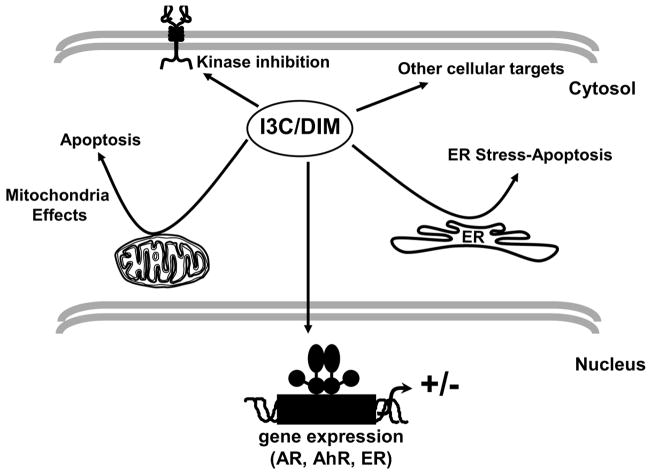
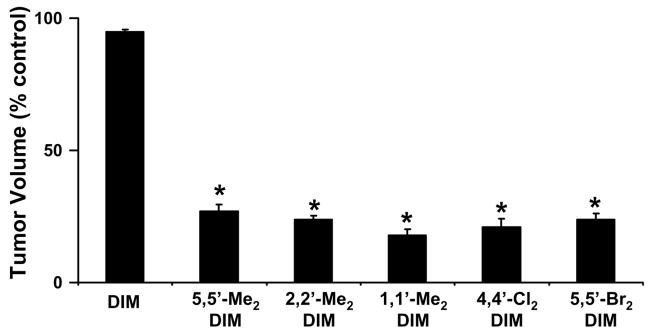
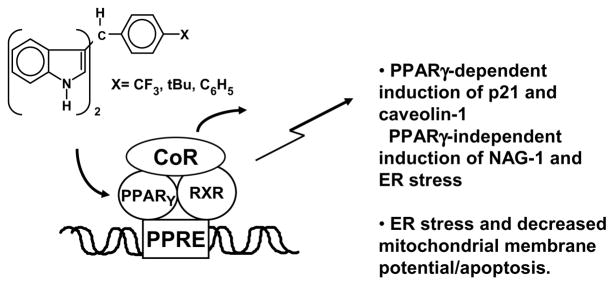
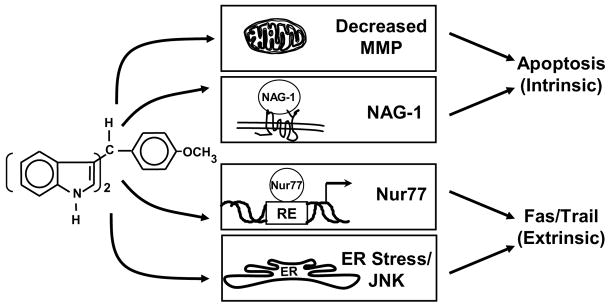
Indole-3-carbinol (I3C) conjugates are phytochemicals expressed in brassica vegetables and have been associated with the anticancer activities of vegetable consumption. I3C and its metabolite bis(3'-indolyl)methane (DIM) induce overlapping and unique responses in multiple cancer cell lines and tumors, and these include growth inhibition, apoptosis and antiangiogenic activities. The mechanisms of these responses are complex and dependent on cell context. I3C and/or DIM activate or inactivate multiple nuclear receptors, induce endoplasmic reticulum stress, decrease mitochondrial membrane potential, and modulate multiple signaling pathways including kinases. DIM has been used as a template to synthesize a series of 1,1-bis(3'indolyl)-1-(substituted aromatic)methanes (i.e. C-DIMs) which are also cytotoxic to cancer cells and tumors. Some of the effects of C-DIMs resemble those reported for DIM analogs; however, structure-activity studies with the aromatic ring has resulted in generation of highly unique receptor agonists. For example, p-trifluoromethylphenyl, p-t-butylphenyl and p-biphenyl analogs activate peroxisome proliferator-activated receptor gamma (PPARgamma), and p-methoxyphenyl and p-phenyl compounds activate nerve growth factor-induced-Balpha (NGFI-Balpha, Nur77) orphan nuclear receptor. The effects of C-DIMs on PPARgamma and Nur77 coupled with their receptor-independent activities has resulted in the development of a novel group of multi-targeted anticancer drugs with excellent potential for clinical treatment of cancer.
Figures
References
-
- Hanahan D, Weinberg RA. The hallmarks of cancer. Cell. 2000;100:57–70. - PubMed
-
- Hung HC, Joshipura KJ, Jiang R, Hu FB, Hunter D, Smith-Warner SA, Colditz GA, Rosner B, Spiegelman D, Willett WC. Fruit and vegetable intake and risk of major chronic disease. J Natl Cancer Inst. 2004;96:1577–1584. - PubMed
-
- Smith-Warner SA, Spiegelman D, Yaun SS, Adami HO, Beeson WL, Van den Brandt PA, Folsom AR, Fraser GE, Freudenheim JL, Goldbohm RA, Graham S, Miller AB, Potter JD, Rohan TE, Speizer FE, Toniolo P, Willett WC, Wolk A, Zeleniuch-Jacquotte A, Hunter DJ. Intake of fruits and vegetables and risk of breast cancer: a pooled analysis of cohort studies. JAMA. 2001;285:769–776. - PubMed
-
- van Gils CH, Peeters PH, Bueno-de-Mesquita HB, Boshuizen HC, Lahmann PH, Clavel-Chapelon F, Thiebaut A, Kesse E, Sieri S, Palli D, Tumino R, Panico S, Vineis P, Gonzalez CA, Ardanaz E, Sanchez MJ, Amiano P, Navarro C, Quiros JR, Key TJ, Allen N, Khaw KT, Bingham SA, Psaltopoulou T, Koliva M, Trichopoulou A, Nagel G, Linseisen J, Boeing H, Berglund G, Wirfalt E, Hallmans G, Lenner P, Overvad K, Tjonneland A, Olsen A, Lund E, Engeset D, Alsaker E, Norat T, Kaaks R, Slimani N, Riboli E. Consumption of vegetables and fruits and risk of breast cancer. JAMA. 2005;293:183–193. - PubMed
Publication types
MeSH terms
Substances
Grants and funding
LinkOut - more resources
Full Text Sources
Miscellaneous
