


Uric acid and the development of metabolic syndrome in women and men
- PMID: 18502269
- PMCID: PMC2486830
- DOI: 10.1016/j.metabol.2008.01.030
Uric acid and the development of metabolic syndrome in women and men
Abstract
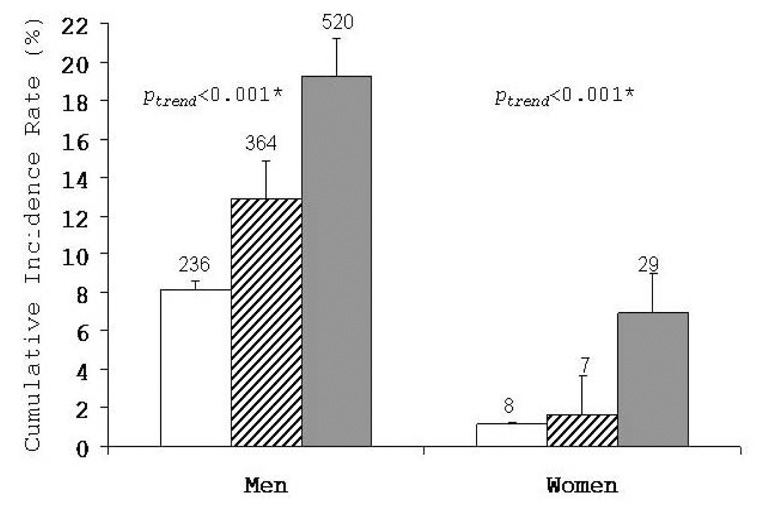
Associations between serum uric acid (UA) levels and metabolic syndrome (MetS) have been reported in cross-sectional studies. Limited information, however, is available concerning the prospective association of UA and the risk of developing MetS. The authors evaluated UA as a risk factor for incident MetS in a prospective study of 8429 men and 1260 women (aged 20-82 years) who were free of MetS and for whom measures of waist girth, resting blood pressure, fasting lipids, and glucose were taken during baseline and follow-up examinations between 1977 and 2003. Hyperuricemia was defined as >7.0 mg/dL in men and >6.0 mg/dL in women. Metabolic syndrome was defined with the National Cholesterol Education Program Adult Treatment Panel III criteria. The overall prevalence of hyperuricemia was 17%. During a mean follow-up of 5.7 years, 1120 men and 44 women developed MetS. Men with serum UA concentrations > or =6.5 mg/dL (upper third) had a 1.60-fold increase in risk of MetS (95% confidence interval, 1.34-1.91) as compared with those who had concentrations <5.5 mg/dL (lowest third). Among women, the risk of MetS was at least 2-fold higher for serum UA concentrations > or =4.6 mg/dL (P for trend = .02). Higher serum UA is a strong and independent predictor of incident MetS in men and women.
Figures
References
-
- Grundy SM, Brewer HB, Jr, Cleeman JI, et al. Definition of metabolic syndrome: Report of the National Heart, Lung, and Blood Institute/American Heart Association conference on scientific issues related to definition. Circulation. 2004;109:433–438. - PubMed
-
- Ford ES, Giles WH, Dietz WH. Prevalence of the metabolic syndrome among US adults: findings from the third National Health and Nutrition Examination Survey. Journal of the American Medical Association. 2002;287:356–359. - PubMed
-
- Ford ES, Giles WH, Mokdad AH. Increasing prevalence of the metabolic syndrome among u.s. Adults. Diabetes Care. 2004;27:2444–2449. - PubMed
-
- Grundy SM, Cleeman JI, Daniels SR, et al. Diagnosis and management of the metabolic syndrome. An American Heart Association/National Heart, Lung, and Blood Institute Scientific Statement. Executive summary. Cardiol Rev. 2005;13:322–327. - PubMed
-
- Wilson PW, D'Agostino RB, Parise H, et al. Metabolic syndrome as a precursor of cardiovascular disease and type 2 diabetes mellitus. Circulation. 2005;112:3066–3072. - PubMed
Publication types
MeSH terms
Substances
Grants and funding
LinkOut - more resources
Full Text Sources
Other Literature Sources
Medical
