


Editorial
doi: 10.1152/ajpheart.00499.2008.
Epub 2008 May 23.
The proverbial chicken or the egg? Dissection of the role of cell-free hemoglobin versus reactive oxygen species in sickle cell pathophysiology
- PMID: 18502905
- PMCID: PMC2494755
- DOI: 10.1152/ajpheart.00499.2008
Item in Clipboard
Editorial
The proverbial chicken or the egg? Dissection of the role of cell-free hemoglobin versus reactive oxygen species in sickle cell pathophysiology
Am J Physiol Heart Circ Physiol.
2008 Jul.
No abstract available
Figures
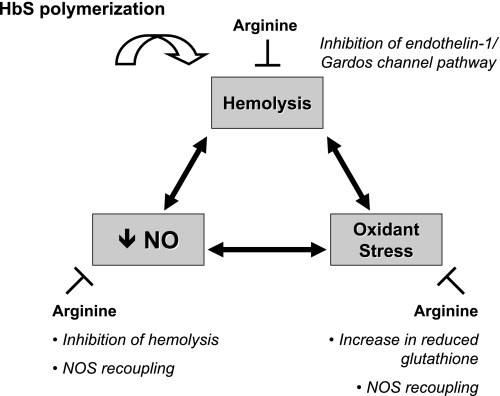
A vicious cycle of hemolysis, nitric oxide (NO) resistance, and oxidant stress, with interruption by arginine repletion. In sickle cell disease, hemoglobin S (HbS) leads to red blood cell (RBC) hemolysis, decreased NO bioavailability, and oxidant stress. Intravascular hemolysis releases cell-free hemoglobin into the plasma compartment, contributing directly to both impaired NO bioavailability and oxidant stress. Hemolysis alters NO homeostasis through scavenging of NO by cell-free hemoglobin and consumption of arginine by arginase released from hemolyzed RBCs. Hemolysis drives oxidant stress through free hemoglobin-mediated peroxidase, autooxidation, and Fenton chemistries, producing nitrogen dioxide and tyrosine nitration. NO resistance is aggravated by enzymatic (xanthine oxidase and NADPH oxidase) production of superoxide, which scavenges NO. Oxidant stress perpetuates the cycle by rendering RBCs more susceptible to damage and hemolysis. Remarkably, arginine supplementation appears to target this triad of pathology by increasing NO formation, reducing hemolysis, and reducing oxidant stress. NOS, NO synthase.
Comment on
-
Arginine therapy of transgenic-knockout sickle mice improves microvascular function by reducing non-nitric oxide vasodilators, hemolysis, and oxidative stress.Am J Physiol Heart Circ Physiol. 2008 Jul;295(1):H39-47. doi: 10.1152/ajpheart.00162.2008. Epub 2008 May 2. Am J Physiol Heart Circ Physiol. 2008. PMID: 18456737 Free PMC article.
References
-
- Aslan M, Ryan TM, Adler B, Townes TM, Parks DA, Thompson JA, Tousson A, Gladwin MT, Patel RP, Tarpey MM, Batinic-Haberle I, White CR, Freeman BA. Oxygen radical inhibition of nitric oxide-dependent vascular function in sickle cell disease. Proc Natl Acad Sci USA 98: 15215–15220, 2001. - PMC - PubMed
-
- Balla J, Vercellotti GM, Jeney V, Yachie A, Varga Z, Jacob HS, Eaton JW, Balla G. Heme, heme oxygenase, and ferritin: how the vascular endothelium survives (and dies) in an iron-rich environment. Antioxid Redox Signal 9: 2119–2137, 2007. - PubMed
-
- Behrendt D, Ganz P. Endothelial function. From vascular biology to clinical applications. Am J Cardiol 90: 40L–48L, 2002. - PubMed
-
- Brennan ML, Wu W, Fu X, Shen Z, Song W, Frost H, Vadseth C, Narine L, Lenkiewicz E, Borchers MT, Lusis AJ, Lee JJ, Lee NA, Abu-Soud HM, Ischiropoulos H, Hazen SL. A tale of two controversies: defining both the role of peroxidases in nitrotyrosine formation in vivo using eosinophil peroxidase and myeloperoxidase-deficient mice, and the nature of peroxidase-generated reactive nitrogen species. J Biol Chem 277: 17415–17427, 2002. - PubMed
Publication types
MeSH terms
Substances
LinkOut - more resources
Full Text Sources
Medical
