. 2008 Jul;74(14):4405-16.
doi: 10.1128/AEM.00489-08. Epub 2008 May 23.

Effect of subtherapeutic administration of antibiotics on the prevalence of antibiotic-resistant Escherichia coli bacteria in feedlot cattle

Affiliations

Effect of subtherapeutic administration of antibiotics on the prevalence of antibiotic-resistant Escherichia coli bacteria in feedlot cattle

T W Alexander et al. Appl Environ Microbiol. 2008 Jul.

Abstract

Antibiotic-resistant Escherichia coli in 300 feedlot steers receiving subtherapeutic levels of antibiotics was investigated through the collection of 3,300 fecal samples over a 314-day period. Antibiotics were selected based on the commonality of use in the industry and included chlortetracycline plus sulfamethazine (TET-SUL), chlortetracycline (TET), virginiamycin, monensin, tylosin, or no antibiotic supplementation (control). Steers were initially fed a barley silage-based diet, followed by transition to a barley grain-based diet. Despite not being administered antibiotics prior to arrival at the feedlot, the prevalences of steers shedding TET- and ampicillin (AMP)-resistant E. coli were >40 and <30%, respectively. Inclusion of TET-SUL in the diet increased the prevalence of steers shedding TET- and AMP-resistant E. coli and the percentage of TET- and AMP-resistant E. coli in the total generic E. coli population. Irrespective of treatment, the prevalence of steers shedding TET-resistant E. coli was higher in animals fed grain-based compared to silage-based diets. All steers shed TET-resistant E. coli at least once during the experiment. A total of 7,184 isolates were analyzed for MIC of antibiotics. Across antibiotic treatments, 1,009 (13.9%), 7 (0.1%), and 3,413 (47.1%) E. coli isolates were resistant to AMP, gentamicin, or TET, respectively. In addition, 131 (1.8%) and 143 (2.0%) isolates exhibited potential resistance to extended-spectrum beta-lactamases, as indicated by either ceftazidime or cefpodoxime resistance. No isolates were resistant to ciprofloxacin. The findings of the present study indicated that subtherapeutic administration of tetracycline in combination with sulfamethazine increased the prevalence of tetracycline- and AMP-resistant E. coli in cattle. However, resistance to antibiotics may be related to additional environmental factors such as diet.


Figures
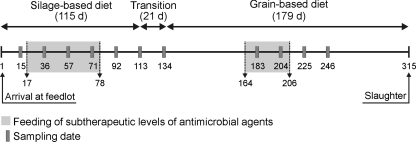
FIG. 1.
FIG. 1.
Schematic representation of the timeline of the experiment. Day numbers are shown within dietary feeding regimen. Animals were fed a silage-based diet and were then transitioned to, and maintained on, a grain-based diet. Gray regions indicate periods during which antibiotics were top dressed onto feed in the trough. Periodic dark rectangles indicate sampling dates, upon which two fecal swabs were obtained from each of the 300 steers.
FIG. 2.
FIG. 2.
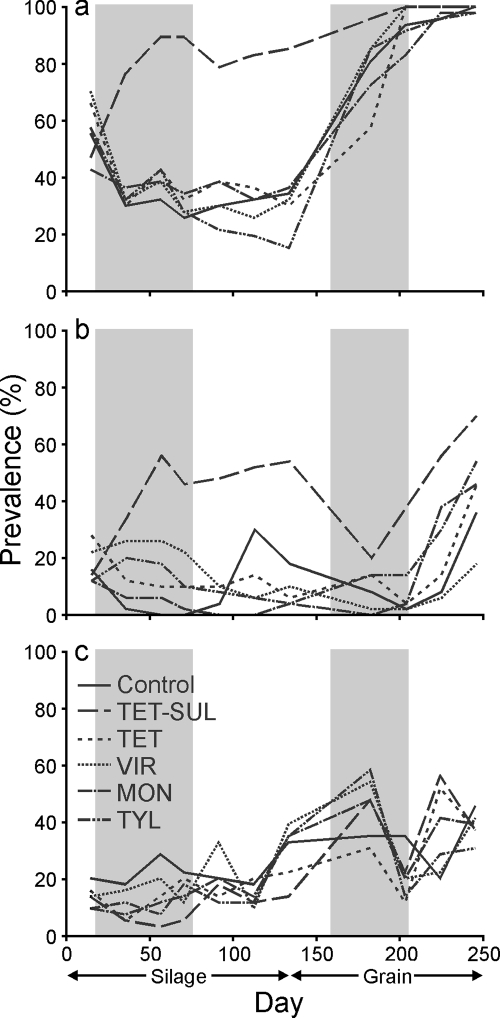
Prevalence of steers harboring fecal E. coli capable of growth on MAC+TET (a), MAC+AMP (b), or MAC+GEN (c) over a 246-day feeding trial during which fecal samples were collected on 11 occasions. Gray areas indicate periods during which antibiotics were supplemented onto feed in the troughs. Line styles distinguish the antibiotics fed (n = 50). The antimicrobial treatments are described fully in Materials and Methods.
FIG. 3.
FIG. 3.
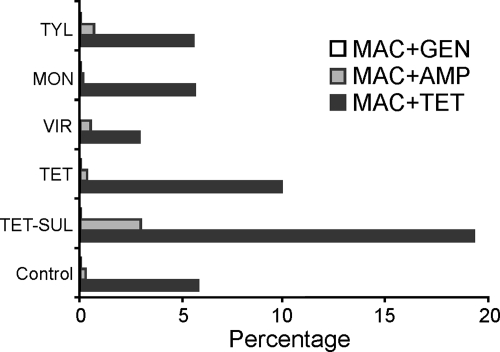
The overall percentages of bovine fecal E. coli isolates that were capable of growth on MAC+GEN, MAC+AMP, or MAC+TET across all sampling dates. Percentages are based on total E. coli from nonselective MacConkey agar. Cattle were fed diets supplemented with (TYL, MON, VIR, TET, and TET-SUL) or without (control) antibiotics as described in Materials and Methods.
FIG. 4.
FIG. 4.
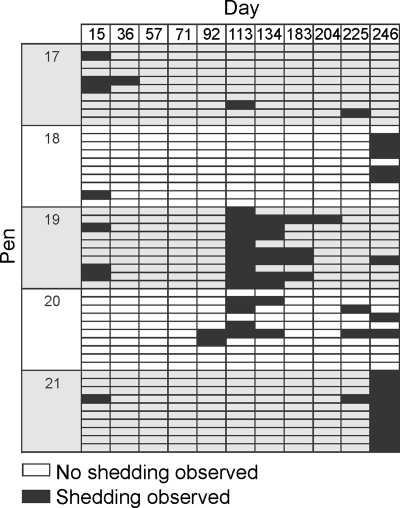
Schematic representation of detection of ampicillin-resistant E. coli in fecal samples from the 50 steers in the control group (no antibiotics fed). The steers were housed in five adjacent pens (17 to 21). Each row represents one of the 10 steers housed in each pen. Column headings indicate sampling days. Filled boxes (black) indicate the days on which fecal isolates resistant to 50 μg of ampicillin ml−1 were collected.
FIG. 5.
FIG. 5.
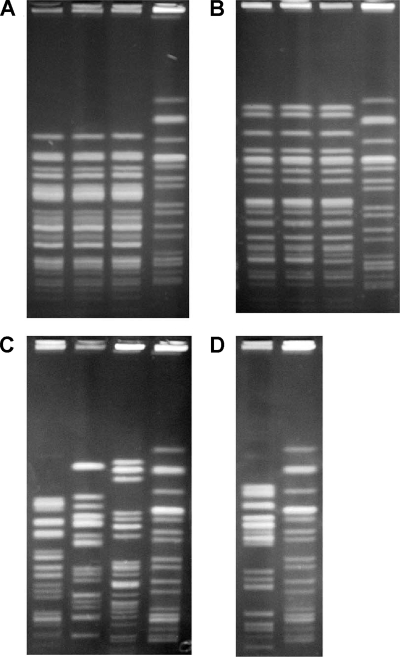
PFGE of ampicillin-resistant E. coli isolates obtained from feces of steers in the control group, i.e., receiving no dietary antibiotic in their feedlot diets throughout the study. In each frame, the lane on the far right contains a reference strain, E. coli E318N. Isolates shown in panels A and B were obtained on days on which all 10 steers in a given pen were positive for ampicillin-resistant E. coli (see Fig. 4); those in panels C and D were collected on the first sampling day after arrival at the feedlot. (A) Isolates collected on day 113 from three steers in pen 19; (B) isolates collected on day 246 from three steers in pen 21; (C) isolates collected from the same three steers as shown in panel A, but on day 15; (D) isolate from the single steer in pen 21 that was positive for ampicillin-resistant E. coli on day 15. Panels A and B contain representative data, since the isolates collected from all 10 steers in these pens produced identical banding patterns. In contrast, the day 15 isolates differed among steers within the pen (in the case of pen 19). Note that within a pen, the banding patterns differed between day 15 isolates and those collected from the same steers later in the feeding period (panel C versus panel A; panel D versus panel B).

References

    1. Aalbaek, B., J. Rasmussen, G. Nielsen, and J. E. Olsen. 1991. Prevalence of antibiotic-resistant Escherichia coli in Danish pigs and cattle. Acta Pathol. Microbiol. Immunol. Scand. 99:1103-1110. - PubMed
    1. Aerestrup, F. M. 2000. Characterization of glycopeptide-resistant Enterococcus faecium (GRE) from broilers and pigs in Denmark: genetic evidence that persistence of GRE in pig herds is associated with coselection by resistance to macrolides. J. Clin. Microbiol. 38:2774-2777. - PMC - PubMed
    1. Bach, S. J., T. A. McAllister, G. J. Mears, and K. Schwartzkopf-Genswein. 2004. Long-haul transport and lack of preconditioning increases fecal shedding of Escherichia coli and E. coli O157:H7 by calves. J. Food Prot. 67:672-678. - PubMed
    1. Barton, M. D. 2000. Antibiotic use in animal feed and its impact on human health. Nutr. Res. Rev. 13:279-299. - PubMed
    1. Bergen, W. G., and D. B. Bates. 1984. Ionophores: their effect on production efficiency and mode of action. J. Anim. Sci. 58:1465-1483. - PubMed

Publication types

MeSH terms