


The effects of methylphenidate on decision making in attention-deficit/hyperactivity disorder
- PMID: 18504036
- PMCID: PMC2577132
- DOI: 10.1016/j.biopsych.2008.04.017
The effects of methylphenidate on decision making in attention-deficit/hyperactivity disorder
Abstract
Background: Children with attention-deficit/hyperactivity disorder (ADHD) frequently display poor judgment and risk taking in their everyday behavior, but there are little empirical data on decision-making cognition in this disorder. The objectives of the study were to assess the effects of stimulant medication on decision making in ADHD and compare performance on the Cambridge Gamble Task between boys with and without ADHD.
Methods: Twenty-one boys (aged 7-13) diagnosed with ADHD underwent a double-blind, placebo-controlled trial of methylphenidate (.5 mg/kg) during which they performed the Cambridge Gamble Task (CGT). A healthy age-matched control group was tested on two occasions off drug.
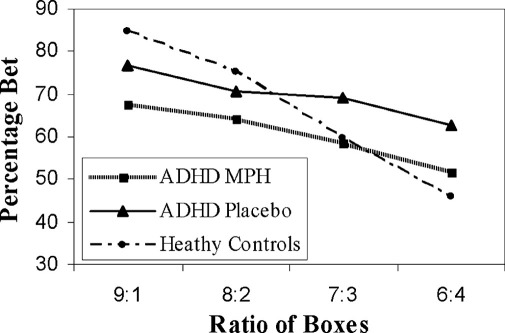
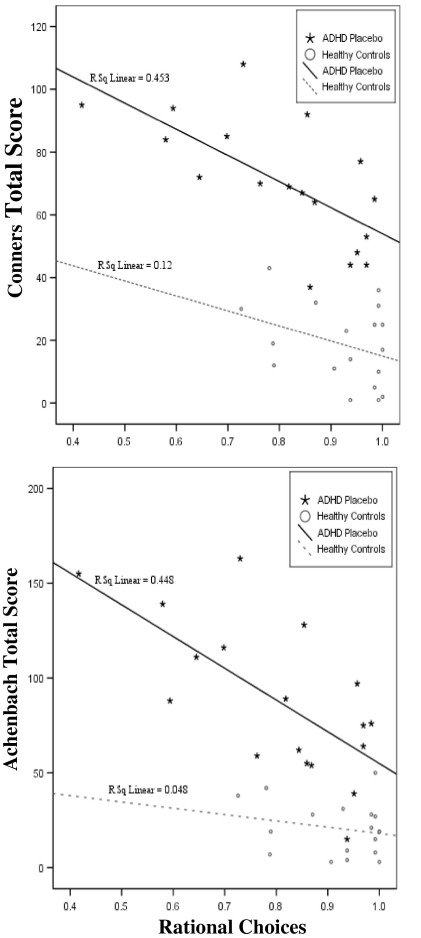
Results: The ADHD group bet more conservatively on the methylphenidate session than on the placebo session. In comparison with healthy control subjects, the ADHD group made more poor decisions, placed their bets more impulsively, and adjusted their bets less according to the chances of winning. Poor decision making was correlated with parent-reported symptoms and disruptive behavior in the ADHD group.
Conclusions: Methylphenidate reduced risk-prone betting behavior on the CGT. Compared with control subjects, children with ADHD display a number of decision-making deficits on the task, and the measure of rational decision making may serve as an ecologically valid neuropsychological marker of impairment.
Figures
References
-
- American Psychiatric Association . 4th ed. American Psychiatric Association; Washington, DC: 1994. Diagnostic and Statistical Manual of Mental Disorders.
-
- Castellanos F.X., Tannock R. Neuroscience of attention-deficit/hyperactivity disorder: The search for endophenotypes. Nat Rev Neurosci. 2002;3:617–628. - PubMed
-
- Pietrzak R.H., Mollica C.M., Maruff P., Snyder P.J. Cognitive effects of immediate-release methylphenidate in children with attention-deficit/hyperactivity disorder. Neurosci Biobehav Rev. 2006;30:1225–1245. - PubMed
Publication types
MeSH terms
Substances
Grants and funding
LinkOut - more resources
Full Text Sources
Medical
