


Social uses of personal health information within PatientsLikeMe, an online patient community: what can happen when patients have access to one another's data
- PMID: 18504244
- PMCID: PMC2553248
- DOI: 10.2196/jmir.1053
Social uses of personal health information within PatientsLikeMe, an online patient community: what can happen when patients have access to one another's data
Abstract
Background: This project investigates the ways in which patients respond to the shared use of what is often considered private information: personal health data. There is a growing demand for patient access to personal health records. The predominant model for this record is a repository of all clinically relevant health information kept securely and viewed privately by patients and their health care providers. While this type of record does seem to have beneficial effects for the patient-physician relationship, the complexity and novelty of these data coupled with the lack of research in this area means the utility of personal health information for the primary stakeholders-the patients-is not well documented or understood.
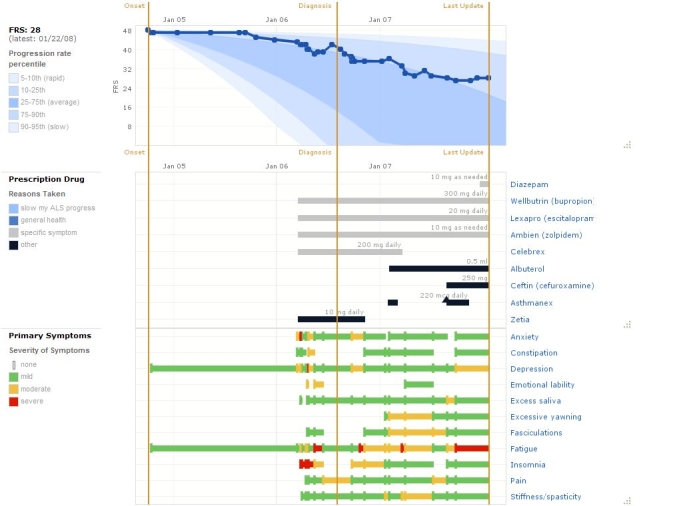
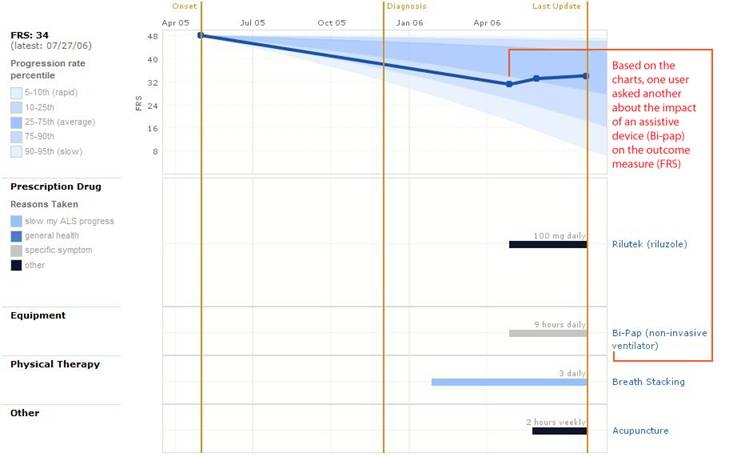
Objective: PatientsLikeMe is an online community built to support information exchange between patients. The site provides customized disease-specific outcome and visualization tools to help patients understand and share information about their condition. We begin this paper by describing the components and design of the online community. We then identify and analyze how users of this platform reference personal health information within patient-to-patient dialogues.
Methods: Patients diagnosed with amyotrophic lateral sclerosis (ALS) post data on their current treatments, symptoms, and outcomes. These data are displayed graphically within personal health profiles and are reflected in composite community-level symptom and treatment reports. Users review and discuss these data within the Forum, private messaging, and comments posted on each other's profiles. We analyzed member communications that referenced individual-level personal health data to determine how patient peers use personal health information within patient-to-patient exchanges.
Results: Qualitative analysis of a sample of 123 comments (about 2% of the total) posted within the community revealed a variety of commenting and questioning behaviors by patient members. Members referenced data to locate others with particular experiences to answer specific health-related questions, to proffer personally acquired disease-management knowledge to those most likely to benefit from it, and to foster and solidify relationships based on shared concerns.
Conclusions: Few studies examine the use of personal health information by patients themselves. This project suggests how patients who choose to explicitly share health data within a community may benefit from the process, helping them engage in dialogues that may inform disease self-management. We recommend that future designs make each patient's health information as clear as possible, automate matching of people with similar conditions and using similar treatments, and integrate data into online platforms for health conversations.
Conflict of interest statement
Jeana Frost and Michael Massagli are employees of PatientsLikeMe.
Figures

References
-
- Markle Foundation, authors. Connecting for Health. Connecting Americans to Their Healthcare. Final Report. Working Group on Policies for Electronic Information Sharing Between Doctors and Patients. New York: Markle Foundation; 2004. http://www.connectingforhealth.org/resources/wg_eis_final_report_0704.pdf.
-
- Tjora Aksel, Tran Trung, Faxvaag Arild. Privacy vs usability: a qualitative exploration of patients' experiences with secure Internet communication with their general practitioner. J Med Internet Res. 2005;7(2):e15. doi: 10.2196/jmir.7.2.e15. http://www.jmir.org/2005/2/e15/v7i2e15 - DOI - PMC - PubMed
-
- Robeznieks Andis. Getting personal. Legal liability, patient-data overload among issues making physicians uneasy over emergence of personal health records. Mod Healthc. 2007 May 21;37(21):40–2. - PubMed
MeSH terms
LinkOut - more resources
Full Text Sources
Other Literature Sources
Medical
Miscellaneous
