. 2008 Jun;131(6):605-16.
doi: 10.1085/jgp.200709910.

MEC-2 and MEC-6 in the Caenorhabditis elegans sensory mechanotransduction complex: auxiliary subunits that enable channel activity

Affiliations

MEC-2 and MEC-6 in the Caenorhabditis elegans sensory mechanotransduction complex: auxiliary subunits that enable channel activity

Austin L Brown et al. J Gen Physiol. 2008 Jun.

Abstract

The ion channel formed by the homologous proteins MEC-4 and MEC-10 forms the core of a sensory mechanotransduction channel in Caenorhabditis elegans. Although the products of other mec genes are key players in the biophysics of transduction, the mechanism by which they contribute to the properties of the channel is unknown. Here, we investigate the role of two auxiliary channel subunits, MEC-2 (stomatin-like) and MEC-6 (paraoxonase-like), by coexpressing them with constitutively active MEC-4/MEC-10 heteromeric channels in Xenopus oocytes. This work extends prior work demonstrating that MEC-2 and MEC-6 synergistically increase macroscopic current. We use single-channel recordings and biochemistry to show that these auxiliary subunits alter function by increasing the number of channels in an active state rather than by dramatically affecting either single-channel properties or surface expression. We also use two-electrode voltage clamp and outside-out macropatch recording to examine the effects of divalent cations and proteases, known regulators of channel family members. Finally, we examine the role of cholesterol binding in the mechanism of MEC-2 action by measuring whole-cell and single-channel currents in MEC-2 mutants deficient in cholesterol binding. We suggest that MEC-2 and MEC-6 play essential roles in modulating both the local membrane environment of MEC-4/MEC-10 channels and the availability of such channels to be gated by force in vivo.


Figures
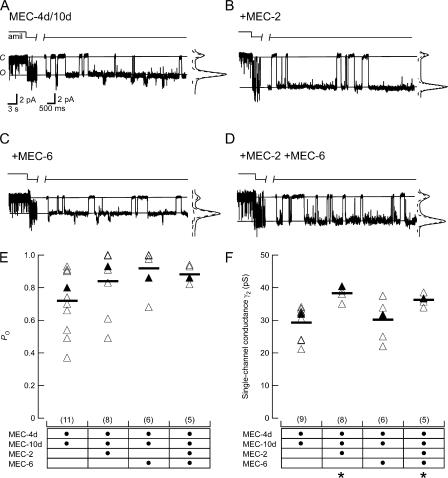
Figure 1.
Figure 1.
Single-channel recordings from outside-out patches. (A) MEC-4d/10d only. (B) MEC-4d/10d + MEC-2. (C) MEC-4d/10d + MEC-6. (D) MEC-4d/10d + MEC-2 + MEC-6. In A–D, two sections are shown: the left demonstrates the sensitivity of the channel to amiloride (50 μM), while the right shows the channel behavior in control saline. Vhold = −150 mV. Closed and open states are labeled C and O respectively and indicated by solid lines. To the right of each record is an all-points histogram of the same trace; dotted lines represent Gaussian fits to each peak. Open probability (E) and single-channel conductance (F) of patches containing a single channel. Data are summarized in Table I. Closed triangles represent the example patches shown in A–D. Bars indicate mean values for each isoform. Number of patches indicated in parentheses. *, significantly different from MEC-4d/10d (P < 0.01).
Figure 2.
Figure 2.
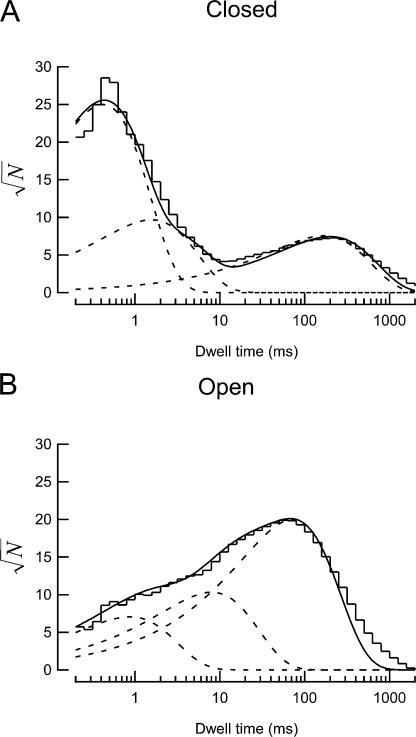
Example dwell-time histograms of single channel recordings. (A) Dwell-time histogram of the closed states of a single MEC-4d/10d + MEC-2 + MEC-6 channel. (B) Dwell-time histogram of the open states of the same channel as in A. For optimal visual estimation of fit quality (Sigworth and Sine, 1987), dwell times are accumulated into logarithmic bins and displayed with a square-root ordinate. Solid lines are fits to the data with the sum of three exponential functions, dotted lines represent each exponential component.
Figure 3.
Figure 3.
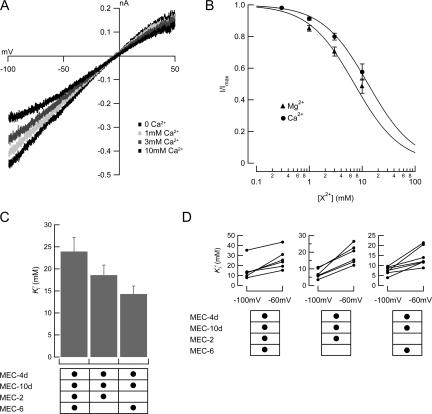
Block by divalent cations. (A) Macroscopic I-V curve of an outside-out patch coexpressing MEC-4d/10d, MEC-2, and MEC-6 exposed to varying Ca2+ concentrations. (B) Dose–response curves for blockade by Ca2+ and Mg2+ at −100 mV. The smooth curve is fit to the average values assuming a Hill coefficient of 1: formula image. Measured Ki' was 12.9 mM for Ca2+, 7.0 mM for Mg2+. (C) Apparent Ca2+ inhibition constant, Ki' as a function of auxiliary subunits. Vhold = −60 mV. (D) Voltage dependence and variation of block affinity. Each line represents a single patch, with Ki' measured at −60 and −100 mV.
Figure 4.
Figure 4.
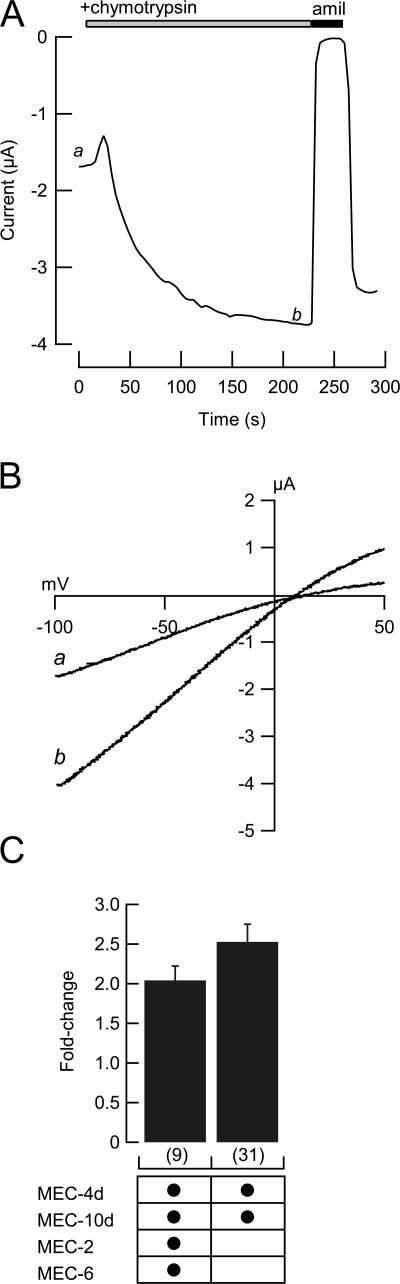
Activation by extracellular chymotrypsin. (A) Example time course of chymotrypsin-evoked current increase in an oocyte expressing MEC-4d/10d + MEC-2 + MEC-6. a and b indicate when the curves shown in B were collected. Current amplitude was measured every 4 s at −85 mV. (B) Whole-cell I-V relationship before (a) and during chymotrypsin application (b). In all cases, chymotypsin-evoked current was blocked by amiloride (300 μM). (C) Chymotrypsin-evoked increase in the amiloride-sensitive current in the presence and absence of MEC-2 and MEC-6.
Figure 5.
Figure 5.
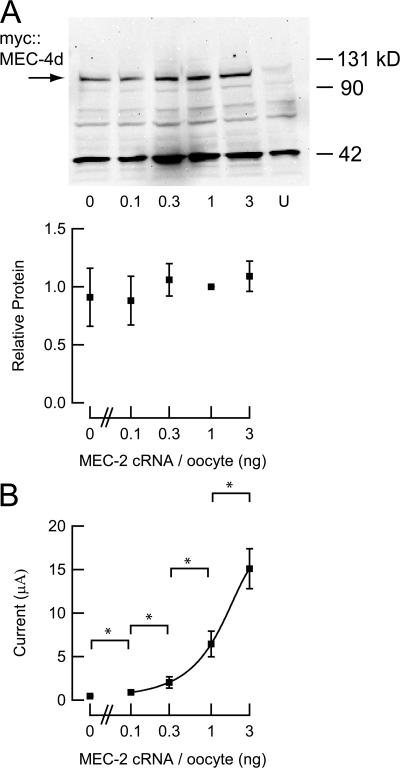
Surface expression and current amplitude as a function of MEC-2 cRNA. (A) Surface expression of myc∷MEC-4d in oocytes coexpressing myc∷MEC-4d, MEC-10d, MEC-2, and MEC-6 (top). The amount of MEC-2 cRNA is indicated below each lane; U indicates uninjected (control) oocytes. Relative surface expression as a function MEC-2 cRNA (bottom), normalized to density with 1 ng MEC-2 cRNA per oocyte. Data represent the results of three independent Western blots. Nonspecific bands are observed in all blots and are visible in uninjected cells. (B) Amiloride-sensitive currents recorded from oocytes analyzed in parallel with those used for Western blotting in A. Stars indicate significance P < 0.01 (Student's t test). Smooth line is fit to the data according to: I = I0 + (ImaxI0)(1 + [MEC-2 cRNA]/EC50)−1. The EC50 is 2.8 ng, IO = 0.48 μA.
Figure 6.
Figure 6.
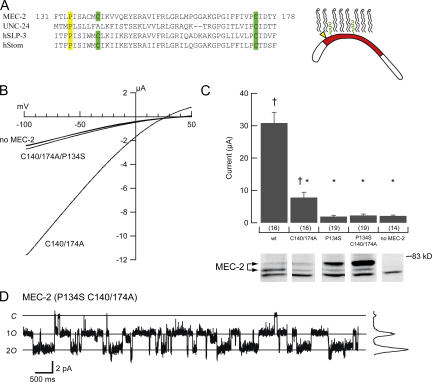
Characterization of cholesterol-binding mutants of MEC-2. (A) Alignment of selected PHB family members. MEC-2 and UNC-24 are coexpressed in vivo. MEC-2 is also represented schematically on the right. In yellow, P134, required for cholesterol binding. In green, C140 and C174 required for palmitoylation (Huber et al., 2006). (B) I-V relationship of channels lacking MEC-2, containing MEC-2 double mutant, and MEC-2 triple mutant. MEC-2(P134S) single mutant currents are essentially indistinguishable from the triple mutant and are omitted for clarity. (C) Average currents recorded from MEC-2 mutant-expressing cells (top). Bars are mean ± SEM. Sample size is indicated in parentheses below each bar. †, P < 0.005, compared with the absence of MEC-2; *, P < 10−6 compared with wild-type MEC-2. Western blot of MEC-2 isoforms (bottom). For clarity, lanes corresponding to each isoform are aligned with the data in A. All lanes were from the same blot (with identical contrast manipulation). Similar results were obtained in a total of three independent experiments. (D) Single-channel activity from an outside-out patch of a cell expressing triple mutant MEC-2. These data were used to measure single-channel conductance. Solid lines indicate zero, one or both channels open; all-points histogram is shown on the right.

References

    1. Anishkin, A., and C. Kung. 2005. Microbial mechanosensation. Curr. Opin. Neurobiol. 15:397–405. - PubMed
    1. Bengrine, A., J. Li, L.L. Hamm, and M.S. Awayda. 2007. Indirect activation of the epithelial Na+ channel by trypsin. J. Biol. Chem. 282:26884–26896. - PubMed
    1. Bianchi, L., B. Gerstbrein, C. Frokjaer-Jensen, D.C. Royal, G. Mukherjee, M.A. Royal, J. Xue, W.R. Schafer, and M. Driscoll. 2004. The neurotoxic MEC-4(d) DEG/ENaC sodium channel conducts calcium: implications for necrosis initiation. Nat. Neurosci. 7:1337–1344. - PubMed
    1. Brown, A.L., S.M. Fernandez-Illescas, Z. Liao, and M.B. Goodman. 2007. Gain-of-function mutations in the MEC-4 DEG/ENaC sensory mechanotransduction channel alter gating and drug blockade. J. Gen. Physiol. 129:161–173. - PMC - PubMed
    1. Caldwell, R.A., R.C. Boucher, and M.J. Stutts. 2004. Serine protease activation of near-silent epithelial Na+ channels. Am. J. Physiol. Cell Physiol. 286:C190–C194. - PubMed

Publication types

MeSH terms