. 2008 Jun;34(3):543-55.
doi: 10.1037/0096-1523.34.3.543.

Transsaccadic representation of layout: what is the time course of boundary extension?

Affiliations

Transsaccadic representation of layout: what is the time course of boundary extension?

Christopher A Dickinson et al. J Exp Psychol Hum Percept Perform. 2008 Jun.

Abstract

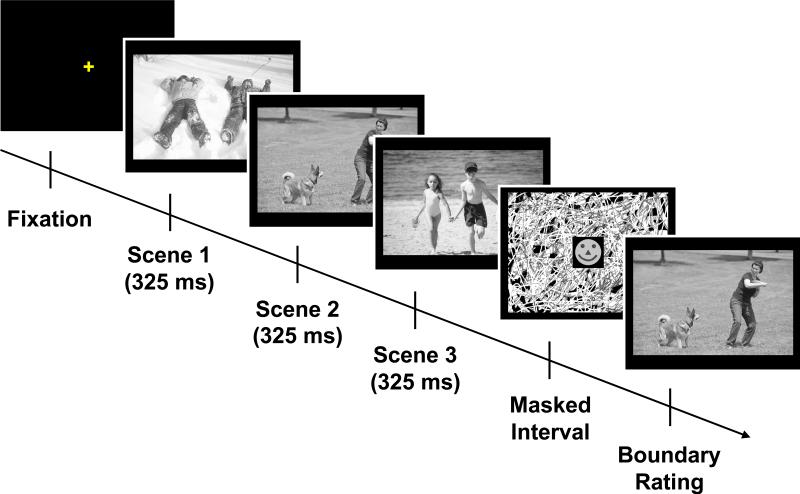
How rapidly does boundary extension occur? Across experiments, trials included a 3-scene sequence (325 ms/picture), masked interval, and repetition of 1 scene. The repetition was the same view or differed (more close-up or wide angle). Observers rated the repetition as same as, closer than, or more wide angle than the original view on a 5-point scale. Masked intervals were 100, 250, 625, or 1,000 ms in Experiment 1 and 42, 100, or 250 ms in Experiments 2 and 3. Boundary extension occurred in all cases: Identical views were rated as too "close-up," and distractor views elicited the rating asymmetry typical of boundary extension (wider angle distractors were rated as being more similar to the original than were closer up distractors). Most important, boundary extension was evident when only a 42-ms mask separated the original and test views. Experiments 1 and 3 included conditions eliciting a gaze shift prior to the rating test; this did not eliminate boundary extension. Results show that boundary extension is available soon enough and is robust enough to play an on-line role in view integration, perhaps supporting incorporation of views within a larger spatial framework.


Figures
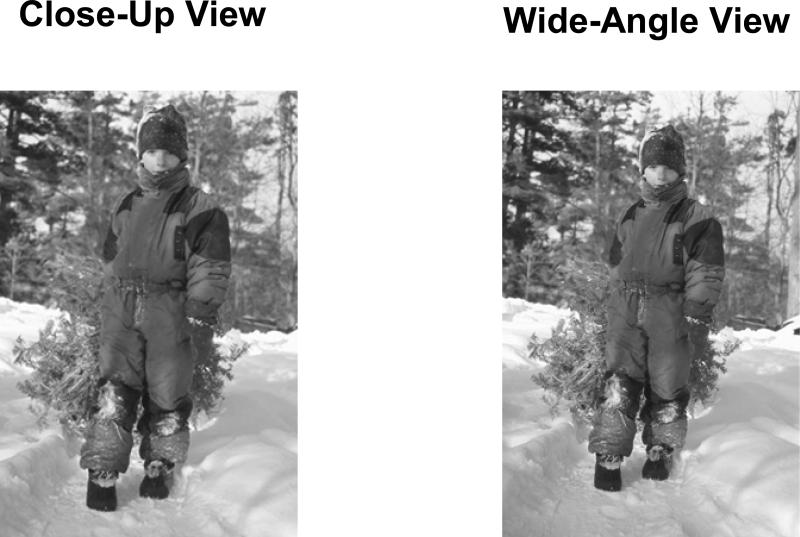
Figure 1
Figure 1
A close-up version of a target picture is shown on the left, and wider angle version of the same target picture is shown on the right.
Figure 2
Figure 2
A schematic illustration of a trial sequence with the test picture in the center of the screen (maintain-fixation condition). Note that the actual stimuli did not fill the screen, as is shown in the example.
Figure 3
Figure 3
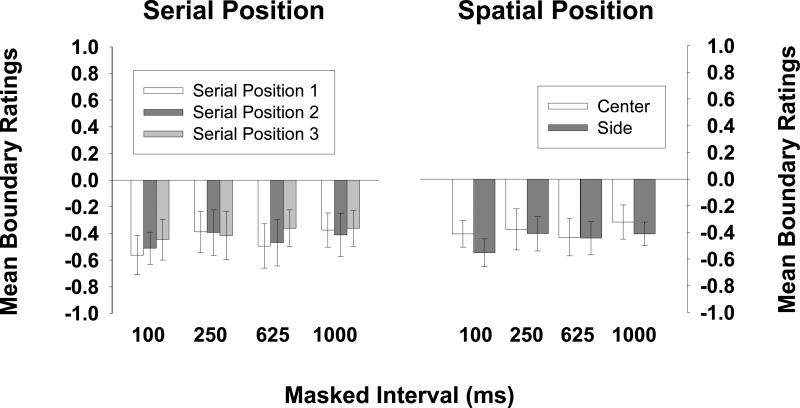
Observers’ mean boundary ratings for each serial position of the target (collapsed across spatial position of the test picture) are shown on the left, and their mean boundary ratings for each spatial position of the test picture (center, side; collapsed across serial position of the target) are shown on the right, for each retention interval (Experiment 1). All error bars show the 95% confidence interval of the mean. Means that are significantly less than zero reflect boundary extension; means that are significantly greater than zero reflect boundary restriction.
Figure 4
Figure 4
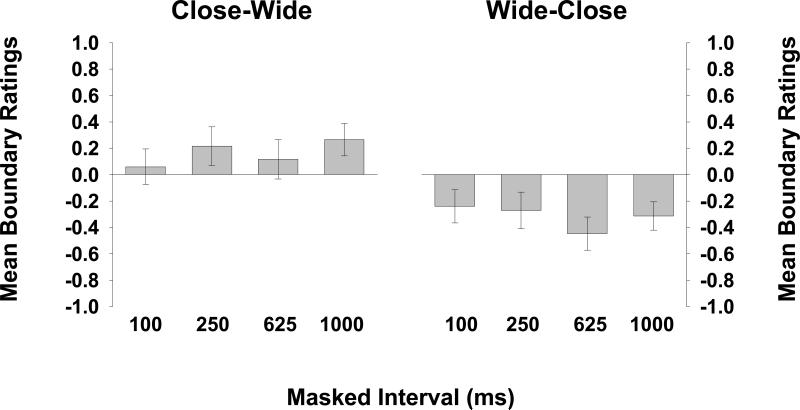
Observers’ mean boundary ratings (collapsed across both serial position of the target and spatial position of the test picture) for trials on which a close-up target was tested by wide-angle view are shown on the left, and their mean boundary ratings for trials on which a wide-angle target was tested by close-up view are shown on the right, for each retention interval (Experiment 1).
Figure 5
Figure 5
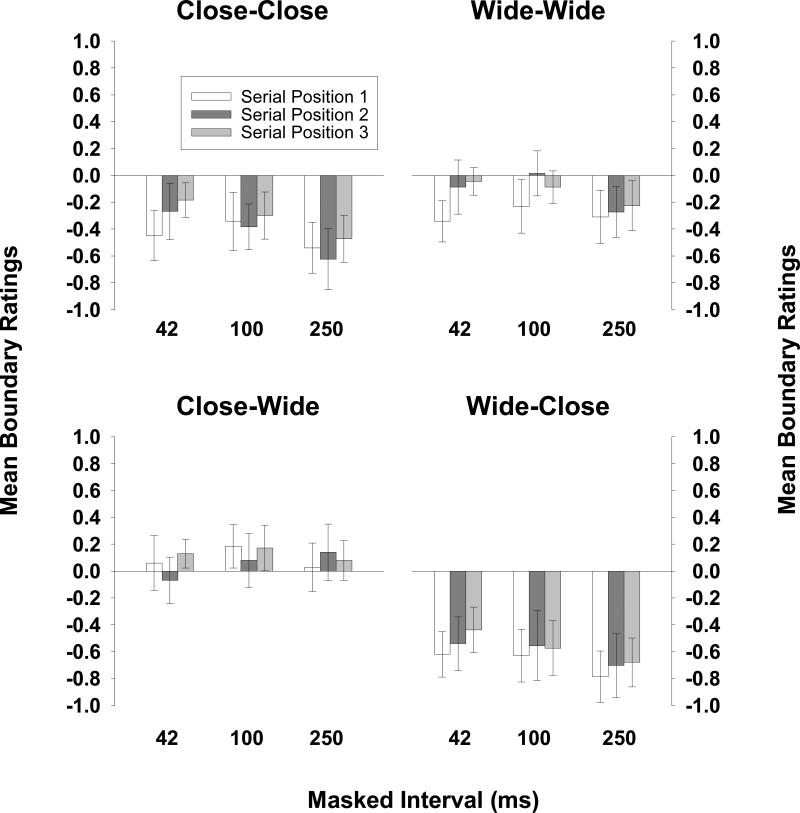
Observers’ mean boundary ratings for CC trials are shown on the upper left, their mean boundary ratings for WW trials are shown on the upper right, their mean boundary ratings for CW trials are shown on the lower left, and their mean boundary ratings for WC trials are shown on the lower right, for each serial position of the target at each retention interval (Experiment 2).
Figure 6
Figure 6
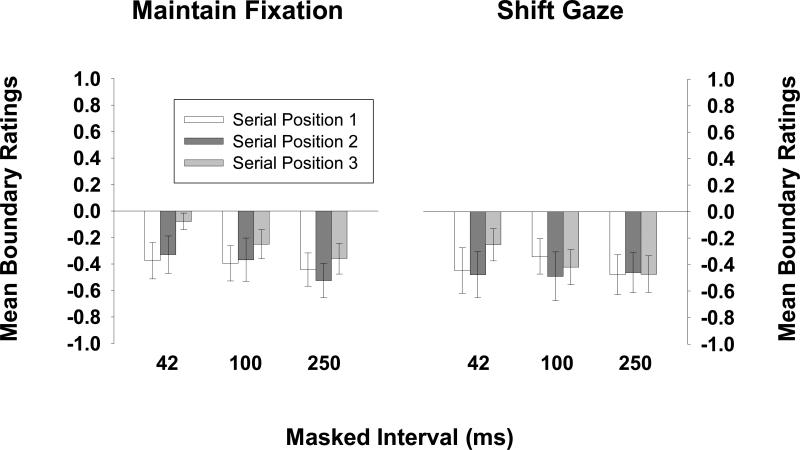
Observers’ mean boundary ratings for maintain-fixation trials are shown on the left, and their mean boundary ratings for shift-gaze trials are shown on the right, for each serial position of the target at each retention interval (Experiment 3a).
Figure 7
Figure 7
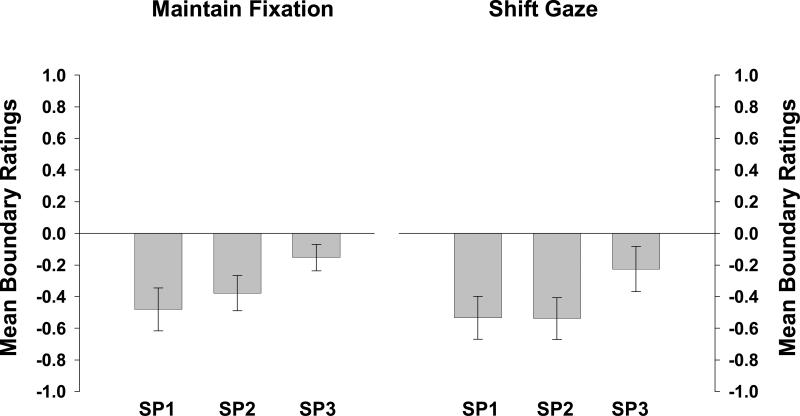
Observers’ mean boundary ratings for maintain-fixation trials are shown on the left, and their mean boundary ratings for shift-gaze trials are shown on the right, for each serial position (SP) of the target (Experiment 3b).

References

    1. Bertamini M, Jones LA, Spooner A, Hecht H. Boundary extension: The role of magnification, object size, context, and binocular information. Journal of Experimental Psychology: Human Perception and Performance. 2005;31(6):1288–1307. - PubMed
    1. Biederman I. On the semantics of a glance at a scene. In: Kubovy M, Pomerantz JR, editors. Perceptual organization. Erlbaum; Hillsdale, NJ: 1981. pp. 213–253.
    1. Candel I, Merckelbach H, Zandbergen M. Boundary distortions for neutral and emotional pictures. Psychonomic Bulletin & Review. 2003;10(3):691–695. - PubMed
    1. Carlson-Radvansky LA. Memory for relational information across eye movements. Perception & Psychophysics. 1999;61(5):919–934. - PubMed
    1. Carlson-Radvansky LA, Irwin DE. Memory for structural information across eye movements. Journal of Experimental Psychology: Learning, Memory, and Cognition. 1995;21(6):1441–1458.

Publication types