Review
. 2008;9(5):224.
doi: 10.1186/gb-2008-9-5-224. Epub 2008 May 22.

Glypicans

Affiliations
Review

Glypicans

Jorge Filmus et al. Genome Biol. 2008.

Abstract

Glypicans are heparan sulfate proteoglycans that are bound to the outer surface of the plasma membrane by a glycosyl-phosphatidylinositol anchor. Homologs of glypicans are found throughout the Eumetazoa. There are six family members in mammals (GPC1 to GPC6). Glypicans can be released from the cell surface by a lipase called Notum, and most of them are subjected to endoproteolytic cleavage by furin-like convertases. In vivo evidence published so far indicates that the main function of membrane-attached glypicans is to regulate the signaling of Wnts, Hedgehogs, fibroblast growth factors and bone morphogenetic proteins (BMPs). Depending on the context, glypicans may have a stimulatory or inhibitory activity on signaling. In the case of Wnt, it has been proposed that the stimulatory mechanism is based on the ability of glypicans to facilitate and/or stabilize the interaction of Wnts with their signaling receptors, the Frizzled proteins. On the other hand, GPC3 has recently been reported to inhibit Hedgehog protein signaling during development by competing with Patched, the Hedgehog receptor, for Hedgehog binding. Surprisingly, the regulatory activity of glypicans in the Wnt, Hedgehog and BMP signaling pathways is only partially dependent on the heparan sulfate chains.


Figures
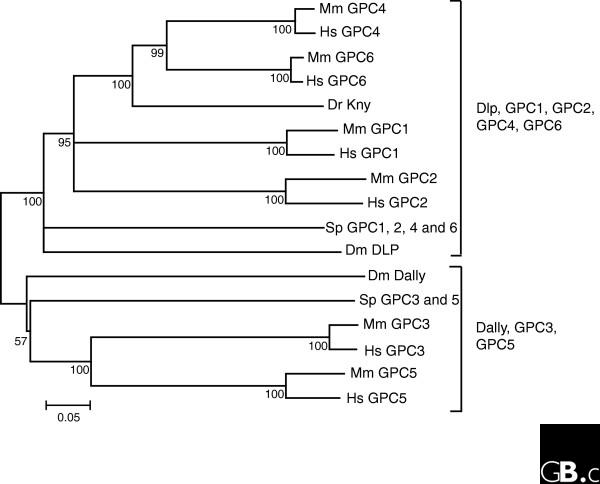
Figure 1
Figure 1
Interrelationships among glypican proteins. The phylogeny was inferred using the neighbor-joining method. The tree is a bootstrap consensus generated from 1,000 replicates using the MEGA4 program suite [47]. The percentage of replicates in which the associated sequences cluster is shown next to branches. All positions containing gaps were eliminated from the dataset. The bar at the bottom indicates proportion of amino-acid differences. The species used are human (Hs), mouse (Mm), zebrafish (Dr), purple sea urchin (Sp), and fruit fly (Dm). Dlp, Dally-like protein. NCBI accession numbers for the sequences used in the analysis are as follows: HsGPC1, NP_002072.2; HsGPC2, NP_689955.1; HsGPC3, NP_004475.1; HsGPC4, NP_001439.2; HsGPC5, NP_004457.1; HsGPC6, NP_005699.1; MmGPC1, NP_057905.1; MmGPC2, NP_766000.1; MmGPC3, NP_057906.2; MmGPC4, NP_032176; MmGPC5, NP_780709.1; MmGPC6, NP_001073313.1; DrKNY, NP_571935; DmDally, AAA97401.1; DmDlp, AAG38110.1. Sea urchin sequences obtained from models generated in the Sea Urchin Genome Project [48] are as follows: SpGPC1/2/4/6, GLEAN3_03084; SpGPC3/5, GLEAN3_13086. A scan of the zebrafish genome reveals additional GPC family members, but complete transcript sequences are not available. The full complement of GPC genes is shown for the other species.
Figure 2
Figure 2
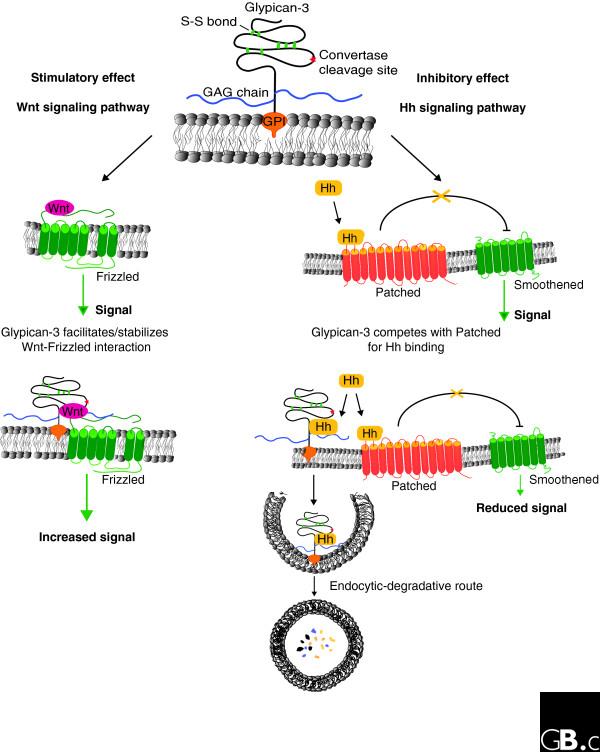
Positive and negative effects of GPC3 on cell signaling. In the Wnt signaling pathway (left), GPC3 exerts a positive effect. Wnt binds to the receptor Frizzled to induce signaling (green arrow). GPC3 facilitates and/or stabilizes the interaction between Wnt and Frizzled with the consequent increment on signaling. In the Hedgehog (Hh) signaling pathway (right), GPC3 exerts an inhibitory effect. The binding of Hh to the receptor Patched (Ptc) triggers the signaling pathway by blocking the inhibitory activity of Ptc on Smoothened. GPC3 competes with Ptc for Hh binding. The interaction of Hh with GPC3 triggers the endocytosis and degradation of the complex with the consequent reduction of Hh available for binding to Ptc.

References

    1. Filmus J, Selleck SB. Glypicans: proteoglycans with a surprise. J Clin Invest. 2001;108:497–501. - PMC - PubMed
    1. Fico A, Maina F, Dono R. Fine-tuning of cell signalling by glypicans. Cell Mol Life Sci - PMC - PubMed
    1. Ensembl http://www.ensembl.org/index.html
    1. Veugelers M, De Cat B, Ceulemans H, Bruystens AM, Coomans C, Durr J, Vermeesch J, Marynen P, David G. Glypican-6, a new member of the glypican family of cell surface proteoglycans. J Biol Chem. 1999;274:26968–26977. doi: 10.1074/jbc.274.38.26968. - DOI - PubMed
    1. Topczewsky J, Sepich DS, Myers DC, Walker C, Amores A, Lele Z, Hammerschmidt M, Postlethwait J, Solnica-Krezel L. The zebrafish glypican Knypek controls cell polarity during gastrulation movements of convergent extension. Dev Cell. 2001;1:251–264. doi: 10.1016/S1534-5807(01)00005-3. - DOI - PubMed

Publication types

LinkOut - more resources