. 2008 Jun;179(2):747-55.
doi: 10.1534/genetics.108.086645. Epub 2008 May 27.

A mutation in the putative MLH3 endonuclease domain confers a defect in both mismatch repair and meiosis in Saccharomyces cerevisiae

Affiliations

A mutation in the putative MLH3 endonuclease domain confers a defect in both mismatch repair and meiosis in Saccharomyces cerevisiae

K T Nishant et al. Genetics. 2008 Jun.

Abstract

Interference-dependent crossing over in yeast and mammalian meioses involves the mismatch repair protein homologs MSH4-MSH5 and MLH1-MLH3. The MLH3 protein contains a highly conserved metal-binding motif DQHA(X)(2)E(X)(4)E that is found in a subset of MLH proteins predicted to have endonuclease activities (Kadyrov et al. 2006). Mutations within this motif in human PMS2 and Saccharomyces cerevisiae PMS1 disrupted the endonuclease and mismatch repair activities of MLH1-PMS2 and MLH1-PMS1, respectively (Kadyrov et al. 2006, 2007; Erdeniz et al. 2007). As a first step in determining whether such an activity is required during meiosis, we made mutations in the MLH3 putative endonuclease domain motif (-D523N, -E529K) and found that single and double mutations conferred mlh3-null-like defects with respect to meiotic spore viability and crossing over. Yeast two-hybrid and chromatography analyses showed that the interaction between MLH1 and mlh3-D523N was maintained, suggesting that the mlh3-D523N mutation did not disrupt the stability of MLH3. The mlh3-D523N mutant also displayed a mutator phenotype in vegetative growth that was similar to mlh3Delta. Overexpression of this allele conferred a dominant-negative phenotype with respect to mismatch repair. These studies suggest that the putative endonuclease domain of MLH3 plays an important role in facilitating mismatch repair and meiotic crossing over.


Figures
F<sc>igure</sc> 1.—
Figure 1.—
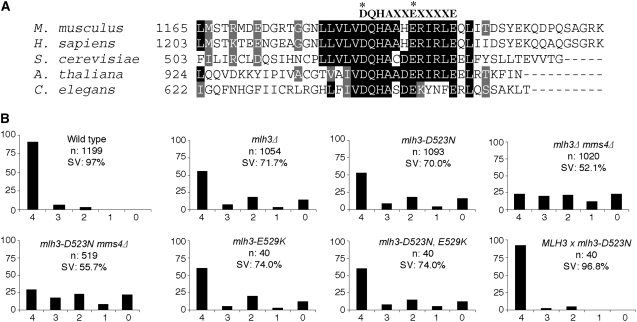
mlh3-endonuclease domain point mutants display an mlh3Δ-like phenotype with respect to meiotic spore viability. (A) Location of the conserved endonuclease motif DQHA(X)2E(X)4E in MLH3 homologs in Mus musculus (BC079861), Homo sapiens (NM_001040108), S. cerevisiae (MLH3), Arabidopsis thaliana (NM_119717) and Caenorhabditis elegans (H12C20.2). (B) The distribution of viable spores in the indicated mutants. The horizontal axis shows the viable-spore tetrad classes, and the vertical axis corresponds to the percentage of each class. The total number of tetrads dissected (n) and the percentage spore viability (SV) are shown for each mutant. Data for wild type are from Argueso et al. (2004).
F<sc>igure</sc> 2.—
Figure 2.—
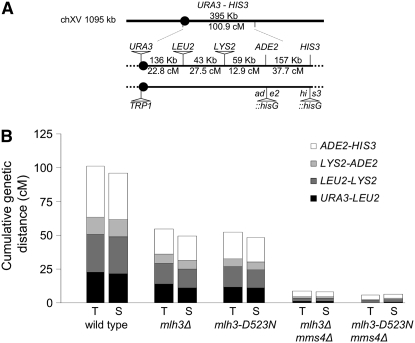
Cumulative genetic distances between the URA3 and HIS3 markers measured from complete tetrads (T) and single spores (S) in wild type, mlh3Δ, mlh3-D523N, mlh3Δ mms4Δ, and mlh3-D523N mms4Δ. (A) Location of genetic markers on chromosome XV. Physical and genetic distances between markers in the wild-type diploid are shown for each interval and the entire URA3-HIS3 interval. Solid circle indicates the centromere. (B) Cumulative genetic distance between the URA3 and HIS3 markers in wild type and the indicated mutant strains. Each bar is further divided into four sectors that correspond to the four genetic intervals that span URA3-HIS3 on chromosome XV. The size of the sectors is proportional to the contribution of each of the four intervals to the total URA3-HIS3 genetic distance. Wild-type data are from Argueso et al. (2004).
F<sc>igure</sc> 3.—
Figure 3.—
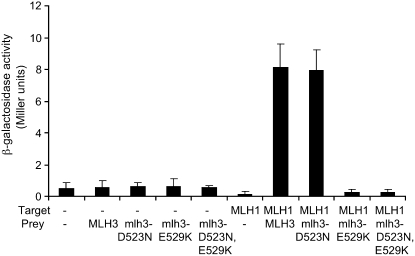
Yeast two-hybrid analysis of mlh3 endonuclease domain point mutants with MLH1. Two-hybrid interactions between lexA-MLH1 (target) and GAL4-MLH3, GAL4-mlh3-D523N, GAL4-mlh3-E529K, and GAL4-mlh3-D523N, -E529K fusion constructs (prey) as measured in the ONPG assay for β-galactosidase activity. “-” indicates the presence of the empty target vector pBTM116 or the empty pGAD10 prey vector. Error bars indicate standard deviation from at least three independent assays. See materials and methods for details.
F<sc>igure</sc> 4.—
Figure 4.—
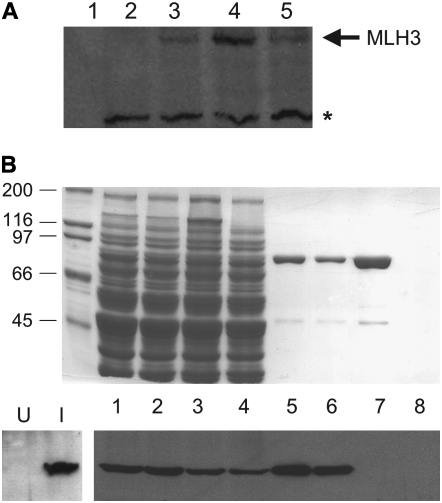
Epitope-tagged MLH3 and mlh3-D523N are stably expressed and interact with MLH1. (A) Crude extracts from galactose-induced yeast containing GAL10-HA-MLH3-2μ and mlh3 derivatives were analyzed in Western blots (8% SDS–PAGE) probed with αHA antibody (materials and methods). Lane 1, purified MLH1-PMS1 (2 μg). Lanes 2–5, cell extracts from strains expressing untagged MLH3 (lane 2), HA-mlh3-E529K (lane 3), HA-mlh3-D523N (lane 4), and HA-MLH3 (lane 5). The asterisk indicates a cross-reacting, nonspecific band. (B) Partial purification of MLH1-HA-MLH3 and MLH1-HA-mlh3-D523N complexes by chitin bead column chromatography. Eluates from chitin bead columns separated on 8% SDS–PAGE and visualized by Coomassie blue (top) and Western blot analysis with αHA antibody (bottom). Crude extracts are from uninduced (U) or galactose-induced (I) yeast containing GAL10-HA-MLH3-2μ-leu2-d. Lanes 1–4, input extract (8 μl loaded from 50 to 60 ml) from cells overexpressing MLH1 and HA-MLH3 (lane 1), MLH1 and HA-mlh3-D523N (lane 2), MLH1 and HA-mlh3-E529K (lane 3), and HA-MLH3 alone (lane 4). Lanes 5–8, pooled chitin bead eluate fractions (8 μl loaded from 5.5- to 7.0-ml fractions) derived from extracts containing overexpressed MLH1 and HA-MLH3 (lane 5), MLH1 and HA-mlh3-D523N (lane 6), MLH1 and HA-mlh3-E529K (lane 7), and HA-MLH3 alone (lane 8). The sizes of the relevant molecular weight (kDa) standards are indicated.

References

    1. Abraham, J., B. Lemmers, M. P. Hande, M. E. Moynahan, C. Chahwan et al., 2003. Eme1 is involved in DNA damage processing and maintenance of genomic stability in mammalian cells. EMBO J. 22 6137–6147. - PMC - PubMed
    1. Argueso, J. L., A. W. Kijas, S. Sarin, J. Heck, M. Waase et al., 2003. Systematic mutagenesis of the Saccharomyces cerevisiae MLH1 gene reveals distinct roles for Mlh1p in meiotic crossing over and in vegetative and meiotic mismatch repair. Mol. Cell. Biol. 23 873–886. - PMC - PubMed
    1. Argueso, J. L., J. Wanat, Z. Gemici and E. Alani, 2004. Competing crossover pathways act during meiosis in Saccharomyces cerevisiae. Genetics 168 1805–1816. - PMC - PubMed
    1. Baker, S. M., A. W. Plug, T.A. Prolla, C. E. Bronner, A. C. Harris et al., 1996. Involvement of mouse Mlh1 in DNA mismatch repair and meiotic crossing over. Nat. Genet. 3 336–342. - PubMed
    1. Barlow, A. L., and M. A. Hultén, 1998. Crossing over analysis at pachytene in man. Eur. J. Hum. Genet. 6 350–358. - PubMed

Publication types

MeSH terms