


Azathioprine-induced warfarin resistance
- PMID: 18505911
- PMCID: PMC3245963
- DOI: 10.1345/aph.1L077
Azathioprine-induced warfarin resistance
Abstract
Objective: To describe a case of azathioprine-induced warfarin resistance, present a literature review on warfarin-azathioprine interactions, and provide recommendations on appropriate management of this clinically significant interaction.
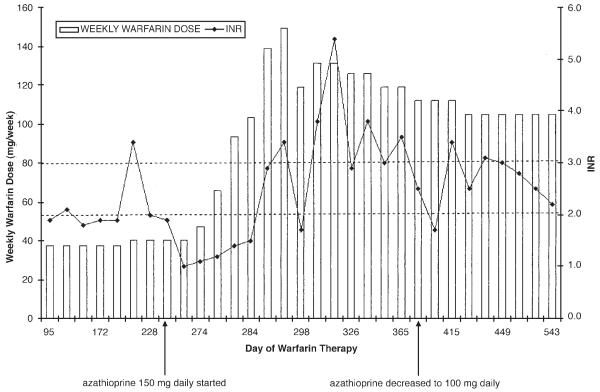
Case summary: A 29-year-old female with Cogan's syndrome experienced thrombosis of the left internal carotid artery. She was treated with an average weekly warfarin dose of 39 mg (5.5 mg daily) prior to beginning azathioprine therapy. Three weeks following initiation of azathioprine 150 mg daily, the international normalized ratio (INR) decreased from 1.9 (prior to the medication change) to 1.0 without any change in the warfarin dose or other relevant factors. Over several weeks, the patient's warfarin dose was titrated up to 112 mg weekly (16 mg daily) to achieve an INR of 2.5 (a 188%, or 2.9-fold dose increase). Because of elevated liver enzyme levels, the azathioprine dosage was decreased to 100 mg daily. Within 2 weeks following that decrease, warfarin requirements decreased to 105 mg weekly (15 mg daily).
Discussion: Azathioprine was the probable causative agent of warfarin resistance according to the Naranjo probability scale, and a possible causative agent according to the Drug Interaction Probability Scale. A literature search (PubMed, 1966-December 2007) revealed 8 case reports of this drug interaction and 2 cases involving a similar effect with 6-mercaptopurine, the active metabolite of azathioprine. The exact mechanism of the interaction remains unknown. Previously published case reports point to a rapid onset and offset of the warfarin-azathioprine interaction and a dose-dependent increase of at least 2.5-fold in warfarin dose requirement with the initiation of azathioprine 75-200 mg daily.
Conclusions: This case report and several others point toward azathioprine as a clinically significant inducer of warfarin resistance. Providers should anticipate the need for higher warfarin doses, warfarin dose adjustment, and close INR monitoring in patients receiving azathioprine or its active metabolite, 6-mercaptopurine.
Figures
References
-
- Holbrook AM, Pereira JA, Labiris R, et al. Systematic overview of warfarin and its drug and food interactions. Arch Intern Med. 2005;165:1095–106. - PubMed
-
- Package insert. Coumadin (warfarin sodium) Bristol-Myers Squibb Co.; Princeton, NJ: Aug, 2007.
-
- Amato M, Mantha S, Corneau R, Sherry P, Tsapatsaris N. Azathioprine induced warfarin resistance: case reports and potential interaction mechanism. J Thromb Thrombolysis. 2008;25:111. Epub 7 Nov 2007. DOI 10.1007/s11239-007-0119-4.
-
- Ng HJ, Crowther MA. Azathioprine and inhibition of the anticoagulant effect of warfarin: evidence from a case report and a literature review. Am J Geriatr Pharmacother. 2006;4:75–7. DOI 10.1016/j.amjopharm.2006.03.001. - PubMed
-
- Walker J, Mendelson H, McClure A, Smith MD. Warfarin and azathioprine: clinically significant drug interaction (letter) J Rheumatol. 2002;29:398–9. - PubMed
Publication types
MeSH terms
Substances
Grants and funding
LinkOut - more resources
Full Text Sources
Medical
