


When a usual source of care and usual provider matter: adult prevention and screening services
- PMID: 18506542
- PMCID: PMC2518015
- DOI: 10.1007/s11606-008-0659-0
When a usual source of care and usual provider matter: adult prevention and screening services
Abstract
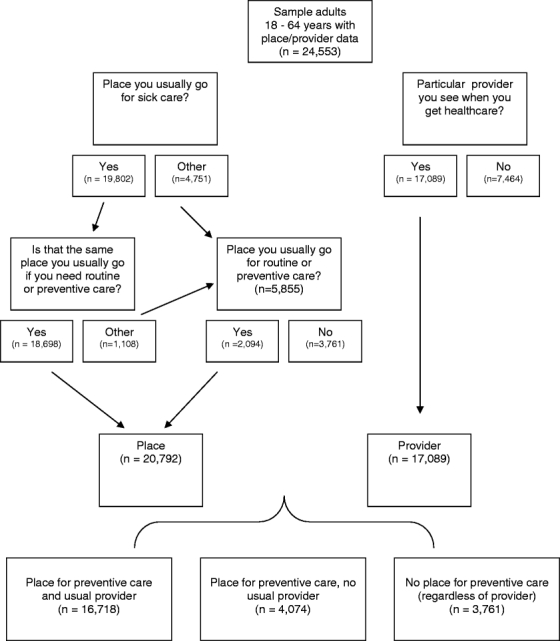
Objective: To examine whether the usual source of preventive care, (having a usual place for care only or the combination of a usual place and provider compared with no usual source of preventive care) is associated with adults receiving recommended screening and prevention services.
Design: Using cross-sectional survey data for 24,138 adults (ages 18-64) from the 1999 National Health Interview Survey (NHIS), we estimated adjusted odds ratios using separate logistic regression models for receipt of five preventive services: influenza vaccine, Pap smear, mammogram, clinical breast exam, and prostate specific antigen.
Results: Having both a usual place and a usual provider was consistently associated with increased odds for receiving preventive care/screening services compared to having a place only or neither. Adults ages 50-64 with a usual place/provider had 2.8 times greater odds of receiving a past year flu shot compared with those who had neither. Men ages 50-64 with a usual place/provider had nearly 10 times higher odds of receiving a PSA test compared with men who had neither. Having a usual place/provider compared with having neither was associated with 3.9 times higher odds of clinical breast exam among women ages 20-64, 4.1 times higher odds of Pap testing among women ages 21-64, and 4.8 times higher odds of mammogram among women ages 40-64.
Conclusions: Having both a usual place and usual provider is a key variable in determining whether adults receive recommended screening and prevention services and should be considered a fundamental component of any medical home model for adults.
Figures
References
-
- Health Resources and Services Administration. Maternal and Child Health Bureau web page, Achieving and Measuring Success: A National Agenda for Children with Special Health Care Needs. Available at: http://mchb.hrsa.gov/programs/specialneeds/measuresuccess.htm. Accessed: June 18, 2007
-
- Starfield B, Shi L. The medical home, access to care, and insurance: a review of evidence. Pediatrics. 2004;113suppl1493–98. - PubMed
Publication types
MeSH terms
Grants and funding
LinkOut - more resources
Full Text Sources
Research Materials
Miscellaneous
