. 2008 May 28:8:82.
doi: 10.1186/1471-2180-8-82.

Assessment of decorin-binding protein A to the infectivity of Borrelia burgdorferi in the murine models of needle and tick infection

Affiliations

Assessment of decorin-binding protein A to the infectivity of Borrelia burgdorferi in the murine models of needle and tick infection

Jon S Blevins et al. BMC Microbiol. .

Abstract

Background: Decorin-binding proteins (Dbps) A and B of Borrelia burgdorferi, the agent of Lyme disease, are surface-exposed lipoproteins that presumably bind to the extracellular matrix proteoglycan, decorin. B. burgdorferi infects various tissues including the bladder, heart, joints, skin and the central nervous system, and the ability of B. burgdorferi to bind decorin has been hypothesized to be important for this disseminatory pathogenic strategy.

Results: To determine the role of DbpBA in the infectious lifecycle of B. burgdorferi, we created a DbpBA-deficient mutant of B. burgdorferi strain 297 and compared the infectious phenotype of the mutant to the wild-type strain in the experimental murine model of Lyme borreliosis. The mutant strain exhibited a 4-log decrease in infectivity, relative to the wild-type strain, when needle inoculated into mice. Upon complementation of the DbpBA-mutant strain with DbpA, the wild-type level of infectivity was restored. In addition, we demonstrated that the DbpBA-deficient mutant was able to colonize Ixodes scapularis larval ticks after feeding on infected mice and persist within the ticks during the molt to the nymphal state. Moreover, surprisingly, the DbpBA-mutant strain was capable of being transmitted to naïve mice via tick bite, giving rise to infected mice.

Conclusion: These results suggest that DbpBA is not required for the natural tick-transmission process to mammals, despite inferences from needle-inoculation experiments implying a requirement for DbpBA during mammalian infection. The combined findings also send a cautionary note regarding how results from needle-inoculation experiments with mice should be interpreted.


Figures

Figure 1
Figure 1
Construction of dbpBA-deletion mutant BbKH500 and Prom-dbpA complementation vector and PCR confirmation. (A) Strategy for the replacement of the dbpBA operon with the PflgB-kan and complementation with pKH2000. pKHdbpBAko was the pGEM-T easy-based suicide plasmid used to transform Bb297 for the homologous recombination of the kanamycin-resistance gene into the dbpBA operon. "A" denotes AscI sites. PflgB-kan denotes the kanamycin-resistance marker expressed from the flgB promoter. The borrelial shuttle vector containing the dbpBA Prom fused to the dbpA ORF (pKH2000) was transformed into BbKH500 to restore DbpA expression. Oligonucleotide primers used for PCR are indicated with short arrows. (B) PCR using primers ko5 and ko4 (shown in panel A). The first two lanes are undigested PCR products from Bb297 and BbKH500, whereas the second two lanes are the corresponding PCR products digested with AscI. (C) Lanes 1, 3 and 5 are PCR products derived from BbKH500 template DNA and lanes 2, 4 and 6 are PCR products derived from Bb297 template DNA. Primer pairs used in PCR are indicated above the lanes. FlaB5' and FlaB3' primers amplify flaB of B. burgdorferi. DNA size standards (M) are shown in base pairs on the left.
Figure 2
Figure 2
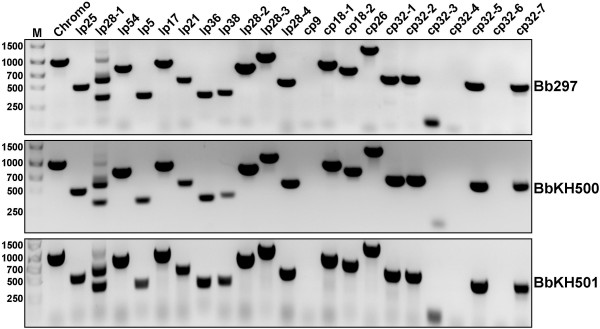
PCR-based plasmid profiling to compare the plasmid contents of the strains employed in this study. PCR amplification with primers specific for each of the known endogenous B. burgdorferi plasmids was used to compare the plasmid content of parent Bb297, BbKH500, and BbKH501. Sequence information for the primers utilized is provided in Table 4. Plasmid designations above each lane are based on strain B31 plasmid annotation. DNA size standards (M) are shown in base pairs.
Figure 3
Figure 3
Characterization of BbKH500 and BbKH501. (A) Whole-cell lysates of Bb297, BbKH500, and BbKH501 were resolved by SDS-PAGE (12.5% acrylamide) and stained with Coomassie brilliant blue or (B) or transferred to nitrocellulose and assessed by immunoblot analysis with antibodies as noted on the right. (C) PCR analysis of Bb297, BbKH500 and BbKH501 for presence of dbpA. (D) Immunoblot analysis of whole-cell lysates of proteinase K-digested (+) or undigested (-) Bb297 or BbKH501. Antibodies used noted on the right. Molecular mass of markers (M) in panel A are shown in kDa. The arrow at the right in panel A denotes the protein band corresponding to DbpA. DNA size standards (M) in panel C are shown in base pairs.

References

    1. Steere AC, Coburn J, Glickstein L. The emergence of Lyme disease. J Clin Invest. 2004;113:1093–1101. - PMC - PubMed
    1. Coburn J, Fischer JR, Leong JM. Solving a sticky problem: new genetic approaches to host cell adhesion by the Lyme disease spirochete. Mol Microbiol. 2005;57:1182–1195. doi: 10.1111/j.1365-2958.2005.04759.x. - DOI - PubMed
    1. Coburn J, Medrano M, Cugini C. Borrelia burgdorferi and its tropisms for adhesion molecules in the joint. Curr Opin Rheumatol. 2002;14:394–398. doi: 10.1097/00002281-200207000-00010. - DOI - PubMed
    1. Zambrano MC, Beklemisheva AA, Bryksin AV, Newman SA, Cabello FC. Borrelia burgdorferi binds to, invades, and colonizes native type I collagen lattices. Infect Immun. 2004;72:3138–3146. doi: 10.1128/IAI.72.6.3138-3146.2004. - DOI - PMC - PubMed
    1. Finlay BB, Falkow S. Common themes in microbial pathogenicity revisited. BMC Microbiol. 1997;61:136–169. - PMC - PubMed

Publication types

MeSH terms

Substances