


Age-related hearing loss in the Fischer 344/NHsd rat substrain
- PMID: 18508213
- PMCID: PMC2556048
- DOI: 10.1016/j.heares.2008.04.006
Age-related hearing loss in the Fischer 344/NHsd rat substrain
Abstract
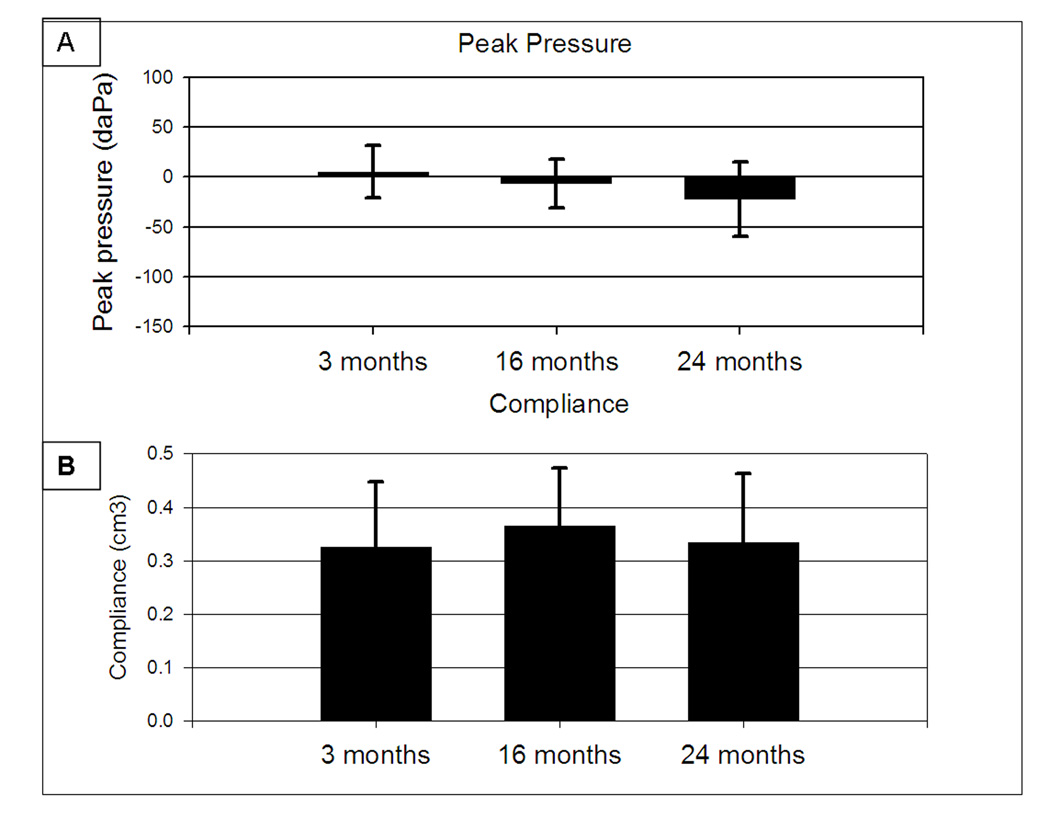
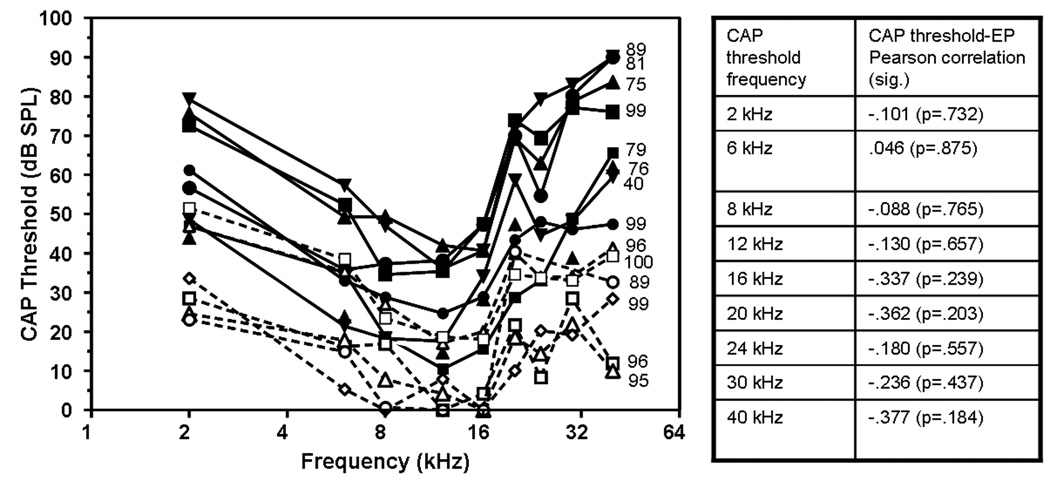
Studies of the F344 rat have shown a variety of age-related auditory anatomy and physiology changes. The current study was undertaken to clarify the ARHL in the F344 rat, by examining the auditory pathway of the F344/NHsd substrain that is distributed by Harlan Laboratories for research in the United States. The F344/NHsd rat begins to lose its hearing at about 12 months, and by 24 months, there are 50-60 dB auditory brainstem response threshold shifts at 20 and 40 kHz and 20 dB losses at 5-10 kHz. Distortion product otoacoustic emissions (DPOAE) amplitudes at 1.8-12 kHz stimuli were depressed in the older (18-24 months) rats. Amplitude input-output functions of the compound action potential (CAP) were also depressed across frequency. The endocochlear potential (EP) was 90-100 mV in the 3 month old rats. All but one of the 24 month old rats' EPs were in the +75-85 mV range. Tympanometry revealed no differences in middle ear function between the young and older rats. Collectively, these findings suggest damage to the outer hair cells, but anatomical examination of the outer hair cells revealed a relative lack of cell loss compared to the magnitude of the hearing and DPOAE loss.
Figures





References
-
- Buckiova D, Popelar J, Syka J. Collagen changes in the cochlea of aged Fischer 344 rats. Exp Gerontol. 2006;41(3):296–302. - PubMed
-
- Buckiova D, Popelar J, Syka J. Aging cochleas in the F344 rat: morphological and functional changes. Exp Gerontol. 2007;42(7):629–638. - PubMed
-
- Charles River Laboratories. Charles River Laboratories Research Models and Services. 2007. Published online at www.criver.com, 14.
-
- Chen GD. Prestin gene expression in the rat cochlea following intense noise exposure. Hear Res. 2006;222(1–2):54–61. - PubMed
-
- Chen GD, Liu Y. Mechanisms of noise-induced hearing loss potentiation by hypoxia. Hear Res. 2005;200(1–2):1–9. - PubMed
Publication types
MeSH terms
Grants and funding
LinkOut - more resources
Full Text Sources
Medical
Miscellaneous
