


Targeting tumors with LIGHT to generate metastasis-clearing immunity
- PMID: 18508404
- PMCID: PMC2517180
- DOI: 10.1016/j.cytogfr.2008.04.004
Targeting tumors with LIGHT to generate metastasis-clearing immunity
Abstract
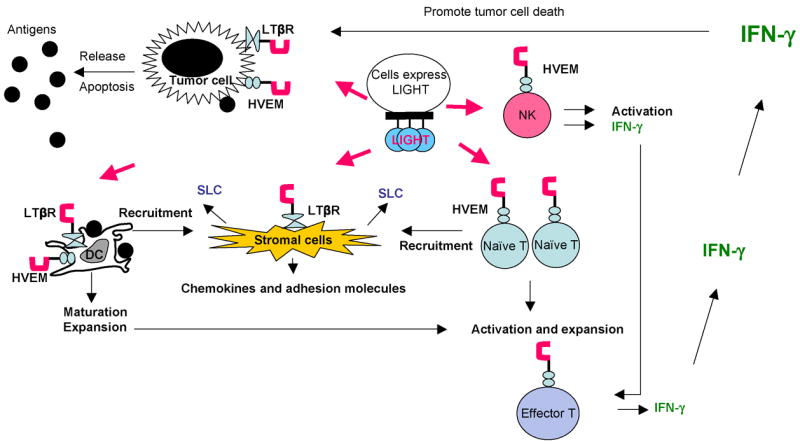
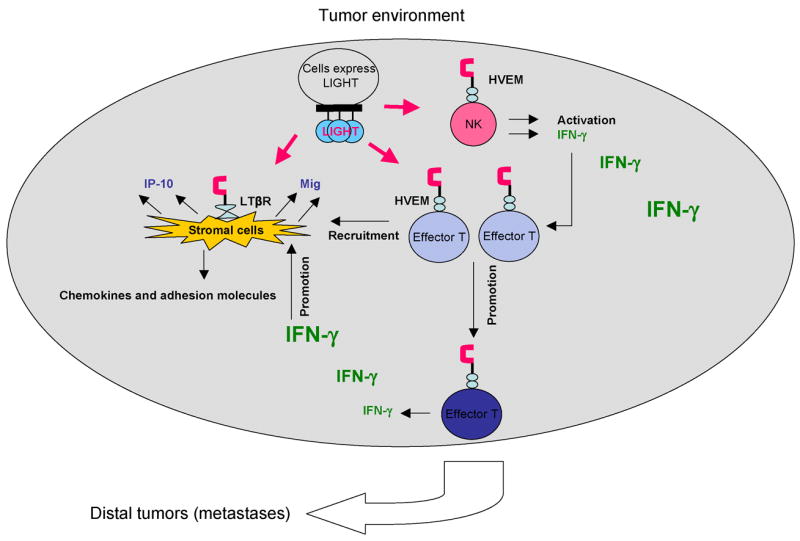
Metastatic diseases cause the majority of morbidity and mortality of cancer patients. Established tumors form both physical and immunological barriers to limit immune detection and destruction. Current immunotherapy of vaccination and adoptive transfer shows limited effect at least in part due to the existing barriers in the tumors and depending on the knowledge of tumor antigens. Tumor necrosis factor (TNF) superfamily (TNFSF) member 14 (TNFSF14) LIGHT interacts with stromal cells, dendritic cells (DCs), NK cells, naïve and activated T cells and tumor cells inside the tumor tissues via its two functional receptors, HVEM and lymphotoxin beta receptor (LTbetaR). Targeting tumor tissues with LIGHT leads to augmentation of priming, recruitment, and retention of effector cells at tumor sites, directly or indirectly, to induce strong anti-tumor immunity to inhibit the growth of primary tumors as well as eradicate metastases. Intratumor treatment would break tumor barriers and allow strong immunity against various tumors without defining tumor antigens. This review summarizes recent findings to support that LIGHT is a promising candidate for an effective cancer immunotherapy.
Figures
References
-
- Mauri DN, Ebner R, Montgomery RI, Kochel KD, Cheung TC, Yu GL, et al. LIGHT, a new member of the TNF superfamily, and lymphotoxin alpha are ligands for herpesvirus entry mediator. Immunity. 1998;8:21–30. - PubMed
-
- Tamada K, Shimozaki K, Chapoval AI, Zhu G, Sica G, Flies D, et al. Modulation of T-cell-mediated immunity in tumor and graft-versus-host disease models through the LIGHT co-stimulatory pathway. Nat Med. 2000;6:283–9. - PubMed
-
- Rooney IA, Butrovich KD, Glass AA, Borboroglu S, Benedict CA, Whitbeck JC, et al. The lymphotoxin-beta receptor is necessary and sufficient for LIGHT-mediated apoptosis of tumor cells. J Biol Chem. 2000;275:14307–15. - PubMed
-
- Harrop JA, McDonnell PC, Brigham-Burke M, Lyn SD, Minton J, Tan KB, et al. Herpesvirus entry mediator ligand (HVEM-L), a novel ligand for HVEM/TR2, stimulates proliferation of T cells and inhibits HT29 cell growth. J Biol Chem. 1998;273:27548–56. - PubMed
Publication types
MeSH terms
Substances
Grants and funding
LinkOut - more resources
Full Text Sources
Other Literature Sources
Research Materials
