


Review
doi: 10.2741/3068.
Converging roles for sphingolipids and cell stress in the progression of neuro-AIDS
Affiliations
- PMID: 18508574
- PMCID: PMC2739118
- DOI: 10.2741/3068
Item in Clipboard
Review
Converging roles for sphingolipids and cell stress in the progression of neuro-AIDS
Front Biosci.
.
Abstract
Sphingolipids are a class of lipids enriched in the central nervous system that have important roles in signal transduction. Recent advances in our understanding of how sphingolipids are involved in the control of life and death signaling have uncovered roles for these lipids in the neuropathogenesis of HIV-associated neurocognitive disorders (HAND). In this review we briefly summarize the molecular mechanisms involved in the pathological production of the toxic sphingolipid, ceramide and address questions of how cytokine and cellular stress pathways that are perturbed in HAND converge to deregulate ceramide-associated signaling.
Figures
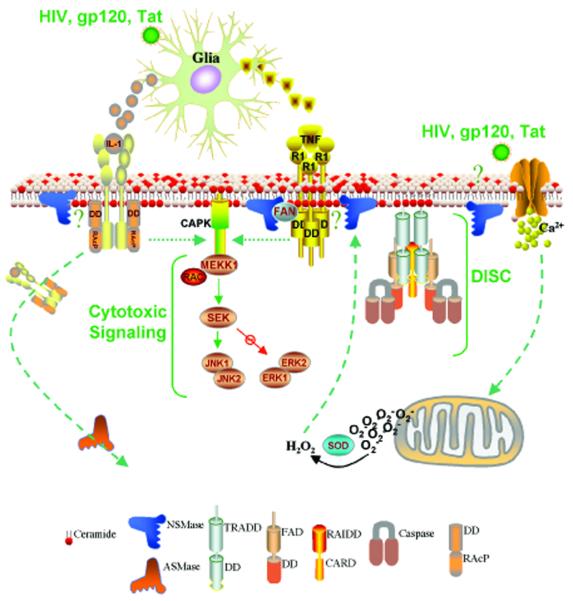
HIV and the HIV-proteins gp120 and Tat can perturb the function of glial cells in brain and deregulate cytokine balance. Two of the inflammatory cytokines that are increased in the brains of patients with HAND, IL-1 and TNF are potent inducers of ceramide generation by signaling that involves the hydrolysis of sphingomyelin by a neutral sphingomyelinse (NSMase). The TNF receptor R1 can signal to NSMase via the adaptor protein, factor associated with neutral sphingomyelinase (FAN) and also by unidentified mechanisms (indicated by ?). Likewise, the exact mechanisms that link IL-1 receptor activation to NSMase are unknown. IL-1 can activate acidic sphingomyelinase following ligandinduced receptor internalization by a mechanism that involves the adaptor protein RacP. Ceramide generated at the plasma membrane is critical for the assembly of proteins involved in the death inducing signaling complex (DISC). Shown are the assembly of TNF receptor associated death domain (TRADD), Fas-associated protein with death domain (FADD), caspase and RIP-adaptor with death domain (RAIDD), RIP-associated ICH-1/CED-3 homologous protein with a death domain (RAIDD), caspase recruitment domain (CARD) and associated caspases. Both IL-1 and TNF receptors can induce ceramide-dependent cytotoxic signaling via activation of ceramide-activated protein kinases (CAPK) that promote death signaling by mitogen-activated protein kinase kinase (MEKK) activation of Jun N-terminal kinase (JNK) and inhibition of extracellular signal-regulated kinase (ERK). HIV, gp120 and Tat-induced deregulation of calcium permeable ion channels and perturbed mitochondrial function can result in a leak of super oxide radicals (O 2-). Some free radical species, such as hydrogen peroxide (H2O2) promote the translocation of NSMase to the plasma membrane to generate ceramide.
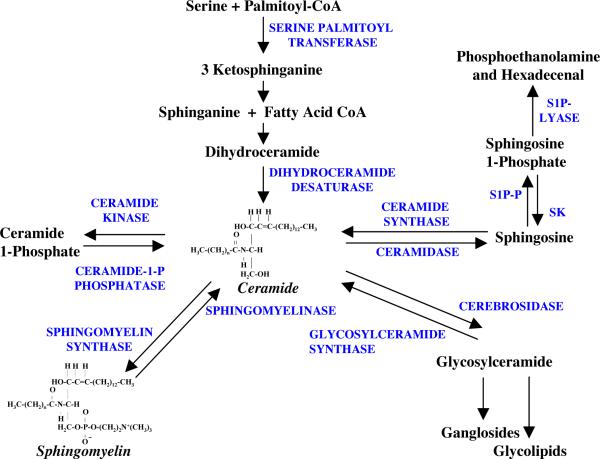
Catabolic and de novo pathways for ceramide production and related sphingolipids are shown. Enzymes involved in each of the pathways are indicated in bold blue letters.
References
-
- France-Lanord V, Brugg B, et al. Mitochondrial free radical signal in ceramide-dependent apoptosis: a putative mechanism for neuronal death in Parkinson's disease. J Neurochem. 1997;69(4):1612–21. - PubMed
-
- Cutler RG, Pedersen WA, et al. Evidence that accumulation of ceramides and cholesterol esters mediates oxidative stress-induced death of motor neurons in amyotrophic lateral sclerosis. Ann Neurol. 2002;52(4):448–57. - PubMed
-
- Haughey NJ, Cutler RG, et al. Perturbation of sphingolipid metabolism and ceramide production in HIV-dementia. Ann Neurol. 2004;55(2):257–67. - PubMed
-
- Charles R, Sandirasegarane L, et al. Ceramide-coated balloon catheters limit neointimal hyperplasia after stretch injury in carotid arteries. Circ Res. 2000;87(4):282–8. - PubMed
Publication types
MeSH terms
Substances
Grants and funding
LinkOut - more resources
Full Text Sources
Medical