


Asparagine 631 variants of the chicken Mx protein do not inhibit influenza virus replication in primary chicken embryo fibroblasts or in vitro surrogate assays
- PMID: 18508886
- PMCID: PMC2493316
- DOI: 10.1128/JVI.00185-08
Asparagine 631 variants of the chicken Mx protein do not inhibit influenza virus replication in primary chicken embryo fibroblasts or in vitro surrogate assays
Abstract
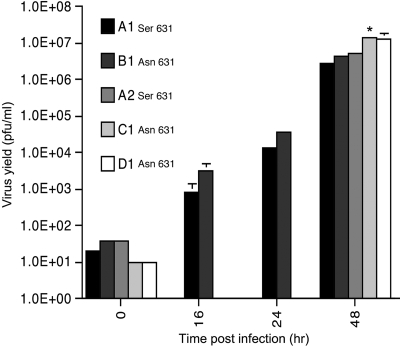
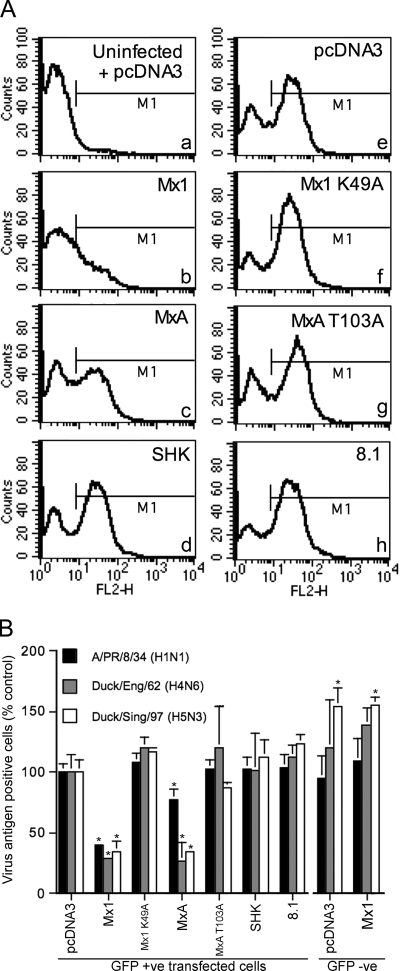
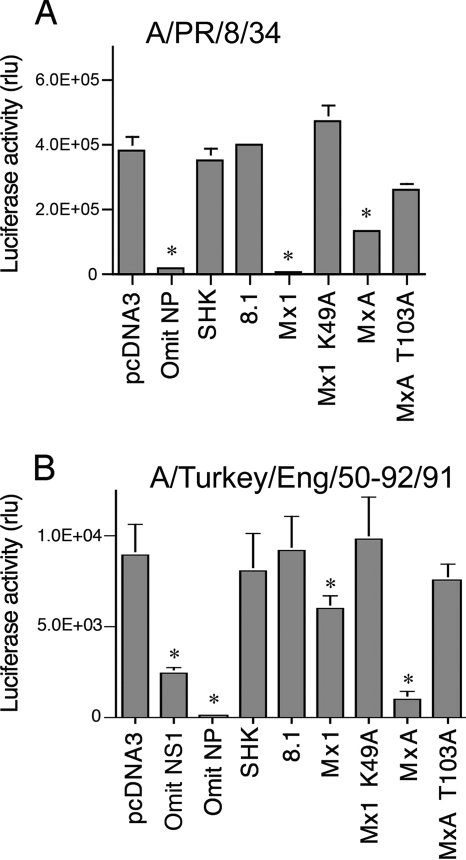
Whether chicken Mx inhibits influenza virus replication is an important question with regard to strategies aimed at enhancing influenza resistance in domestic flocks. The Asn631 polymorphism of the chicken Mx protein found in the Shamo (SHK) chicken line was previously reported to be crucial for the antiviral activity of this highly polymorphic chicken gene. Our aims were to determine whether cells from commercial chicken lines containing Asn631 alleles were resistant to influenza virus infection and to investigate the effects that other polymorphisms might have on Mx function. Unexpectedly, we found that the Asn631 genotype had no impact on multicycle replication of influenza virus (A/WSN/33 [H1N1]) in primary chicken embryo fibroblast lines. Furthermore, expression of the Shamo (SHK) chicken Mx protein in transfected 293T cells did not inhibit viral gene expression (A/PR/8/34 [H1N1], A/Duck/England/62 [H4N6], and A/Duck/Singapore/97 [H5N3]). Lastly, in minireplicon systems (A/PR/8/34 and A/Turkey/England/50-92/91 [H5N1]), which were highly sensitive to inhibition by the murine Mx1 and human MxA proteins, respectively, Shamo chicken Mx also proved ineffective in the context of avian as well as mammalian cell backgrounds. Our findings demonstrate that Asn631 chicken Mx alleles do not inhibit influenza virus replication of the five strains tested here and efforts to increase the frequency of Asn631 alleles in commercial chicken populations are not warranted. Nevertheless, chicken Mx variants with anti-influenza activity might still exist. The flow cytometry and minireplicon assays described herein could be used as efficient functional screens to identify such active chicken Mx alleles.
Figures
References
-
- Arnheiter, H., S. Skuntz, M. Noteborn, S. Chang, and E. Meier. 1990. Transgenic mice with intracellular immunity to influenza virus. Cell 6251-61. - PubMed
-
- Balkissoon, D., K. Staines, J. McCauley, J. Wood, J. Young, J. Kaufman, and C. Butter. 2007. Low frequency of the Mx allele for viral resistance predates recent intensive selection in domestic chickens. Immunogenetics 59687-691. - PubMed
-
- Bazzigher, L., A. Schwarz, and P. Staeheli. 1993. No enhanced influenza virus resistance of murine and avian cells expressing cloned duck Mx protein. Virology 195100-112. - PubMed
-
- Berger, J., J. Hauber, R. Hauber, R. Geiger, and B. R. Cullen. 1988. Secreted placental alkaline phosphatase: a powerful new quantitative indicator of gene expression in eukaryotic cells. Gene 661-10. - PubMed
-
- Bernasconi, D., U. Schultz, and P. Staeheli. 1995. The interferon-induced Mx protein of chickens lacks antiviral activity. J. Interferon Cytokine Res. 1547-53. - PubMed
Publication types
MeSH terms
Substances
Grants and funding
LinkOut - more resources
Full Text Sources
Molecular Biology Databases
Research Materials
