


Age of child, more than HPV type, is associated with clinical course in recurrent respiratory papillomatosis
- PMID: 18509465
- PMCID: PMC2386234
- DOI: 10.1371/journal.pone.0002263
Age of child, more than HPV type, is associated with clinical course in recurrent respiratory papillomatosis
Abstract
Background: RRP is a devastating disease in which papillomas in the airway cause hoarseness and breathing difficulty. The disease is caused by human papillomavirus (HPV) 6 or 11 and is very variable. Patients undergo multiple surgeries to maintain a patent airway and in order to communicate vocally. Several small studies have been published in which most have noted that HPV 11 is associated with a more aggressive course.
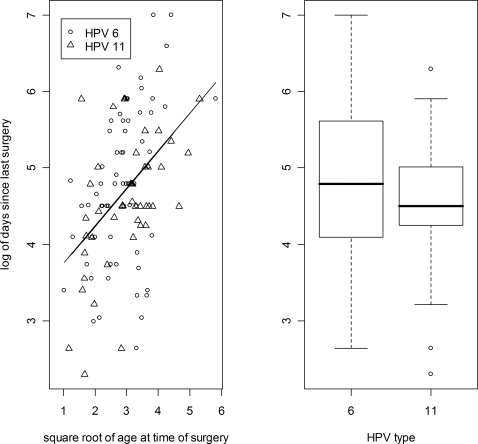
Methodology/principal findings: Papilloma biopsies were taken from patients undergoing surgical treatment of RRP and were subjected to HPV typing. 118 patients with juvenile-onset RRP with at least 1 year of clinical data and infected with a single HPV type were analyzed. HPV 11 was encountered in 40% of the patients. By our definition, most of the patients in the sample (81%) had run an aggressive course. The odds of a patient with HPV 11 running an aggressive course were 3.9 times higher than that of patients with HPV 6 (Fisher's exact p = 0.017). However, clinical course was more closely associated with age of the patient (at diagnosis and at the time of the current surgery) than with HPV type. Patients with HPV 11 were diagnosed at a younger age (2.4y) than were those with HPV 6 (3.4y) (p = 0.014). Both by multiple linear regression and by multiple logistic regression HPV type was only weakly associated with metrics of disease course when simultaneously accounting for age. CONCLUSIONS/SIGNIFICANCE ABSTRACT: The course of RRP is variable and a quarter of the variability can be accounted for by the age of the patient. HPV 11 is more closely associated with a younger age at diagnosis than it is associated with an aggressive clinical course. These data suggest that there are factors other than HPV type and age of the patient that determine disease course.
Conflict of interest statement
Figures
References
-
- Kashima HK, Kessis T, Mounts P, Shah K. Polymerase chain reaction identification of human papillomavirus DNA in CO2 laser plume from recurrent respiratory papillomatosis. Otolaryngol Head Neck Surg. 1991;104:191–195. - PubMed
-
- Gómez MA, Drut R, Lojo MM, Drut RM. Detection of human papillomavirus in juvenile laryngeal papillomatosis using polymerase chain reaction. Medicina. 1995;55(3):213–217. - PubMed
-
- Silverberg MJ, Thorsen P, Lindeberg H, Ahdieh-Grant L, Shah K. Clinical course of recurrent respiratory papillomatosis in Danish children. Arch Otolaryngol Head Neck Surg. 2004;130:711–716. - PubMed
Publication types
MeSH terms
Substances
Grants and funding
LinkOut - more resources
Full Text Sources
