. 2008 Jun;212(6):736-46.
doi: 10.1111/j.1469-7580.2008.00899.x.

Cranial performance in the Komodo dragon (Varanus komodoensis) as revealed by high-resolution 3-D finite element analysis

Affiliations

Cranial performance in the Komodo dragon (Varanus komodoensis) as revealed by high-resolution 3-D finite element analysis

Karen Moreno et al. J Anat. 2008 Jun.

Abstract

The Komodo dragon (Varanus komodoensis) displays a unique hold and pull-feeding technique. Its delicate 'space-frame' skull morphology differs greatly from that apparent in most living large prey specialists and is suggestive of a high degree of optimization, wherein use of materials is minimized. Here, using high-resolution finite element modelling based on dissection and in vivo bite and pull data, we present results detailing the mechanical performance of the giant lizard's skull. Unlike most modern predators, V. komodoensis applies minimal input from the jaw muscles when butchering prey. Instead it uses series of actions controlled by postcranial muscles. A particularly interesting feature of the performance of the skull is that it reveals considerably lower overall stress when these additional extrinsic forces are added to those of the jaw adductors. This remarkable reduction in stress in response to additional force is facilitated by both internal and external bone anatomy. Functional correlations obtained from these analyses also provide a solid basis for the interpretation of feeding ecology in extinct species, including dinosaurs and sabre-tooth cats, with which V. komodoensis shares various cranial and dental characteristics.


Figures
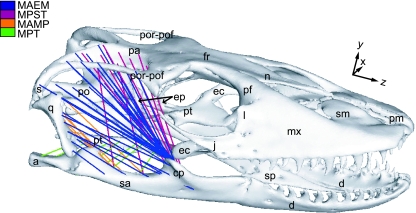
Fig. 1
Fig. 1
FE model showing distribution of pretensioned muscle trusses (Table 1). MAEM: m. adductor externus mandibulae; MPST = m. pseudotemporalis superficialis and profundus; MAMP = m. adductor mandibulae posterior; MPT = m. pterygoid; a, articular; cp, coronoid process; d, dentary; ec, ectopterygoid; ep, epipterygoid; fr, frontal; j, jugal; l, lacrimal; mx, maxilla; n, nasal; pa, parietal; pf, prefrontal; pm, premaxilla; po, prootic; por-pof, postorbital + postfrontal; pt, pterygoid; qu, quadrate; sa, surangular; sm, septomaxilla; s, squamosal; sp, splenial.
Fig. 2
Fig. 2
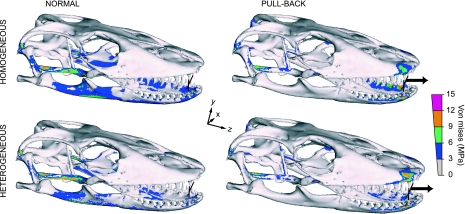
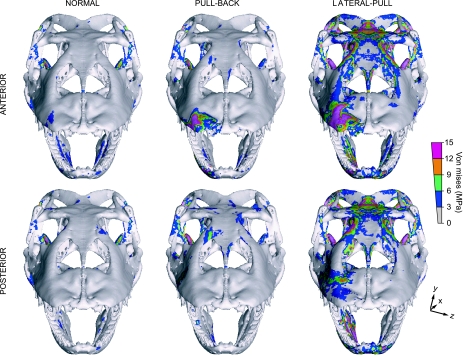
Von Mises stress distribution for a symmetrical mesial bite in normal (action of masticatory muscles only) and pull-back load cases (i.e. combined actions of masticatory muscles plus additional loading that simulates a pull along the Z-axis by postcranial musculature): Muscle tensional force plus 50 N force (Z-axis), applied at the midpoint node of the interdental beam (arrow), for heterogeneous and homogeneous models. Peak stresses have been scaled out to minimize visual impact of model artefacts. Stress is more widely distributed in homogeneous than heterogeneous models but general patterns are preserved. In biting at a mesial point in the tooth row, stress is lower where an additional extrinsic load is applied (mesial pull-back bite) than where loading is restricted to masticatory muscles only (mesial normal bite).
Fig. 3
Fig. 3
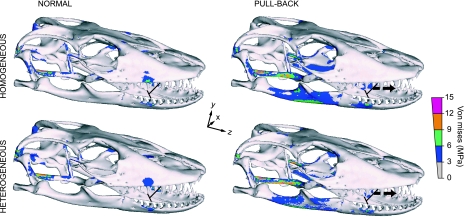
Von Mises stress distribution in symmetrical distal bite in normal (action of masticatory muscles only) and pull-back load cases (i.e. action masticatory muscles plus additional loading that simulates a pull along the Z-axis by postcranial musculature): Muscle tensional force plus 50 N force (Z-axis) applied at the midpoint node of the interdental beam (arrow), for heterogeneous and homogeneous models. Peak stresses have been scaled out. In contrast to biting at an anterior point in the tooth row, when biting at a distal point, stress is lower when loading is restricted to masticatory muscles only (normal) and the addition of pull loading along the Z axis (pull-back) increases stress.
Fig. 4
Fig. 4
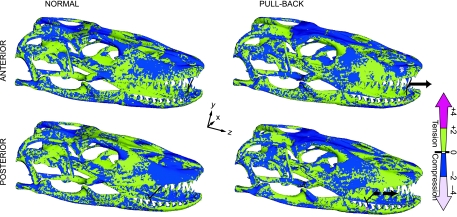
Minimum principal stress distribution for heterogeneous models of symmetrical distal/mesial, normal/pull-back bite. Colour scale indicates compressive and tensile stress distributions. Peak stresses have been scaled out. Note that distal and mesial pull-back load cases receive higher compressive stress in the dorsal cranium, posterior maxilla, anterior quadrate and pterygoid-epipterygoid joint than in distal and mesial normal bites.
Fig. 5
Fig. 5
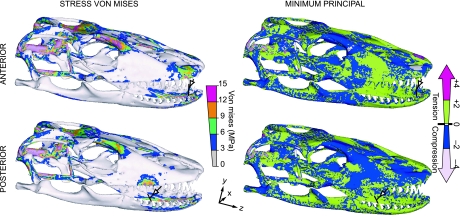
Von Mises and minimum principal stress distributions for a symmetrical heterogeneous lateral-pull bite: Action of masticatory muscles plus lateral tensile force of 50 N (arrow) in distal/mesial load cases. Peak stresses have been scaled out. Note that high stress is scattered along the rostrum, contrasting with the low VM stress values observed in normal and pull-back load cases.
Fig. 6
Fig. 6
Von Mises stress distribution for asymmetric (unilateral) bites in distal/mesial, and normal/pull-back/lateral-pull load cases. Peak stresses have been scaled out.

References

    1. Akersten WA. Canine function in Smilodon(mammalia; felidae; machairodontinae) Contrib Sci. 1985;356:1–22.
    1. Auffenberg W. The Behavioral Ecology of the Komodo Monitor. Gainesville: University Presses of Florida; 1981.
    1. Barrett PM, Rayfield EJ. Ecological and evolutionary implications of dinosaur feeding behaviour. Trends Ecol Evol. 2006;21:217–224. - PubMed
    1. Busbey ABI. Form and function of the feeding apparatus of Alligator mississippiensis. J Morphol. 1989;202:99–127. - PubMed
    1. Christiansen P, Wroe S. Bite forces and evolutionary adaptations to feeding ecology in carnivores. Ecology. 2007;88:347–358. - PubMed

Publication types

LinkOut - more resources