Meta-Analysis
. 2008 May 29:9:75.
doi: 10.1186/1471-2474-9-75.

A systematic review with procedural assessments and meta-analysis of low level laser therapy in lateral elbow tendinopathy (tennis elbow)

Affiliations
Meta-Analysis

A systematic review with procedural assessments and meta-analysis of low level laser therapy in lateral elbow tendinopathy (tennis elbow)

Jan M Bjordal et al. BMC Musculoskelet Disord. .

Abstract

Background: Recent reviews have indicated that low level level laser therapy (LLLT) is ineffective in lateral elbow tendinopathy (LET) without assessing validity of treatment procedures and doses or the influence of prior steroid injections.

Methods: Systematic review with meta-analysis, with primary outcome measures of pain relief and/or global improvement and subgroup analyses of methodological quality, wavelengths and treatment procedures.

Results: 18 randomised placebo-controlled trials (RCTs) were identified with 13 RCTs (730 patients) meeting the criteria for meta-analysis. 12 RCTs satisfied half or more of the methodological criteria. Publication bias was detected by Egger's graphical test, which showed a negative direction of bias. Ten of the trials included patients with poor prognosis caused by failed steroid injections or other treatment failures, or long symptom duration or severe baseline pain. The weighted mean difference (WMD) for pain relief was 10.2 mm [95% CI: 3.0 to 17.5] and the RR for global improvement was 1.36 [1.16 to 1.60]. Trials which targeted acupuncture points reported negative results, as did trials with wavelengths 820, 830 and 1064 nm. In a subgroup of five trials with 904 nm lasers and one trial with 632 nm wavelength where the lateral elbow tendon insertions were directly irradiated, WMD for pain relief was 17.2 mm [95% CI: 8.5 to 25.9] and 14.0 mm [95% CI: 7.4 to 20.6] respectively, while RR for global pain improvement was only reported for 904 nm at 1.53 [95% CI: 1.28 to 1.83]. LLLT doses in this subgroup ranged between 0.5 and 7.2 Joules. Secondary outcome measures of painfree grip strength, pain pressure threshold, sick leave and follow-up data from 3 to 8 weeks after the end of treatment, showed consistently significant results in favour of the same LLLT subgroup (p < 0.02). No serious side-effects were reported.

Conclusion: LLLT administered with optimal doses of 904 nm and possibly 632 nm wavelengths directly to the lateral elbow tendon insertions, seem to offer short-term pain relief and less disability in LET, both alone and in conjunction with an exercise regimen. This finding contradicts the conclusions of previous reviews which failed to assess treatment procedures, wavelengths and optimal doses.


Figures
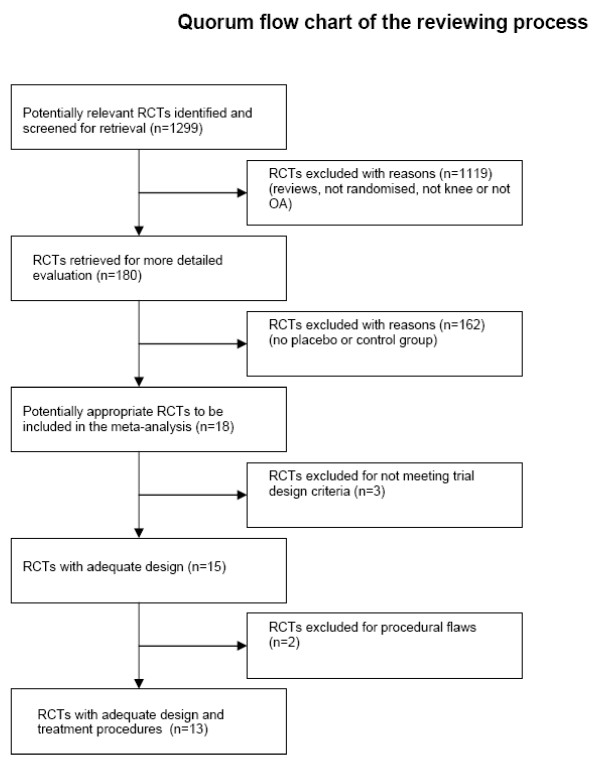
Figure 1
Figure 1
Quorum flow chart. Quorum flow chart of the steps in the reviewing process.
Figure 2
Figure 2
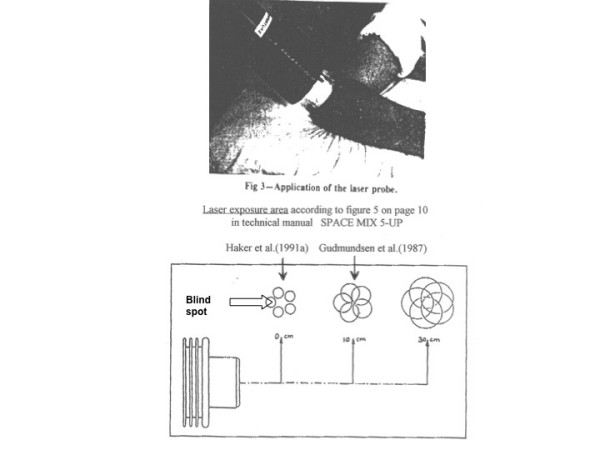
Photograph showing laser therapy procedure with laser head in skin contact in trial by Haker et al. The photograph is taken the trial report in from Archives of Physical Medicine 1991. The drawing of the laser spot sizes at different distances is taken from the manual of Space Mix 5 Mid-Laser (Space s.r.l, Italy).
Figure 3
Figure 3
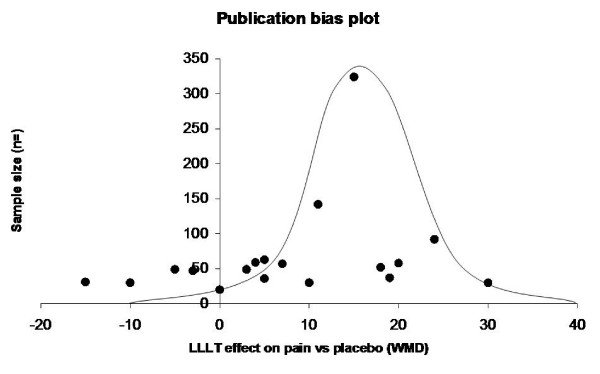
Funnel plot of published trial results given by WMD for pain relief over placebo measured on 100 mm VAS (x-axis), and sample size (y-axis).
Figure 4
Figure 4
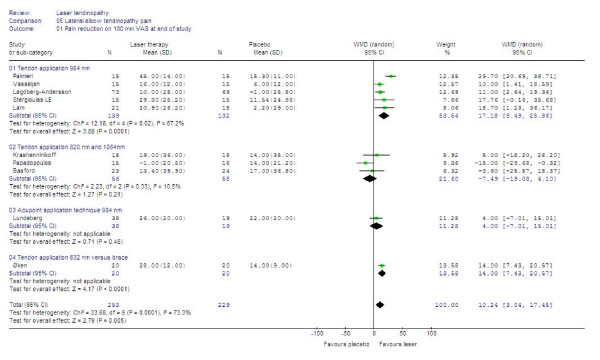
End of treatment results for LLLT measured as the WMD pain reduction on 100 mm VAS. Trials are subgrouped by application technique and wavelengths, and combined results are shown as total at the bottom of the table. Plots on the right hand side of the middle line indicate that the LLLT effect is superior to the control treatment.
Figure 5
Figure 5
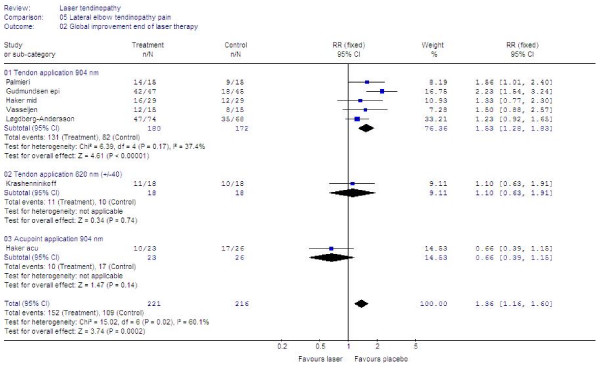
End of treatment results for LLLT measured as global improvement. Trials are subgrouped by application technique and wavelengths, and their combined results are shown as total at the bottom of the table. Plots on the right hand side of the middle line indicate that the LLLT effect is superior to the control treatment.
Figure 6
Figure 6
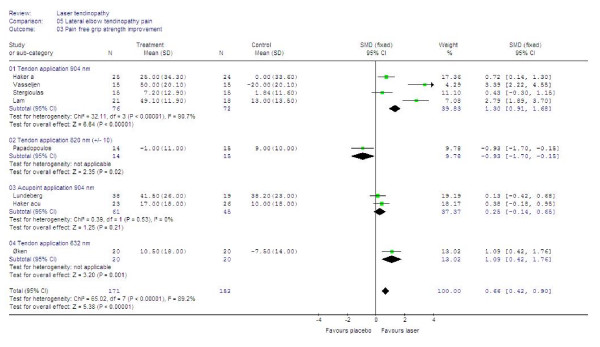
End of treatment results for LLLT measured as the SMD for pain-free grip strength. Trials are subgrouped by application technique and wavelengths, and their combined results are shown as total at the bottom of the table. Plots on the right hand side of the middle line indicate that the LLLT effect is superior to the control treatment.
Figure 7
Figure 7
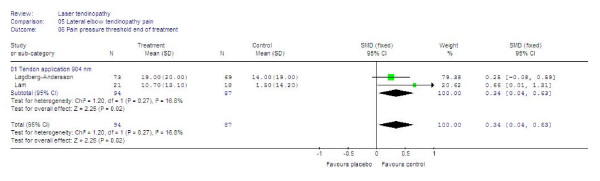
End of treatment results for LLLT measured as the SMD for pain pressure threshold. Only trials using the tendon application technique and 904 nm wavelength were available, and their combined results are shown as the total at the bottom of the table. Plots on the right hand side of the middle line indicate that the LLLT effect is superior to the control treatment.
Figure 8
Figure 8
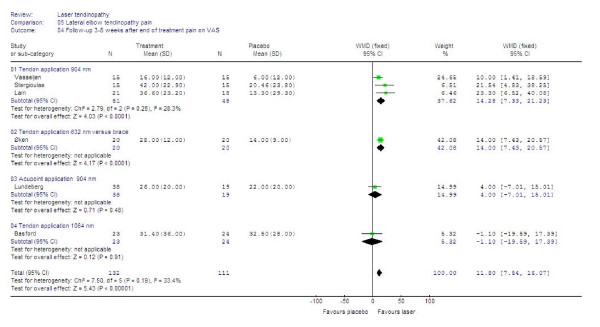
Follow-up results at 3–8 weeks after end of treatment for LLLT measured as the WMD for pain reduction on 100 mm VAS. Trials are subgrouped by application technique and wavelengths, and combined results are shown as total at the bottom of the table. Plots on the right hand side of the middle line indicate that the LLLT effect is superior to the control treatment.
Figure 9
Figure 9
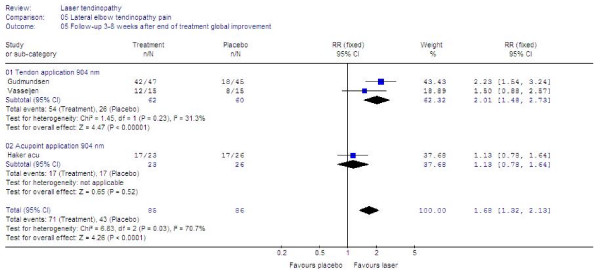
Follow-up results at 3–8 weeks after the end of treatment measured as the relative risk for global improvement for LLLT compared to placebo. Trials are subgrouped by application technique and wavelengths, and combined results are shown as total at the bottom of the table. Plots on the right hand side of the middle line indicate that the LLLT effect is superior to the control treatment.

References

    1. Shiri R, Viikari-Juntura E, Varonen H, Heliovaara M. Prevalence and determinants of lateral and medial epicondylitis: a population study. Am J Epidemiol. 2006;164:1065–74. doi: 10.1093/aje/kwj325. - DOI - PubMed
    1. Smidt N, Lewis M, DA VDW, Hay EM, Bouter LM, Croft P. Lateral epicondylitis in general practice: course and prognostic indicators of outcome. J Rheumatol. 2006;33:2053–59. - PubMed
    1. Peterson M, Elmfeldt D, Svardsudd K. Treatment practice in chronic epicondylitis: a survey among general practitioners and physiotherapists in Uppsala County, Sweden. Scand J Prim Health Care. 2005;23:239–41. doi: 10.1080/02813430510031333. - DOI - PubMed
    1. Assendelft WJJ, Hay EM, Adshead R, Bouter LM. Corticosteroid injections for lateral epicondylitis: a systematic review. British Journal of General Practice. 1996;46:209–216. - PMC - PubMed
    1. Smidt N, Assendelft WJ, Windt DA van der, Hay EM, Buchbinder R, Bouter LM. Corticosteroid injections for lateral epicondylitis: a systematic review. Pain. 2002;96:23–40. doi: 10.1016/S0304-3959(01)00388-8. - DOI - PubMed

Publication types