A new approach to understanding the impact of circadian disruption on human health
- PMID: 18510756
- PMCID: PMC2430544
- DOI: 10.1186/1740-3391-6-7
A new approach to understanding the impact of circadian disruption on human health
Abstract
Background: Light and dark patterns are the major synchronizer of circadian rhythms to the 24-hour solar day. Disruption of circadian rhythms has been associated with a variety of maladies. Ecological studies of human exposures to light are virtually nonexistent, however, making it difficult to determine if, in fact, light-induced circadian disruption directly affects human health.
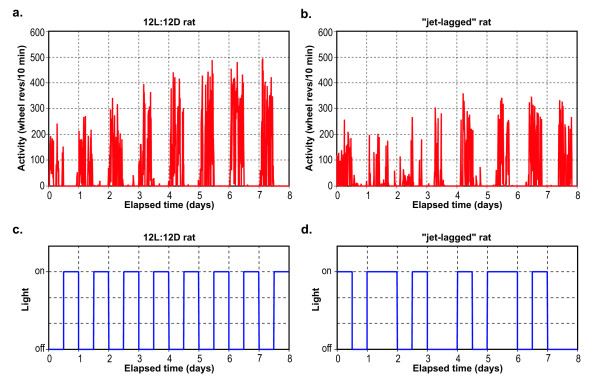
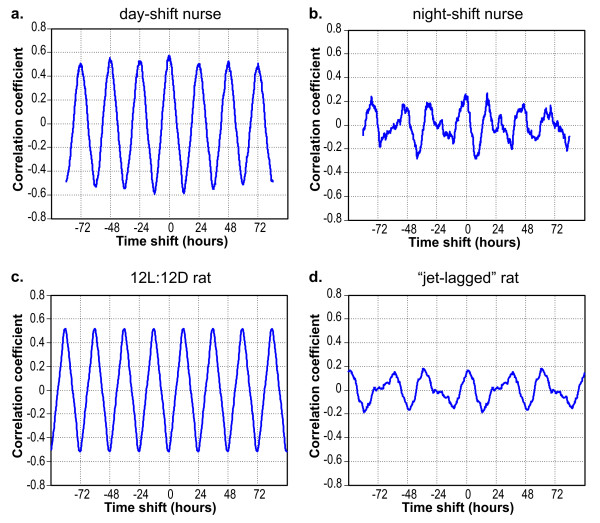
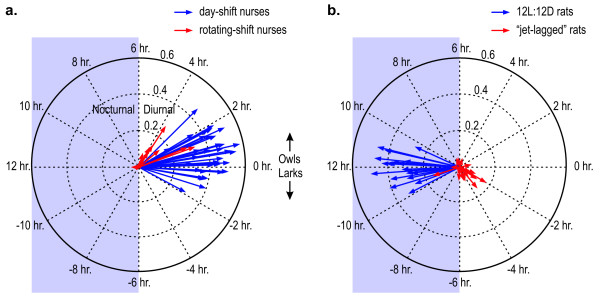
Methods: A newly developed field measurement device recorded circadian light exposures and activity from day-shift and rotating-shift nurses. Circadian disruption defined in terms of behavioral entrainment was quantified for these two groups using phasor analyses of the circular cross-correlations between light exposure and activity. Circadian disruption also was determined for rats subjected to a consistent 12-hour light/12-hour dark pattern (12L:12D) and ones subjected to a "jet-lagged" schedule.
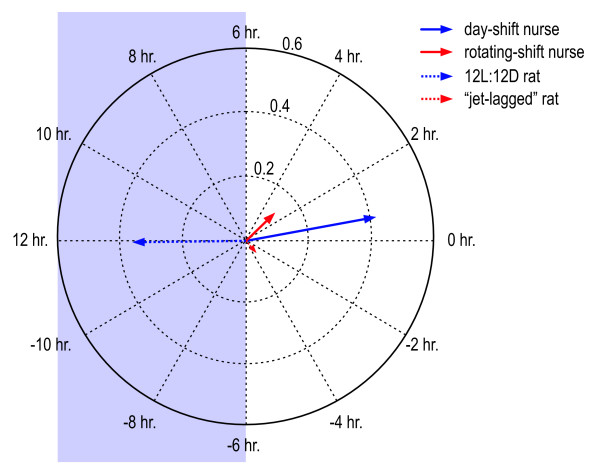
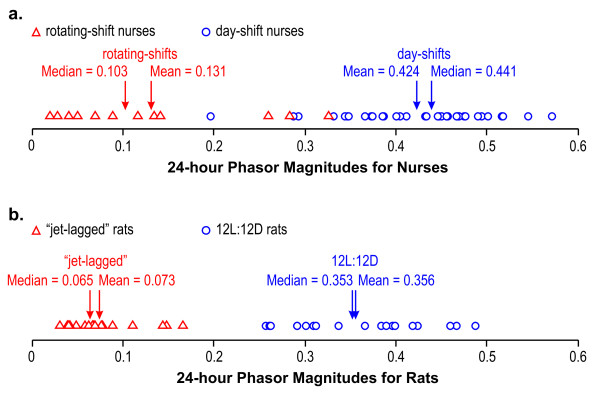
Results: Day-shift nurses and rats exposed to the consistent light-dark pattern exhibited pronounced similarities in their circular cross-correlation functions and 24-hour phasor representations except for an approximate 12-hour phase difference between species. The phase difference reflects the diurnal versus nocturnal behavior of humans versus rodents. Phase differences within species likely reflect chronotype differences among individuals. Rotating-shift nurses and rats subjected to the "jet-lagged" schedule exhibited significant reductions in phasor magnitudes compared to the day-shift nurses and the 12L:12D rats. The reductions in the 24-hour phasor magnitudes indicate a loss of behavioral entrainment compared to the nurses and the rats with regular light-dark exposure patterns.
Conclusion: This paper provides a quantitative foundation for systematically studying the impact of light-induced circadian disruption in humans and in animal models. Ecological light and activity data are needed to develop the essential insights into circadian entrainment/disruption actually experienced by modern people. These data can now be obtained and analyzed to reveal the interrelationship between actual light exposures and markers of circadian rhythm such as rest-activity patterns, core body temperature, and melatonin synthesis. Moreover, it should now be possible to bridge ecological studies of circadian disruption in humans to parametric studies of the relationships between circadian disruption and health outcomes using animal models.
Figures
References
-
- Moore-Ede MC., Sulzman, F. M., Fuller, C. A. The Clocks That Time Us. Cambridge , Harvard University Press; 1982.
-
- Refinetti R. Circadian Physiology. 2nd . Boca Raton, London, New York , CRC Taylor & Francis; 2006.
-
- Wever R. The Circadian System of Man: Results of Experiments Under Temporal Isolation. New York, Springer-Verlag; 1979.
-
- Aschoff J. In: Endocrine Rhythms. Krieger DTE, editor. New York , Raven; 1979.
-
- Czeisler CA, Weitzman E, Moore-Ede MC, Zimmerman JC, Knauer RS. Human sleep: its duration and organization depend on its circadian phase. Science. 1980;210:1264–1267. - PubMed
Grants and funding
LinkOut - more resources
Full Text Sources
Other Literature Sources