. 2008 Jul;173(1):161-9.
doi: 10.2353/ajpath.2008.070494. Epub 2008 May 29.

Cleavage of type II collagen by cathepsin K in human osteoarthritic cartilage

Affiliations

Cleavage of type II collagen by cathepsin K in human osteoarthritic cartilage

Valeria M Dejica et al. Am J Pathol. 2008 Jul.

Abstract

Cathepsin K is a cysteine protease of the papain family that cleaves triple-helical type II collagen, the major structural component of the extracellular matrix of articular cartilage. In osteoarthritis (OA), the anabolic/catabolic balance of articular cartilage is disrupted with the excessive cleavage of collagen II by collagenases or matrix metalloproteinases. A polyclonal antibody against a C-terminal neoepitope (C2K) generated in triple-helical type II collagen by the proteolytic action of cathepsin K was prepared and used to develop an enzyme-linked immunosorbent assay to study the generation of this epitope and the effects of its presence in normal adult and osteoarthritic femoral condylar articular cartilage. The generation of the C2K epitope in explant culture and the effect of a specific cathepsin K inhibitor were studied. The neoepitope, which is not generated by the collagenase matrix metalloproteinase-13, increased with age in articular cartilage and was significantly elevated in osteoarthritic cartilage compared with adult nonarthritic cartilage. Moreover, in explants from three of eight OA patients, the generation of the neoepitope in culture was significantly reduced by a specific, nontoxic inhibitor of cathepsin K. These data suggest that cathepsin K is involved in the cleavage of type II collagen in human articular cartilage in certain OA patients and that it may play a role in both OA pathophysiology and the aging process.


Figures
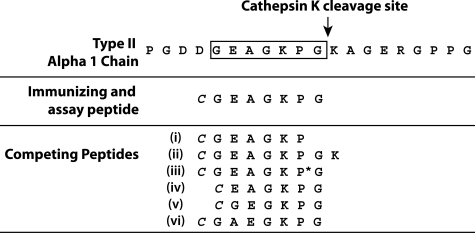
Figure 1
Figure 1
Sequences of the collagen α1(II) chain in the region of the cathepsin K cleavage site and the synthetic peptides used in the antisera preparation and characterization. A cysteine residue (italics) was added to the N terminus for coupling to the carrier protein. P* denotes 4-hydroxyproline.
Figure 2
Figure 2
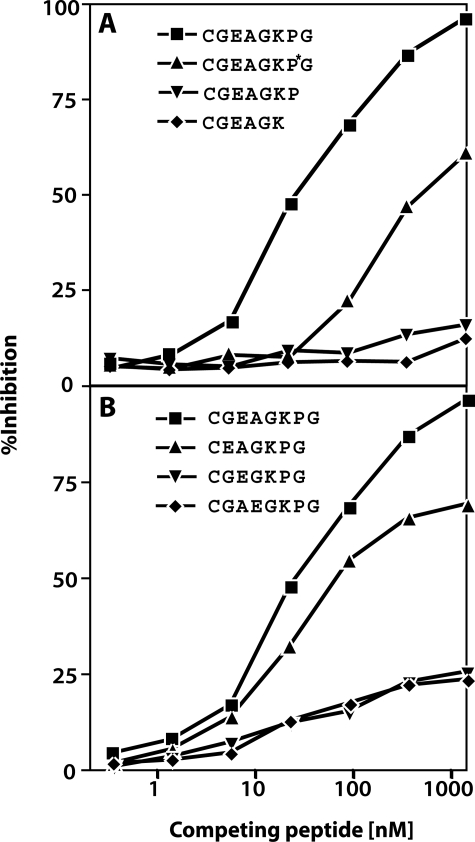
Immunoassay standard curve and epitope specificity of the antiserum R771. Percent inhibition obtained with serial dilutions of the immunizing and competing peptides with amino acid addition or deletion at the carboxy terminus (A) or modification of the amino terminus (B).
Figure 3
Figure 3
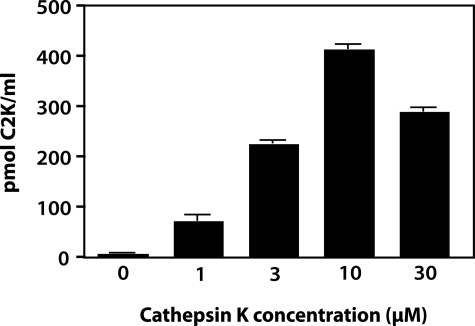
Concentration-dependent generation of C2K neoepitope by cathepsin K. Human Col II (0.6 mg/ml) was digested for 3 hours with various concentrations of cathepsin K. Neoepitope was measured by competitive ELISA.
Figure 4
Figure 4
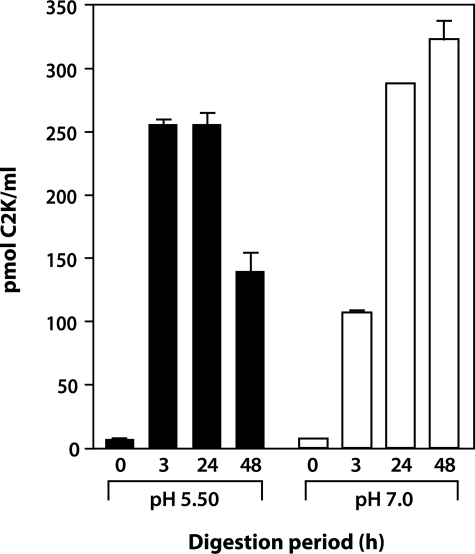
Time courses of cleavage of triple helical human Col II by cathepsin K at pH 5.5 and pH 7.0. The generation of the C2K neoepitope was measured by competitive ELISA.
Figure 5
Figure 5
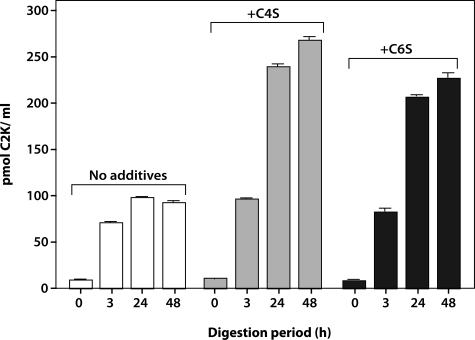
Effect of chondroitin sulfate on cathepsin K activity with time. Col II was digested with cathepsin K in the absence and presence of either chondroitin 4-sulfate (C4S) or chondroitin 6-sulfate (C6S), at pH 7.0. The generation of the cathepsin K neoepitope was measured by competitive ELISA.
Figure 6
Figure 6
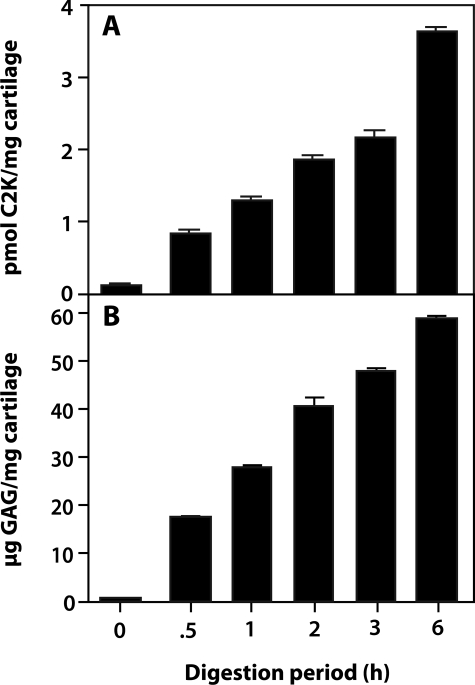
Digestion of normal articular human cartilage with cathepsin K. The digestions were performed at pH 5.5 and the release of C2K neoepitope (A) and GAG (B) throughout time was measured by competitive ELISA and the DMMB assay, respectively.
Figure 7
Figure 7
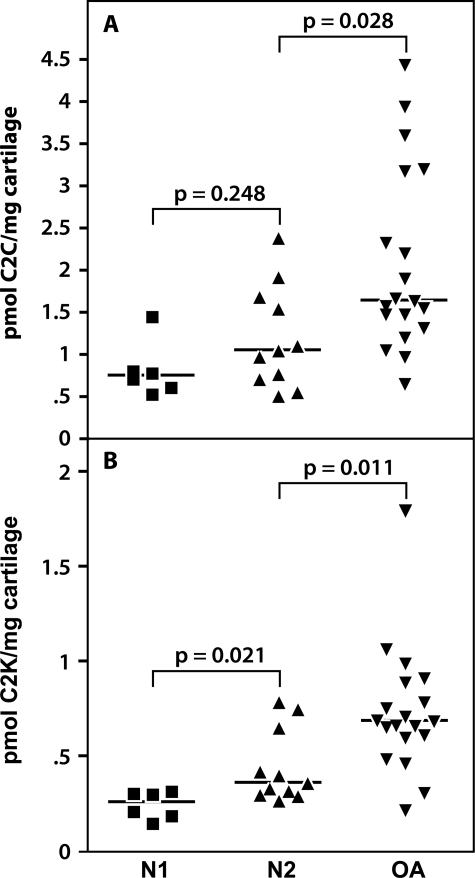
C2C and C2K neoepitope contents in normal and OA articular cartilages. The cartilage was digested with α-chymotrypsin and C2C (A) and C2K (B) neoepitope levels were quantitated in the digests by competitive ELISAs. Nonarthritic cartilages were divided into two groups: N1 (patient ages, 15 to 38 years) and N2 (patient ages, 41 to 70 years); patient ages for OA cartilages ranged between 49 to 87 years. In both cases the difference between the median (bar) of neoepitope content in the nonarthritic and the OA cartilages was determined by Mann-Whitney analysis and the P values are shown in the figures.
Figure 8
Figure 8
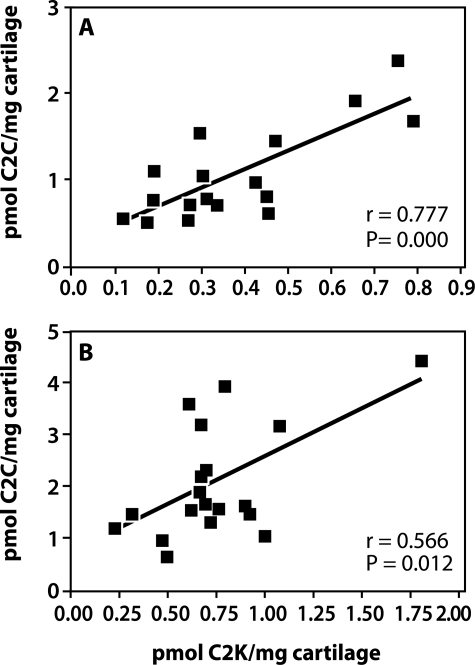
Correlations between the content of C2C (MMP collagenase-generated neoepitope) and C2K neoepitopes in articular cartilages. Data from Figure 7 were used to show the correlation between C2C and C2K neoepitope content in nonarthritic (A) and OA (B) cartilages. Statistically significant relationships between the two neoepitope contents were determined by Spearman rank correlational analysis (n, r, and P values are shown in the figure).
Figure 9
Figure 9
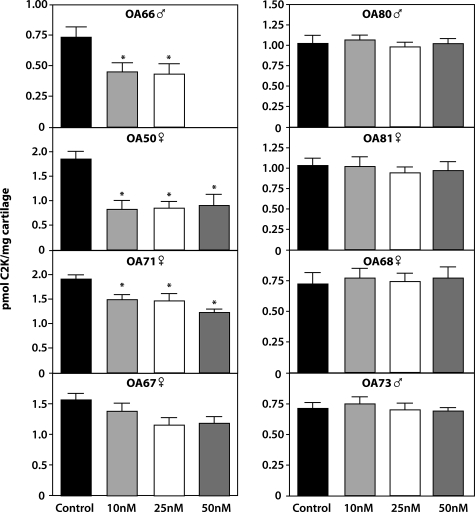
Reduction in the generation of C2K neoepitope by a specific cathepsin K inhibitor. OA explants from eight patients were cultured in the presence and absence of L-873724 inhibitor for 16 days. The content of the C2K neoepitope at the end of the culture was determined by competitive ELISA. The age and gender of each patient is indicated. P values, determined by one-way analysis of variance test and less than 0.05, are considered significant compared to control and are indicated (asterisk).

References

    1. Dodge GR, Poole AR. Immunohistochemical detection and immunochemical analysis of type II collagen degradation in human normal, rheumatoid and osteoarthritic articular cartilages and in explants of bovine articular cartilage cultured with interleukin 1. J Clin Invest. 1989;83:647–661. - PMC - PubMed
    1. Billinghurst RC, Dahlberg L, Ionescu M, Reiner A, Bourne R, Rorabeck C, Mitchell P, Hambor J, Diekmann O, Tschesche H, Chen J, Van Wart H, Poole AR. Enhanced cleavage of type II collagen by collagenases in osteoarthritic articular cartilage. J Clin Invest. 1997;99:1534–1545. - PMC - PubMed
    1. Mitchell PG, Magna HA, Reeves LM, Lopresti-Morrow LL, Yocum SA, Rosner PJ, Geoghegan KF, Hambor JE. Cloning, expression, and type II collagenolytic activity of matrix metalloproteinase-13 from human osteoarthritic cartilage. J Clin Invest. 1996;97:761–768. - PMC - PubMed
    1. Dahlberg L, Billinghurst RC, Manner P, Nelson F, Webb G, Ionescu M, Reiner A, Tanzer M, Zukor D, Chen J, Van Wart HE, Poole AR. Selective enhancement of collagenase-mediated cleavage of resident type II collagen in cultured osteoarthritic cartilage and arrest with a synthetic inhibitor that spares collagenase 1 (matrix metalloproteinase 1). Arthritis Rheum. 2000;43:673–682. - PubMed
    1. Hollander AP, Heathfield TF, Webber C, Iwata Y, Bourne R, Rorabeck C, Poole AR. Increased damage to type II collagen in osteoarthritic articular cartilage detected by a new immunoassay. J Clin Invest. 1994;93:1722–1732. - PMC - PubMed

Publication types

MeSH terms