. 2008 Sep;74(3):736-43.
doi: 10.1124/mol.108.048165. Epub 2008 May 29.

Sulfonylurea receptor-dependent and -independent pathways mediate vasodilation induced by ATP-sensitive K+ channel openers

Affiliations

Sulfonylurea receptor-dependent and -independent pathways mediate vasodilation induced by ATP-sensitive K+ channel openers

Adebowale Adebiyi et al. Mol Pharmacol. 2008 Sep.

Abstract

ATP-sensitive K+ (KATP) channel openers are vasodilators that activate both plasma membrane and mitochondrial KATP channels. Here, we investigated the molecular mechanisms by which diazoxide and pinacidil induce vasodilation by studying diameter regulation of wild-type [SUR2(+/+)] and sulfonylurea receptor (SUR) 2-deficient [SUR2(-/-)] mouse myogenic mesenteric arteries. Ryanodine (10 microM), a ryanodine-sensitive Ca2+ release (RyR) channel blocker; iberiotoxin (100 nM), a large-conductance Ca2+-activated K+ (KCa) channel blocker; 4-aminopyridine (4-AP; 1 mM), a voltage-gated K+ (KV) channel blocker; manganese(III) tetrakis(1-methyl-4-pyridyl)porphyrin (MnTMPyP; 100 microM), an antioxidant; and a combination of ryanodine and 4-AP reduced diazoxide (100 microM)-induced dilation in pressurized (60 mm Hg) SUR2(+/+) arteries by 45 to 77%. In contrast, these inhibitors did not alter pinacidil (5 microM)-induced dilation in SUR2(+/+) arteries. Reverse transcription-polymerase chain reaction indicated that SUR2B was the only SUR isoform expressed in SUR2(+/+) mesenteric artery smooth muscle cells, whereas SURs were absent in SUR2(-/-) cells. In SUR2(-/-) arteries, pinacidil-induced vasodilation was 10% of that in SUR2(+/+) arteries, whereas diazoxide-induced vasodilation was similar in SUR2(+/+) and SUR2(-/-) arteries. Atpenin (1 microM), a selective electron transport chain (ETC) complex II inhibitor, dilated arteries similarly to diazoxide, and this effect was attenuated by MnTMPyP and ryanodine + 4-AP. Atpenin also attenuated diazoxide-, but not pinacidil-induced vasodilation. In summary, data indicate that pinacidil-induced vasodilation requires SUR2B, whereas diazoxide-induced vasodilation does not require SURs. Rather, diazoxide-induced vasodilation involves ETCII inhibition; a smooth muscle cell-reactive oxygen species elevation; and RyR, KCa, and KV channel activation. These data indicate that KATP channel openers regulate arterial diameter via SUR-dependent and -independent pathways.


Figures
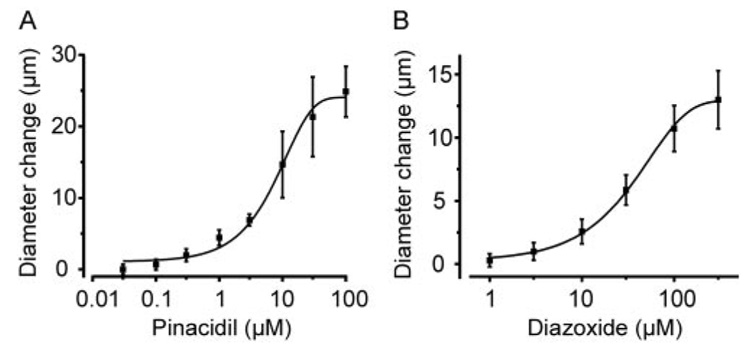
Fig. 1
Fig. 1
Concentration-dependent dilation by pinacidil and diazoxide in pressurized (60 mm Hg) murine mesenteric arteries. Concentration-response effect of pinacidil (n = 8) (A) and diazoxide (n = 6) (B).
Fig. 2
Fig. 2
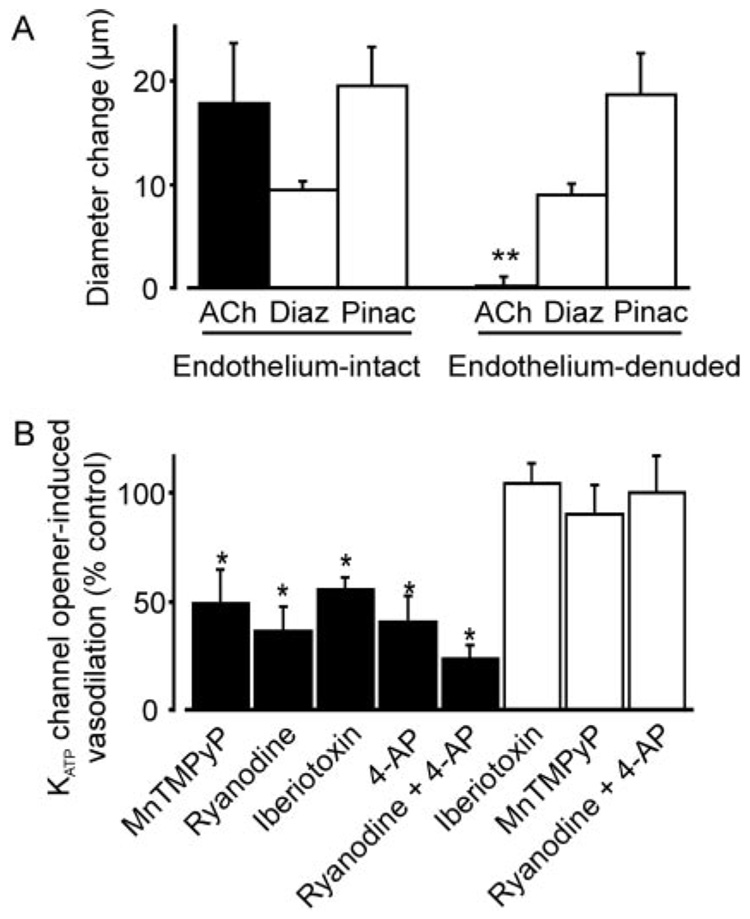
Diazoxide-induced mesenteric artery dilation is endothelium-independent and attenuated by RyR, KCa, and KV channel blockers. A, diameter responses to 10 µM acetylcholine (ACh; n = 7), 100 µM diazoxide (Diaz; endothelium-intact, n = 28 and endothelium-denuded, n = 7), and 5 µM pinacidil (Pinac; endothelium-intact, n = 19 and endothelium-denuded, n = 7) in pressurized (60 mm Hg) mesenteric arteries. B, diameter responses to diazoxide and pinacidil in endothelium-intact arteries. Filled bars illustrate the average effect of 100 µM MnTMPyP (n = 6), 10 µM ryanodine (n = 6), 100 nM iberiotoxin (n = 6), 1 mM 4-AP (n = 6), and ryanodine + 4-AP (n = 7) on dilation induced by 100 µM diazoxide. Empty bars show the mean effects of 100 nM iberiotoxin (n = 6), 100 µM MnTMPyP (n = 7), and ryanodine + 4-AP (n = 7) on dilation induced by 5 µM pinacidil. **, p < 0.05 compared with endothelium-intact arteries; *, p < 0.05 compared with the control.
Fig. 3
Fig. 3
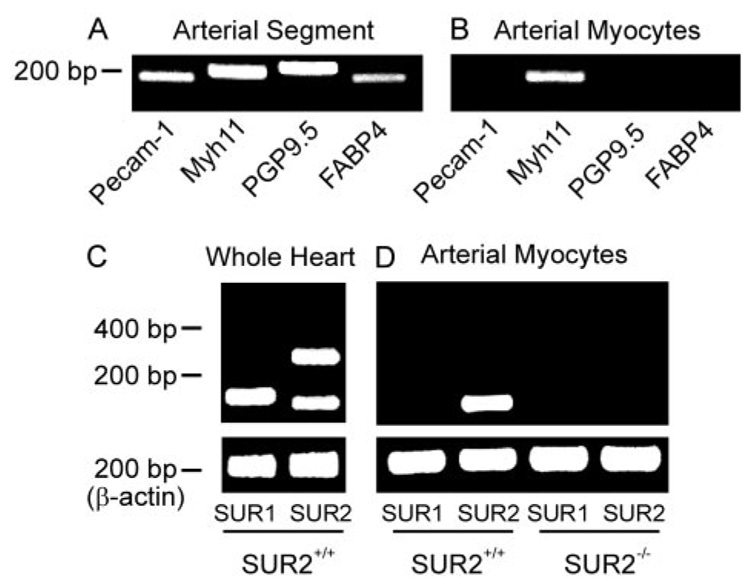
SUR2(+/+) murine mesenteric artery myocytes express SUR2B, whereas SUR2(−/−) myocytes do not express SUR subunits. A, mesenteric artery segments express transcripts for Pecam-1, Myh11, PGP9.5, and FABP4. B, in contrast, isolated, selected mesenteric artery smooth muscle cells only express transcript for Myh11. C, RT-PCR indicates that transcripts for SUR1, SUR2A, and SUR2B are amplified from cDNA generated from wild-type heart lysate (control; n = 4 for each). D, mesenteric artery smooth muscle cells isolated from SUR2(+/+) mice express only SUR2B, whereas mesenteric artery smooth muscle cells from SUR2(−/−) mice do not express any SURs (n = 4 for each). Transcript-specific primers for Pecam-1, Myh11, PGP9.5, FABP4, SUR1, SUR2A, SUR2B, and β-actin generated cDNA fragments of 176, 201, 219, 182, 169, 320, 144, and 208 bp, respectively.
Fig. 4
Fig. 4
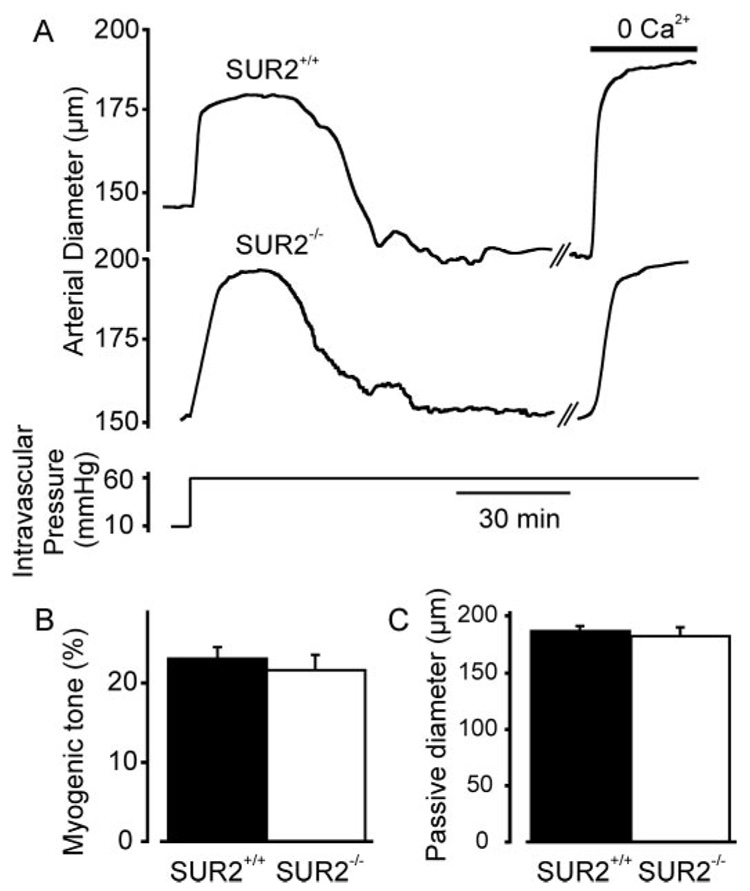
Myogenic response and passive diameter are similar in mesenteric arteries of SUR2(+/+) and SUR2(−/−) mice. A, representative traces illustrating that an elevation in intravascular pressure from 10 to 60 mm Hg induces a similar myogenic constriction in SUR2(+/+) and SUR2(−/−) arteries. B, mean myogenic tone in SUR2(+/+) (n = 49) and SUR2(−/−) arteries (n = 24) pressurized to 60 mm Hg. C, Mean passive diameter of SUR2(+/+) (n = 49) and SUR2(−/−) arteries (n = 24), as determined in a Ca2+-free bath solution.
Fig. 5
Fig. 5
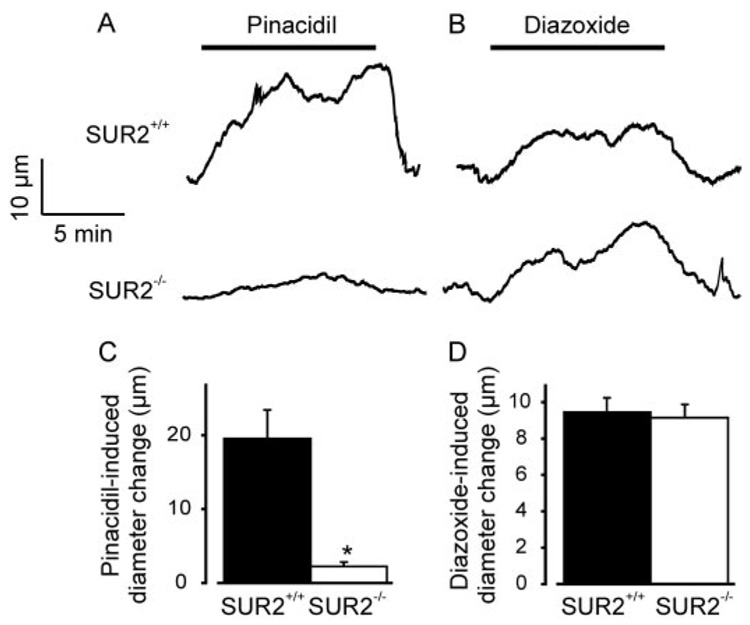
SUR deficiency inhibits pinacidil-induced dilation, but does not alter diazoxide-induced dilation in mesenteric arteries. A and B, representative traces illustrating a pinacidil (5 µM) and diazoxide (100 µM)- induced dilation in SUR2(+/+) and SUR2(−/−) arteries. C and D, mean dilation induced by pinacidil (SUR2(+/+), n = 19; SUR2(−/−), n = 16) and diazoxide (SUR2(+/+), n = 28; SUR2(−/−), n = 15). *, p < 0.05 compared with SUR2(+/+).
Fig. 6
Fig. 6
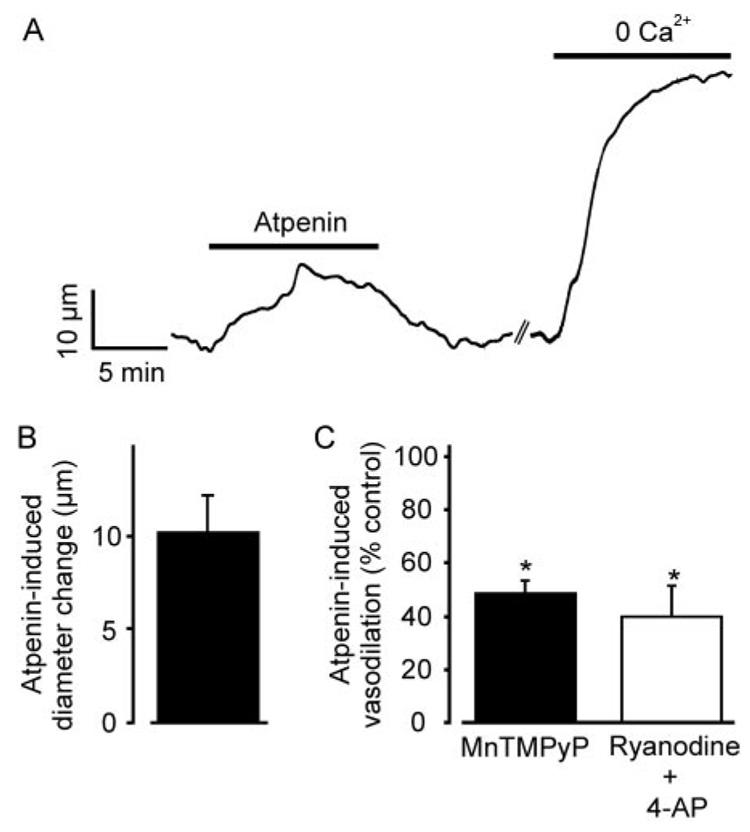
Atpenin, an ETCII inhibitor, dilates pressurized arteries, and this effect is attenuated by MnTMPyP and ryanodine + 4-AP. A, representative trace illustrating atpenin (1 µM)-induced vasodilation and dilation induced by removal of bath Ca2+ in the same artery. B, mean arterial dilation to 1 µM atpenin (n = 10). C, MnTMPyP (100 µM; n = 6) and ryanodine + 4-AP (n = 5) attenuate 1 µMatpenin-induced dilation. *, p < 0.05 compared with the control.
Fig. 7
Fig. 7
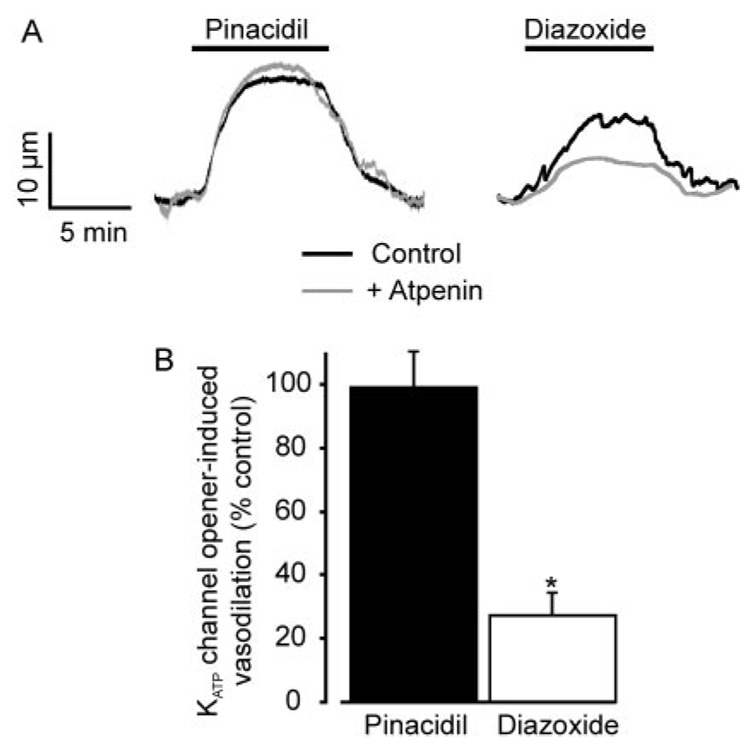
Atpenin reduces diazoxide-, but not pinacidil-induced, vasodilation. A, representative traces illustrating vasodilation to 100 µM diazoxide and 5 µM pinacidil in the same arteries in control (black trace) and in the presence of 1 µM atpenin (gray trace). B, mean effects of atpenin on dilation induced by 100 µM diazoxide (n = 9) and 5 µM pinacidil (n = 7). *, p < 0.05 compared with the control.

References

    1. Aguilar-Bryan L, Clement JP, 4th, Gonzalez G, Kunjilwar K, Babenko A, Bryan J. Toward understanding the assembly and structure of KATP channels. Physiol Rev. 1998;78:227–245. - PubMed
    1. Ardehali H, Chen Z, Ko Y, Mejía-Alvarez R, Marbán E. Multiprotein complex containing succinate dehydrogenase confers mitochondrial ATP-sensitive K+ channel activity. Proc Natl Acad Sci U S A. 2004;101:11880–11885. - PMC - PubMed
    1. Ashcroft SJ, Ashcroft FM. Properties and functions of ATP-sensitive K-channels. Cell Signal. 1990;2:197–214. - PubMed
    1. Babenko AP, Aguilar-Bryan L, Bryan J. A view of Sur/KIR6.X, KATP channels. Annu Rev Physiol. 1998;60:667–687. - PubMed
    1. Bajgar R, Seetharaman S, Kowaltowski AJ, Garlid KD, Paucek P. Identification and properties of a novel intracellular (mitochondrial) ATP-sensitive potassium channel in brain. J Biol Chem. 2001;276:33369–33374. - PubMed

MeSH terms

LinkOut - more resources