Randomized Controlled Trial
. 2008 Sep;34(9):1615-23.
doi: 10.1007/s00134-008-1163-z. Epub 2008 May 30.

Subject-ventilator synchrony during neural versus pneumatically triggered non-invasive helmet ventilation

Affiliations
Randomized Controlled Trial

Subject-ventilator synchrony during neural versus pneumatically triggered non-invasive helmet ventilation

Onnen Moerer et al. Intensive Care Med. 2008 Sep.

Abstract

Objective: Patient-ventilator synchrony during non-invasive pressure support ventilation with the helmet device is often compromised when conventional pneumatic triggering and cycling-off were used. A possible solution to this shortcoming is to replace the pneumatic triggering with neural triggering and cycling-off-using the diaphragm electrical activity (EA(di)). This signal is insensitive to leaks and to the compliance of the ventilator circuit.

Design: Randomized, single-blinded, experimental study.

Setting: University Hospital. PARTICIPANTS AND SUBJECTS: Seven healthy human volunteers.

Interventions: Pneumatic triggering and cycling-off were compared to neural triggering and cycling-off during NIV delivered with the helmet.

Measurements and results: Triggering and cycling-off delays, wasted efforts, and breathing comfort were determined during restricted breathing efforts (<20% of voluntary maximum EA(di)) with various combinations of pressure support (PSV) (5, 10, 20 cm H(2)O) and respiratory rates (10, 20, 30 breath/min). During pneumatic triggering and cycling-off, the subject-ventilator synchrony was progressively more impaired with increasing respiratory rate and levels of PSV (p < 0.001). During neural triggering and cycling-off, effect of increasing respiratory rate and levels of PSV on subject-ventilator synchrony was minimal. Breathing comfort was higher during neural triggering than during pneumatic triggering (p < 0.001).

Conclusions: The present study demonstrates in healthy subjects that subject-ventilator synchrony, trigger effort, and breathing comfort with a helmet interface are considerably less impaired during increasing levels of PSV and respiratory rates with neural triggering and cycling-off, compared to conventional pneumatic triggering and cycling-off.


Figures
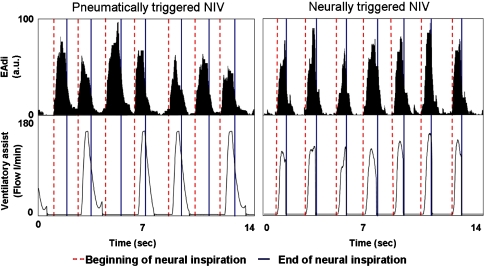
Fig. 1
Fig. 1
Example of diaphragm electrical activity (EAdi), and ventilatory assist during pneumatically (left panel) and neurally (right panel) triggered and cycled-off NIV in one healthy subject breathing with the helmet interface. In this example, respiratory rate was 30 bpm, PSV level was 20 cm H2O. The dashed line shows the start of neural inspiration and the continuous line shows the end of neural inspiration. Note excessive asynchrony during pneumatically triggered and cycled-off NIV
Fig. 2
Fig. 2
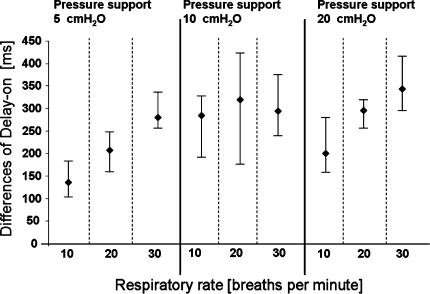
Differences in inspiratory delays (delay time Ptr − delay time Ntr) during NIV with a pressure support of 5, 10 and 20 cm H2O and respiratory rates of 10, 20 and 30 bpm were shown. During all combinations of respiratory rates and pressure support levels, there was a significant difference in inspiratory delays being highly increased during pneumatically triggered NIV. Symbols represent group median values and the bars indicate 25th and 75th percentiles. Delay-on inspiratory delay between the onset of the volunteers’ inspiratory effort and the start of the ventilatory support, P tr pneumatic trigger, N tr neural trigger, NIV non-invasive ventilation
Fig. 3
Fig. 3
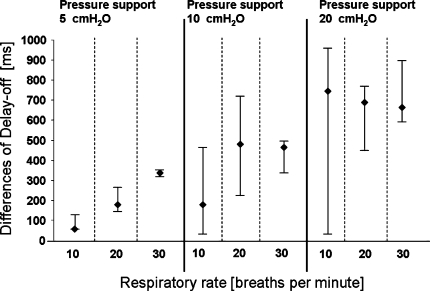
Differences in expiratory delays (delay time Poff − delay time Noff) during NIV with PSV of 5, 10 and 20 cm H2O and respiratory rates of 10, 20 and 30 bpm were shown. During all combinations of respiratory rates and pressure support levels, there was a significant difference in expiratory delays that were highly increased during pneumatically triggered NIV. Symbols represent group median values and the bars indicate 25th and 75th percentiles. Delay-off delay between the onset neural end of inspiration and the end of the ventilatory support, P off pneumatic cycling-off, N off neural cycling-off, NIV non-invasive ventilation
Fig. 4
Fig. 4
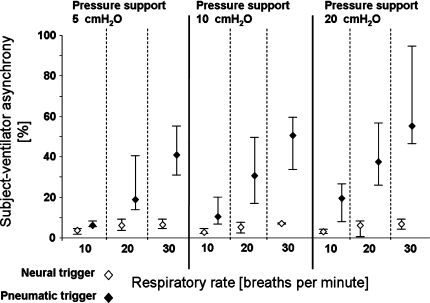
Percentage of asynchrony over the whole breath duration as calculated during Ntr and Ptr NIV: (delay-on + delay-off/neural T tot × 100). Wasted inspiratory efforts were counted as 100% asynchrony. Percentage of asynchrony during Ptr was markedly higher compared to Ntr. Symbols represent group median values and the bars indicate 25th and 75th percentiles. N tr neurally triggered, P tr pneumatically triggered, NIV non-invasive ventilation, PSV pressure support ventilation
Fig. 5
Fig. 5
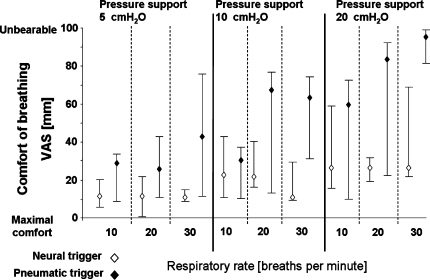
Breathing comfort in mm as assessed by a visual analogue scale during neurally and pneumatically triggered and cycled-off NIV at different levels of assist and respiratory rates (0 very comfortable, 100 unbearable). During all combinations of respiratory rates and PSV levels, comfort of breathing was better during neurally triggered and cycled-off NIV. Symbols represent group median values and the bars indicate 25th and 75th percentiles. NIV non-invasive ventilation, PSV pressure support ventilation, VAS visual analogue scale

Comment in

References

    1. Ferrer M, Valencia M, Nicolas JM, Bernadich O, Badia JR, Torres A. Early noninvasive ventilation averts extubation failure in patients at risk: a randomized trial. Am J Respir Crit Care Med. 2006;173:164–170. doi: 10.1164/rccm.200505-718OC. - DOI - PubMed
    1. Ferrer M, Esquinas A, Arancibia F, Bauer TT, Gonzalez G, Carrillo A, Rodriguez-Roisin R, Torres A. Noninvasive ventilation during persistent weaning failure: a randomized controlled trial. Am J Respir Crit Care Med. 2003;168:70–76. doi: 10.1164/rccm.200209-1074OC. - DOI - PubMed
    1. Carlucci A, Richard JC, Wysocki M, Lepage E, Brochard L. Noninvasive versus conventional mechanical ventilation. An epidemiologic survey. Am J Respir Crit Care Med. 2001;163:874–880. - PubMed
    1. Brochard L, Mancebo J, Wysocki M, Lofaso F, Conti G, Rauss A, Simonneau G, Benito S, Gasparetto A, Lemaire F. Noninvasive ventilation for acute exacerbations of chronic obstructive pulmonary disease. N Engl J Med. 1995;333:817–822. doi: 10.1056/NEJM199509283331301. - DOI - PubMed
    1. Ram FS, Picot J, Lightowler J, Wedzicha JA. Non-invasive positive pressure ventilation for treatment of respiratory failure due to exacerbations of chronic obstructive pulmonary disease. Cochrane Database Syst Rev. 2004;3:CD004104. - PubMed

Publication types