


Cartilage degradation is fully reversible in the presence of aggrecanase but not matrix metalloproteinase activity
- PMID: 18513402
- PMCID: PMC2483454
- DOI: 10.1186/ar2434
Cartilage degradation is fully reversible in the presence of aggrecanase but not matrix metalloproteinase activity
Abstract
Introduction: Physiological and pathophysiological cartilage turnover may coexist in articular cartilage. The distinct enzymatic processes leading to irreversible cartilage damage, compared with those needed for continuous self-repair and regeneration, remain to be identified. We investigated the capacity of repair of chondrocytes by analyzing their ability to initiate an anabolic response subsequent to three different levels of catabolic stimulation.
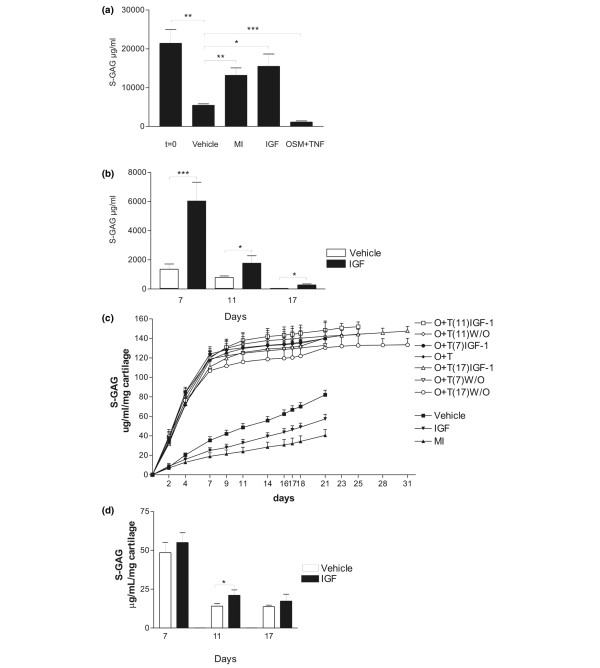
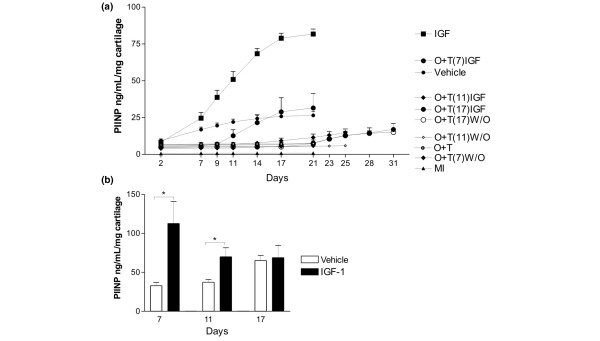
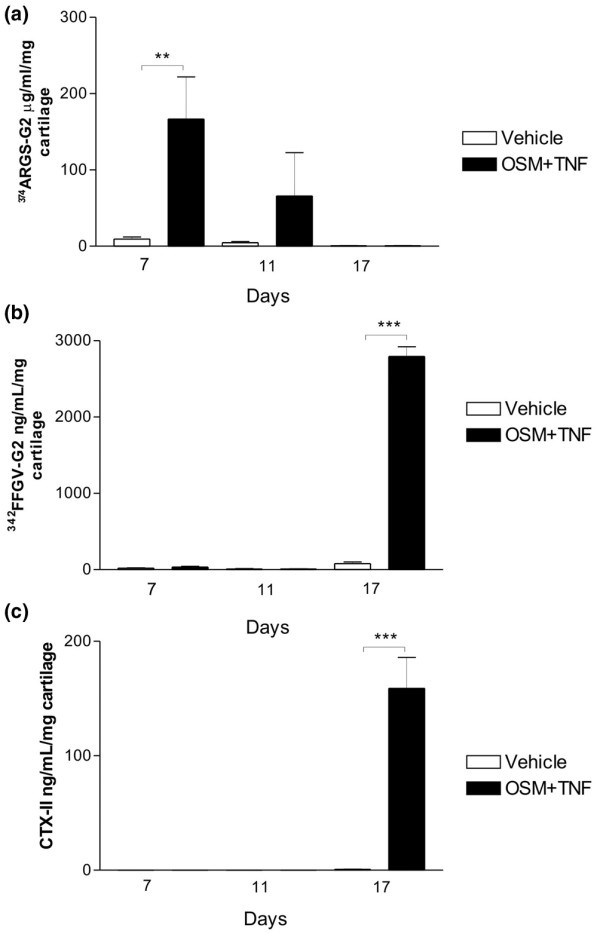
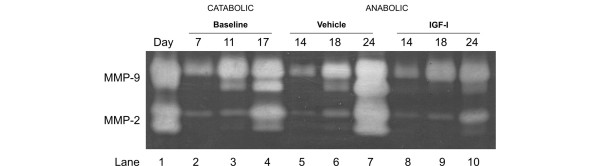
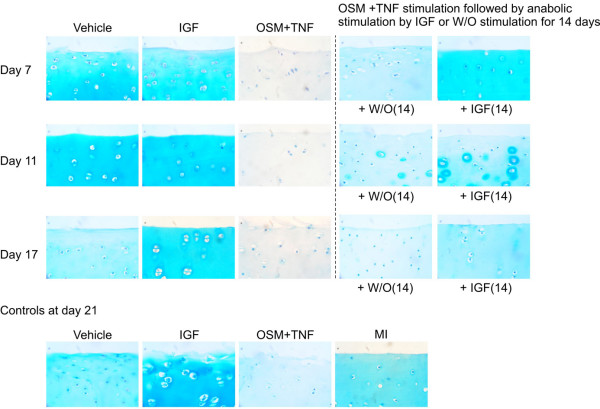
Methods: Cartilage degradation was induced by oncostatin M and tumour necrosis factor in articular cartilage explants for 7, 11, or 17 days. The catabolic period was followed by 2 weeks of anabolic stimulation (insulin growth factor-I). Cartilage formation was assessed by collagen type II formation (PIINP). Cartilage degradation was measured by matrix metalloproteinase (MMP) mediated type II collagen degradation (CTX-II), and MMP and aggrecanase mediated aggrecan degradation by detecting the 342FFGVG and 374ARGSV neoepitopes. Proteoglycan turnover, content, and localization were assessed by Alcian blue.
Results: Catabolic stimulation resulted in increased levels of cartilage degradation, with maximal levels of 374ARGSV (20-fold induction), CTX-II (150-fold induction), and 342FFGVG (30-fold induction) (P < 0.01). Highly distinct protease activities were found with aggrecanase-mediated aggrecan degradation at early stages, whereas MMP-mediated aggrecan and collagen degradation occurred during later stages. Anabolic treatment increased proteoglycan content at all time points (maximally, 250%; P < 0.001). By histology, we found a complete replenishment of glycosaminoglycan at early time points and pericellular localization at an intermediate time point. In contrast, only significantly increased collagen type II formation (200%; P < 0.01) was observed at early time points.
Conclusion: Cartilage degradation was completely reversible in the presence of high levels of aggrecanase-mediated aggrecan degradation. After induction of MMP-mediated aggrecan and collagen type II degradation, the chondrocytes had impaired repair capacity.
Figures
References
-
- van Meurs JB, van Lent PL, Holthuysen AE, Singer II, Bayne EK, Berg WB Van den. Kinetics of aggrecanase- and metalloproteinase-induced neoepitopes in various stages of cartilage destruction in murine arthritis. Arthritis Rheum. 1999;42:1128–1139. doi: 10.1002/1529-0131(199906)42:6<1128::AID-ANR9>3.0.CO;2-2. - DOI - PubMed
-
- Karsdal MA, Henriksen K, Sørensen MG, Gram J, Schaller S, Dziegiel MH, Heegaard AM, Christophersen P, Martin TJ, Christiansen C, Bollerslev J. Acidification of the osteoclastic resorption compartment provides insight into the coupling of bone formation to bone resorption. Am J Pathol. 2005;166:467–476. - PMC - PubMed
Publication types
MeSH terms
Substances
LinkOut - more resources
Full Text Sources
Other Literature Sources
