Case Reports
. 2008 May 30:8:21.
doi: 10.1186/1471-230X-8-21.

Changes in the gastric enteric nervous system and muscle: a case report on two patients with diabetic gastroparesis

Affiliations
Case Reports

Changes in the gastric enteric nervous system and muscle: a case report on two patients with diabetic gastroparesis

Pankaj J Pasricha et al. BMC Gastroenterol. .

Abstract

Background: The pathophysiological basis of diabetic gastroparesis is poorly understood, in large part due to the almost complete lack of data on neuropathological and molecular changes in the stomachs of patients. Experimental models indicate various lesions affecting the vagus, muscle, enteric neurons, interstitial cells of Cajal (ICC) or other cellular components. The aim of this study was to use modern analytical methods to determine morphological and molecular changes in the gastric wall in patients with diabetic gastroparesis.

Methods: Full thickness gastric biopsies were obtained laparoscopically from two gastroparetic patients undergoing surgical intervention and from disease-free areas of control subjects undergoing other forms of gastric surgery. Samples were processed for histological and immunohistochemical examination.

Results: Although both patients had severe refractory symptoms with malnutrition, requiring the placement of a gastric stimulator, one of them had no significant abnormalities as compared with controls. This patient had an abrupt onset of symptoms with a relatively short duration of diabetes that was well controlled. By contrast, the other patient had long standing brittle and poorly controlled diabetes with numerous episodes of diabetic ketoacidosis and frequent hypoglycemic episodes. Histological examination in this patient revealed increased fibrosis in the muscle layers as well as significantly fewer nerve fibers and myenteric neurons as assessed by PGP9.5 staining. Further, significant reduction was seen in staining for neuronal nitric oxide synthase, heme oxygenase-2, tyrosine hydroxylase as well as for c-KIT.

Conclusion: We conclude that poor metabolic control is associated with significant pathological changes in the gastric wall that affect all major components including muscle, neurons and ICC. Severe symptoms can occur in the absence of these changes, however and may reflect vagal, central or hormonal influences. Gastroparesis is therefore likely to be a heterogeneous disorder. Careful molecular and pathological analysis may allow more precise phenotypic differentiation and shed insight into the underlying mechanisms as well as identify novel therapeutic targets.


Figures
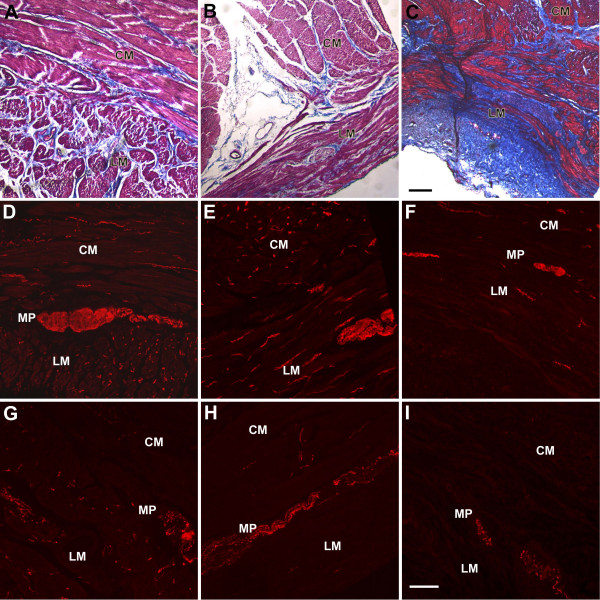
Figure 1
Figure 1
Staining for fibrosis and for neuronal structures. Panels A-C. Trichrome staining. The control (A) and sections from case 1 (B) showed no increase in fibrosis, whereas sections from case 2 (C) showed an increase in fibrosis in both muscle layers and along the myenteric plexus. Scale bar 200 μm. Panels D-F. PGP 9.5 immunoreactivity. PGP9.5 immunoreactivity as a marker for neuronal structures was normal in control (D) and in case 1 (E). There was a decrease in PGP 9.5 immunoreactivity in both the muscle layers and the myenteric plexus in sections from case 2 (F) suggesting a loss of neuronal structures. Panels G-I. Tyrosine hydroxylase immunoreactivity. Tyrosine hydroxylase immunoreactivity was normal in the control (G). Sections from case 1 (H) showing normal tyrosine hydroxylase immunoreactivity around the myenteric plexus with a lsight decrease in tyrosine hydroxylase immunoreactivity in the muscle layers. Sections from case 2 (I) showed a marked loss of tyrosine hydroxylase immunoreactivity in all regions suggesting a loss of extrinsic nerve fibers. Scale bar 100 μm. Circular muscle (CM), myenteric plexus (MP), longitudinal muscle (LM).
Figure 2
Figure 2
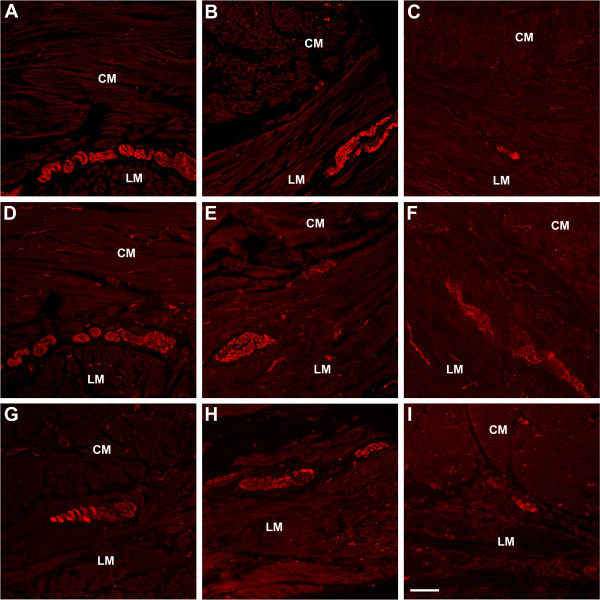
Immunoreactiivty for nNOS, SP and HO2 as markers for inhibitory and excitatory nerve cell bodies and fibers. Panels A-C. Normal immunoreactivity for nNOS in control (A) and case 1 (B). nNOS immunoreactivity was markedly decreased in case 2 (C). Panels D-F. Substance P expression was normal in control (D), case 1 (E), and case 2 (F). Panels G-I. Heme Oxygenase II (HO-2) immunoreactivity was normal in control (G) and case 1 (H). Sections from Case 2 (I) showed a loss of HO-2 immunoreactivity which together with the decrease in nNOS immunoreactivty suggests a loss of inhibitory input ot smooth muscle. Scale bar 100 μm. Circular muscle (CM), longitudinal muscle (LM).
Figure 3
Figure 3
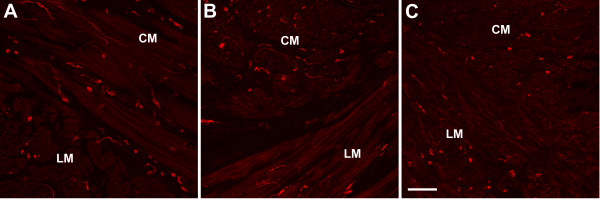
c-Kit expression as a marker for interstitial cells of Cajal. Control (A) and case 1 (B) showed normal c-Kit immunoreactivity while in case 2 (C) there was a loss of c-Kit immunoreactivity suggesting a decreased number of ICC. Scale bar 100 μm. Circular muscle (CM), longitudinal muscle (LM).

References

    1. Parkman HP, Hasler WL, Fisher RS. American Gastroenterological Association medical position statement: diagnosis and treatment of gastroparesis. Gastroenterology. 2004;127:1589–1591. doi: 10.1053/j.gastro.2004.09.054. - DOI - PubMed
    1. Vittal H, Farrugia G, Gomez G, Pasricha PJ. Mechanisms of disease: the pathological basis of gastroparesis–a review of experimental and clinical studies. Nat Clin Pract Gastroenterol Hepatol. 2007;4:336–346. doi: 10.1038/ncpgasthep0838. - DOI - PubMed
    1. Xue L, Farrugia G, Miller SM, Ferris CD, Snyder SH, Szurszewski JH. Carbon monoxide and nitric oxide as coneurotransmitters in the enteric nervous system: evidence from genomic deletion of biosynthetic enzymes. Proc Natl Acad Sci USA. 2000;97:1851–1855. doi: 10.1073/pnas.97.4.1851. - DOI - PMC - PubMed
    1. Farrugia G, Lei S, Lin X, Miller SM, Nath KA, Ferris CD, Levitt M, Szurszewski JH. A major role for carbon monoxide as an endogenous hyperpolarizing factor in the gastrointestinal tract. Proc Natl Acad Sci USA. 2003;100:8567–8570. doi: 10.1073/pnas.1431233100. - DOI - PMC - PubMed
    1. Rundles RW. Diabetic neuropathy. Bull N Y Acad Med. 1950;26:598–616. - PMC - PubMed

Publication types