. 2008 Jul;36(12):3950-5.
doi: 10.1093/nar/gkn339. Epub 2008 May 30.

The Escherichia coli RutR transcription factor binds at targets within genes as well as intergenic regions

Affiliations

The Escherichia coli RutR transcription factor binds at targets within genes as well as intergenic regions

Tomohiro Shimada et al. Nucleic Acids Res. 2008 Jul.

Abstract

The Escherichia coli RutR protein is the master regulator of genes involved in pyrimidine catabolism. Here we have used chromatin immunoprecipitation in combination with DNA microarrays to measure the binding of RutR across the chromosome of exponentially growing E. coli cells. Twenty RutR-binding targets were identified and analysis of these targets generated a DNA consensus logo for RutR binding. Complementary in vitro binding assays showed high-affinity RutR binding to 16 of the 20 targets, with the four low-affinity RutR targets lacking predicted key binding determinants. Surprisingly, most of the DNA targets for RutR are located within coding segments of the genome and appear to have little or no effect on transcript levels in the conditions tested. This contrasts sharply with other E. coli transcription factors whose binding sites are primarily located in intergenic regions. We suggest that either RutR has yet undiscovered function or that evolution has been slow to eliminate non-functional DNA sites for RutR because they do not have an adverse effect on cell fitness.


Figures

Figure 1.
Figure 1.
Distribution of RutR binding across the E. coli chromosome. (A) The figure shows an overview of results from ChIP-chip experiments that measure the profile of RutR binding across the E. coli chromosome during exponential growth in the absence of added uracil. Binding signals (y-axis) are plotted against their location on the 4.64 Mbp E. coli chromosome (x-axis). The locations of selected signals are lablelled. A complete list of the targets is presented in Table 1. Data shown in all panels are average values from replicate experiments. (B) The figure shows RutR binding to intergenic segments of the chromosome in either the absence (blue) or presence (red) of added uracil. (C) The figure shows RutR binding to coding segments of the chromosome in either the absence (blue) or presence (red) of added uracil.
Figure 2.
Figure 2.
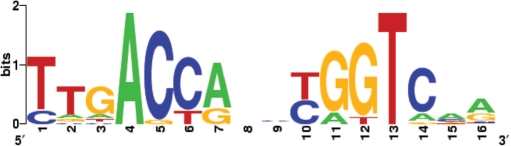
The RutR-binding site DNA sequence logo. The sequence logo was generated by aligning binding sites identified by ChIP-chip.
Figure 3.
Figure 3.
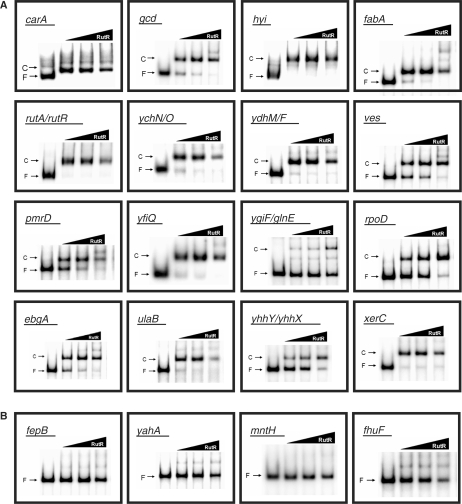
Binding of RutR to its DNA targets in vitro. The figure shows the results of electrophoretic mobility shift assays in which the binding of RutR (10, 25 or 50 nM) to purified end-labelled PCR products was measured in vitro. Free DNA fragments (F) and RutR–DNA complexes (C) are labelled. High-affinity targets are shown in (A) and low-affinity targets are shown in (B).
Figure 4.
Figure 4.
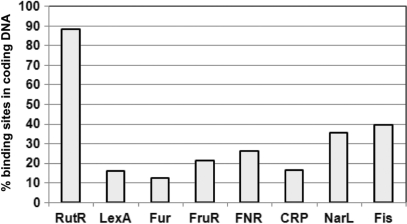
Distribution of sites for global DNA-binding proteins between coding and non-coding DNA in the E. coli chromosome. Using equally stringent search conditions for each factor, we screened the E. coli MG1655 genome for DNA sequences that resembled the DNA-binding sites of RutR, LexA, Fur, FruR, FNR, CRP, NarL and Fis. The results show that, while predicted high-affinity-binding sites for most factors are found in non-coding DNA, most sequences resembling the RutR-binding site were found in coding DNA.

References

    1. Babu MM, Teichmann SA. Evolution of transcription factors and the gene regulatory network in Escherichia coli. Nucleic Acids Res. 2003;31:1234–1244. - PMC - PubMed
    1. Martinez-Antonio A, Collado-Vides J. Indentifying global regulators in transcriptional regulatory networks in bacteria. Curr. Opin. Microbiol. 2003;6:482–489. - PubMed
    1. Browning DF, Busby SJW. The regulation of bacterial transcription initiation. Nat. Rev. Microbiol. 2004;2:57–65. - PubMed
    1. Loh DK, Gyaneshwar P, Papadimitriou EM, Fong R, Kim K-S, Parales R, Zhou Z, Inwood W, Kustu S. A previously undescribed pathway for pyrimidine catabolism. Proc. Natl Acad. Sci. USA. 2006;103:5144–5199. - PMC - PubMed
    1. Shimada T, Hirao K, Kori A, Yamamoto K, Ishihama A. RutR is the uracil/thymine-sensing master regulator of a set of genes for synthesis and degradation of pyrimidines. Mol. Microbiol. 2007;66:744–757. - PubMed

Publication types

MeSH terms