. 2008 Aug;190(15):5279-90.
doi: 10.1128/JB.00100-08. Epub 2008 May 30.

The Campylobacter jejuni thiol peroxidases Tpx and Bcp both contribute to aerotolerance and peroxide-mediated stress resistance but have distinct substrate specificities

Affiliations

The Campylobacter jejuni thiol peroxidases Tpx and Bcp both contribute to aerotolerance and peroxide-mediated stress resistance but have distinct substrate specificities

John M Atack et al. J Bacteriol. 2008 Aug.

Abstract

The microaerophilic food-borne pathogen Campylobacter jejuni experiences variable oxygen concentrations during its life cycle, especially during transitions between the external environment and the avian or mammalian gut. Single knockout mutations in either one of two related thiol peroxidase genes, tpx and bcp, resulted in normal microaerobic growth (10% [vol/vol] oxygen) but poorer growth than that of the wild type under high-aeration conditions (21% [vol/vol] oxygen). However, a tpx/bcp double mutant had a severe microaerobic growth defect and did not grow at high aeration in shake flasks. Although the single mutant strains were no more sensitive than the wild-type strains in disc diffusion assays with hydrogen peroxide, organic peroxides, superoxide, or nitrosative stress agents, in all cases the double mutant was hypersensitive. Quantitative cell viability and cellular lipid peroxidation assays indicated some increased sensitivity of the single tpx and bcp mutants to peroxide stress. Protein carbonylation studies revealed that the tpx/bcp double mutant had a higher degree of oxygen- and peroxide-induced oxidative protein damage than did either of the single mutants. An analysis of the peroxidase activity of the purified recombinant enzymes showed that, surprisingly, Tpx reduced only hydrogen peroxide as substrate, whereas Bcp also reduced organic peroxides. Immunoblotting of wild-type cell extracts with Tpx- or Bcp-specific antibodies showed increased abundance of both proteins under high aeration compared to that under microaerobic growth conditions. Taken together, the results suggest that Tpx and Bcp are partially redundant antioxidant enzymes that play an important role in protection of C. jejuni against oxygen-induced oxidative stress.


Figures
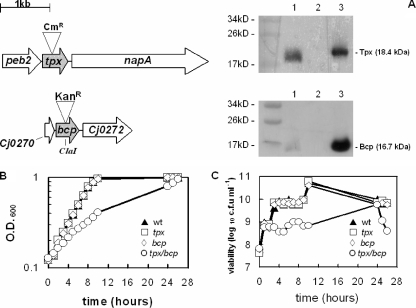
FIG. 1.
FIG. 1.
Growth phenotypes of tpx and bcp mutants. (A) Mutation strategy for the tpx and bcp genes of C. jejuni NCTC 11168 and the loss of Tpx and Bcp proteins in the respective mutants, as shown by immunoblotting with anti-Tpx antibodies (upper blot) or anti-Bcp antibodies (lower blot). Lane 1 contains wild-type CE, and lane 2 contains CE from either the tpx (upper blot) or the bcp (lower blot) mutant. Lane 3 contains purified Tpx (upper blot) or Bcp (lower blot). (B) Growth curve of the wild-type (wt) and tpx, bcp, and tpx/bcp mutant strains under microaerobic conditions. (C) Viable counts corresponding to the growth curve in panel B.
FIG. 2.
FIG. 2.
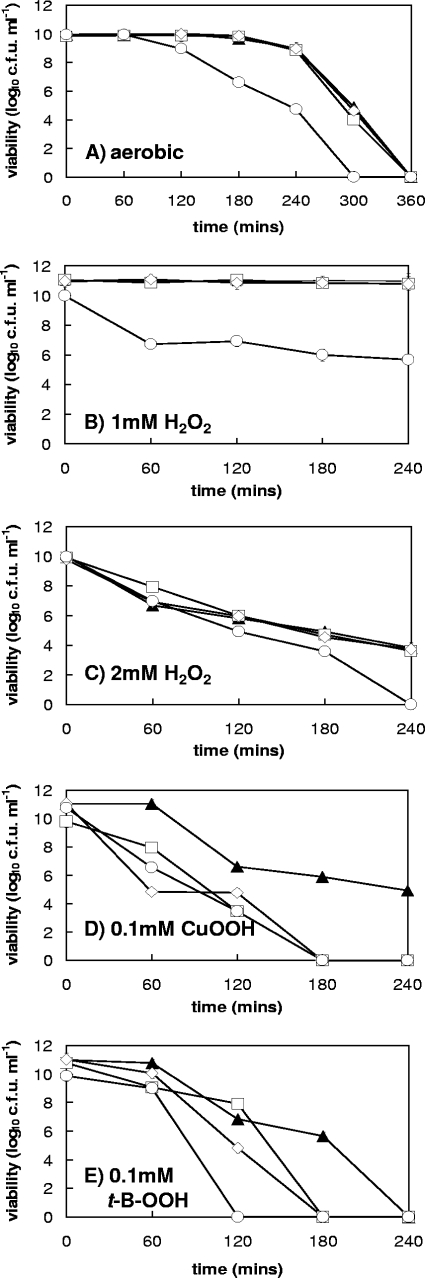
Effect of oxidative stress on the viability of early-stationary-phase cells. Strains were grown overnight in BHI-FBS, and viable counts were determined in triplicate on individual cell suspensions after the initial OD600 was adjusted to approximately 1.0, as described in Materials and Methods. In most cases error bars are too small to be seen. (A) Aerobic conditions; (B) 1 mM hydrogen peroxide; (C) 2 mM hydrogen peroxide; (D) 0.1 mM cumene hydroperoxide; (E) 0.1 mM tert-butyl-hydroperoxide. Symbols: closed triangles, wild type; open squares, tpx mutant; open diamonds, bcp mutant; open circles, tpx/bcp mutant. The data shown are from one representative experiment, but it was repeated twice with similar results.
FIG. 3.
FIG. 3.
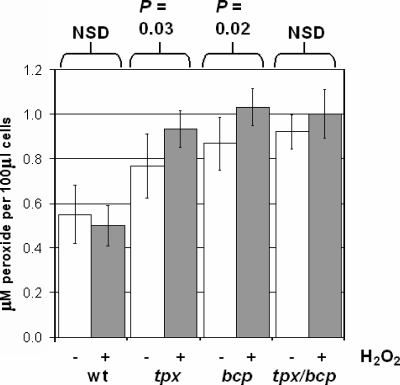
tpx and bcp mutants have increased lipid peroxide contents. Lipid peroxide contents of wild-type (wt) C. jejuni NCTC 11168 and the three mutant strains were determined under unstressed (white bars) and 1 mM hydrogen peroxide-stressed (gray bars) conditions. Cells were grown to early stationary phase, and lipid peroxide contents were measured using the FOX II reagent as described in Materials and Methods. NSD, no significant difference.
FIG. 4.
FIG. 4.
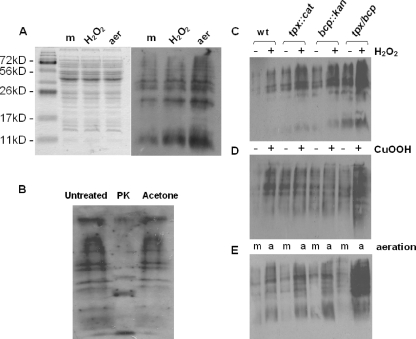
Effect of tpx and bcp mutations on protein carbonyl content. (A) Relative levels of protein carbonylation in wild-type cells grown microaerobically to early stationary phase with no further treatment (m), exposed to 1 mM hydrogen peroxide for a further 2 h (H2O2), or incubated with vigorous shaking at high aeration (21% [vol/vol] oxygen) for 2 h (aer). (Left panel) Coomassie blue-stained 12% (wt/vol) SDS-polyacrylamide gel containing equivalent amounts of wild-type CE protein. (Right panel) Corresponding immunoblot with anti-DNP antibodies. (B) Control immunoblot assay to confirm that the detected bands are carbonylated proteins. Aliquots of a CE from aerated cells were either left untreated, incubated with 200 μg ml−1 proteinase K (PK) at 37°C for 16 h, or treated with 2 volumes of −20°C acetone to precipitate protein and remove lipid. Samples were then derivatized as described in Materials and Methods, and equal loadings were applied to a 12% (wt/vol) SDS-polyacrylamide gel and immunoblotted with anti-DNP antibodies. (C to E) Levels of protein carbonylation detected on anti-DNP immunoblots in wild-type (wt) and mutant strains in the presence (+) and absence (−) of 1 mM hydrogen peroxide (C) or 0.1 mM cumene hydroperoxide (D) or after growth at high aeration (E), under 21% (vol/vol) oxygen (a) versus microaerobically (m).
FIG. 5.
FIG. 5.
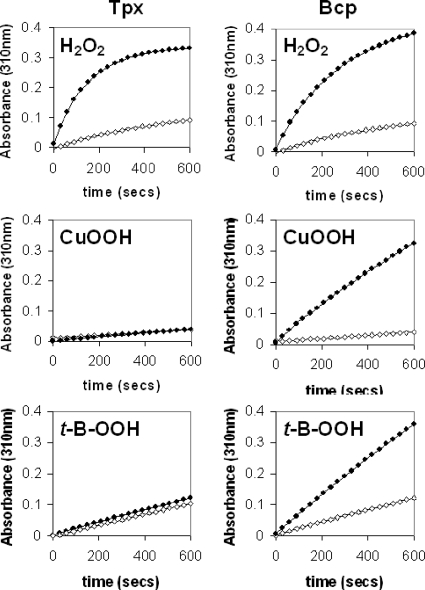
Peroxidase activities of purified enzymes using DTT as reductant. Each panel is an absorbance time course at 310 nm (due to oxidized DTT) in the absence (open symbols) or the presence (closed symbols) of the peroxide substrate shown, using purified Tpx (left column) or Bcp (right column). The reaction mixture contained 50 mM HEPES-NaOH (pH 7.0), 1 mM EDTA, 1 μM pure Tpx or Bcp, 2 mM DTT, and 2 mM peroxide (hydrogen peroxide, cumene hydroperoxide, or tert-butyl-hydroperoxide) in a total volume of 1 ml at 37°C. The reaction was started by the addition of the substrate. All buffers and water used were Chelex treated per the manufacturer's instructions (Sigma) to minimize nonspecific DTT oxidation.
FIG. 6.
FIG. 6.
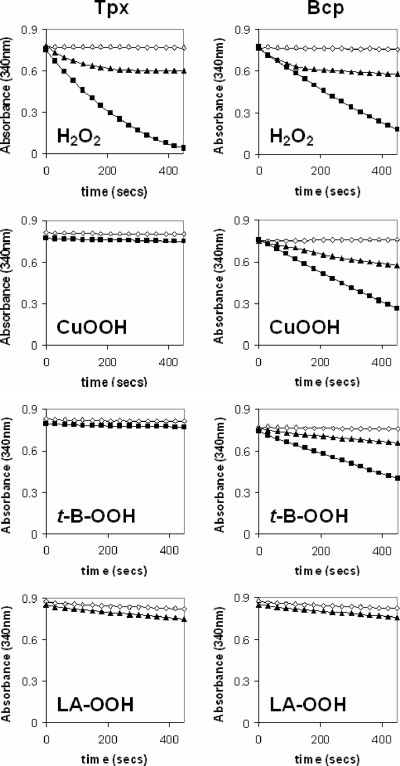
Peroxidase activities of purified enzymes using the thioredoxin system as reductant. Each panel is an absorbance time course at 340 nm (due to NADPH oxidation) in the absence (open diamonds) or the presence (closed symbols) of the peroxide substrate shown, using purified Tpx (left column) or Bcp (right column). The reaction mixture contained 50 mM HEPES-NaOH (pH 7.0), 20 μM NADPH, 20 μg E. coli Trx, 6.25 μg E. coli TrxR, 1 μM pure thiol peroxidase enzyme (Tpx or Bcp), and either 20 μM (closed triangles) or 100 μM (closed squares) peroxide substrate. Reactions were carried out in a total volume of 1 ml at 37°C. The reaction was started by the addition of NADPH. LA, linoleic acid.
FIG. 7.
FIG. 7.
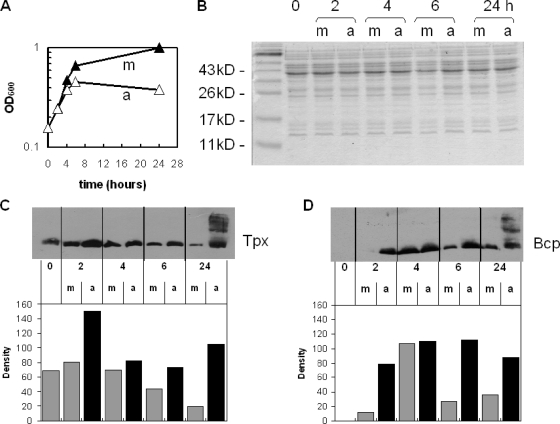
Effect of oxygen on the synthesis of Tpx and Bcp in wild-type cells. (A) Growth curves of microaerobically (m; closed triangles) and aerobically (a; open triangles) grown wild-type C. jejuni used to measure Tpx and Bcp expression. (B) Coomassie blue-stained SDS-polyacrylamide gel showing normalized protein loadings of CEs from each time point for microaerobic (m) and aerobic (a) cells. (C and D) Immunoblots (upper panels) and corresponding densitometry histograms (lower panels; arbitrary units) of gels identical to panel B, using anti-Tpx (C) or anti-Bcp (D) as the primary antibody. Note that for the 24-h samples only the density of the major Tpx or Bcp band was measured.
FIG. 8.
FIG. 8.
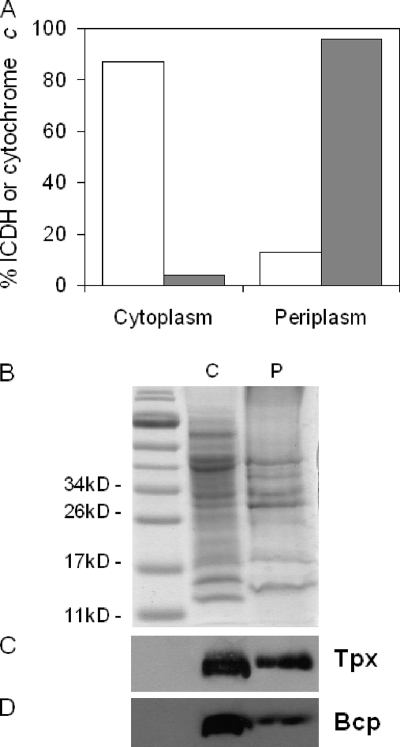
Cellular location of Tpx and Bcp proteins in C. jejuni. (A) Distribution of marker proteins in cytoplasm and periplasm after fractionation of wild-type C. jejuni cells according to the method of Sommerlad and Hendrixson (37). Open bars represent the activity of the cytoplasmic enzyme ICDH, and gray bars represent cytochrome c content determined spectroscopically at 550 nm after dithionite reduction (24). (B) Coomassie blue-stained 12% (wt/vol) SDS-polyacrylamide gel showing normalized loadings of cytoplasm (C) and periplasm (P). (C) Immunoblot assay of an identical gel using anti-Tpx antibodies. (D) Immunoblot assay using anti-Bcp antibodies.

References

    1. Atack, J. M., and D. J. Kelly. 2006. Structure, mechanism and physiological roles of bacterial cytochrome c peroxidases. Adv. Microb. Physiol. 5273-106. - PubMed
    1. Baillon, M.-L. A., A. H. M. van Vliet, J. M. Ketley, C. Constantinidou, and C. W. Penn. 1999. An iron-regulated alkyl hydroperoxide reductase (AhpC) confers aerotolerance and oxidative stress resistance to the microaerophilic pathogen Campylobacter jejuni. J. Bacteriol. 1814798-4804. - PMC - PubMed
    1. Bryk, R., P. Griffin, and C. Nathan. 2000. Peroxynitrite reductase activity of bacterial peroxiredoxins. Nature 407211-215. - PubMed
    1. Cha, M., H. Kim, and I. Kim. 1995. Thioredoxin-linked “thiol peroxidase” from periplasmic space of Escherichia coli. J. Biol. Chem. 27028635-28641. - PubMed
    1. Cha, M., H. Kim, and I. Kim. 1996. Mutation and mutagenesis of thiol peroxidase of Escherichia coli and a new type of thiol peroxidase family. J. Bacteriol. 1785610-5614. - PMC - PubMed

Publication types

MeSH terms

LinkOut - more resources