


In vitro study of the effect of cationic biocides on bacterial population dynamics and susceptibility
- PMID: 18515475
- PMCID: PMC2519354
- DOI: 10.1128/AEM.00573-08
In vitro study of the effect of cationic biocides on bacterial population dynamics and susceptibility
Abstract
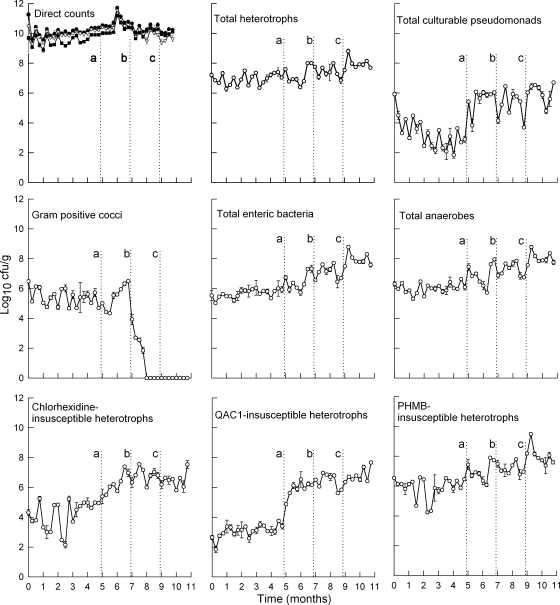
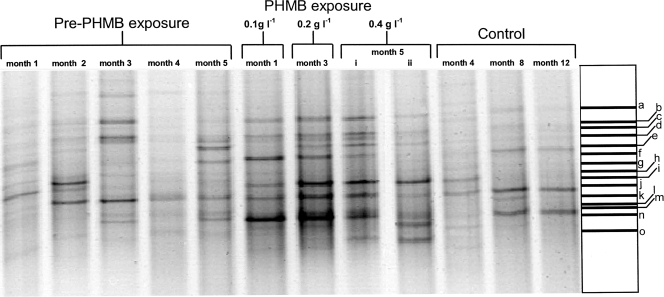
Cationic biocides (CBs) are widely used in domestic and public hygiene and to control biofouling and microbial contamination in industry. The increased use of biocides has led to concern regarding possible reductions in biocide effectiveness. Domestic drain microcosms were stabilized for 5 months and then exposed to polyhexamethylene biguanide (PHMB) at 0.1, 0.2, and 0.4g liter(-1) over 6 months and characterized throughout by differential culture, together with eubacterial-specific PCR-denaturing gradient gel electrophoresis. Additionally, MICs and minimal bactericidal concentrations (MBCs) for bacteria previously isolated from a domestic drain (n = 18) and the human skin (n = 13) were determined before, during, and after escalating, sublethal exposure (14 passages) to two quaternary ammonium compounds (QAC1 and QAC2), the bisbiguanide chlorhexidine (CHX), and PHMB. Exposure of the drain microcosm to PHMB did not decrease the total viable count although significant (P < 0.01) decreases in recovery were observed for the gram-positive cocci with associated clonal expansion of pseudomonads (from ca. 0.1% of the population to ca. 10%). This clonal expansion was also manifested as elevations in bacteria that could grow in the presence of PHMB, CHX, and QAC1. Decreases in susceptibility (greater than twofold) occurred for 10/31 of the test bacteria for QAC1, 14/31 for QAC2, 10/31 for CHX, and 7/31 for PHMB. Exposure of microcosms to PHMB targeted gram-positive species and caused the clonal expansion of pseudomonads. In terms of prolonged-sublethal passage on CBs, exposure to all the biocides tested resulted in susceptibility decreases for a proportion of test bacteria, but refractory clones were not generated.
Figures
References
-
- Allen, M. J., G. F. White, and A. P. Morby. 2006. The response of Escherichia coli to exposure to the biocide polyhexamethylene biguanide. Microbiology 152:989-1000. - PubMed
-
- Brown, M. R., W. M. Watkins, and J. H. Foster. 1969. Step-wise resistance to polymyxin and other agents by Pseudomonas aeruginosa. J. Gen. Microbiol. 55:17-18. - PubMed
-
- Broxton, P., P. M. Woodcock, F. Heatley, and P. Gilbert. 1984. Interaction of some polyhexamethylene biguanides and membrane phospholipids in Escherichia coli. J. Appl. Bacteriol. 57:115-124. - PubMed
-
- Bruinsma, G. M., M. Rustema-Abbing, H. C. van der Mei, C. Lakkis, and H. J. Busscher. 30 January 2006. Resistance to a polyquaternium-1 lens care solution and isoelectric points of Pseudomonas aeruginosa strains. J. Antimicrob. Chemother. 57:764-766. [Epub ahead of print.] - PubMed
MeSH terms
Substances
LinkOut - more resources
Full Text Sources
Other Literature Sources
