. 2008 Jun;14(6):667-75.
doi: 10.1038/nm1775. Epub 2008 Jun 1.

Leptin controls adipose tissue lipogenesis via central, STAT3-independent mechanisms

Affiliations

Leptin controls adipose tissue lipogenesis via central, STAT3-independent mechanisms

Christoph Buettner et al. Nat Med. 2008 Jun.

Abstract

Leptin (encoded by Lep) controls body weight by regulating food intake and fuel partitioning. Obesity is characterized by leptin resistance and increased endocannabinoid tone. Here we show that leptin infused into the mediobasal hypothalamus (MBH) of rats inhibits white adipose tissue (WAT) lipogenesis, which occurs independently of signal transducer and activator of transcription-3 (STAT3) signaling. Correspondingly, transgenic inactivation of STAT3 signaling by mutation of the leptin receptor (s/s mice) leads to reduced adipose mass compared to db/db mice (complete abrogation of leptin receptor signaling). Conversely, the ability of hypothalamic leptin to suppress WAT lipogenesis in rats is lost when hypothalamic phosphoinositide 3-kinase signaling is prevented or when sympathetic denervation of adipose tissue is performed. MBH leptin suppresses the endocannabinoid anandamide in WAT, and, when this suppression of endocannabinoid tone is prevented by systemic CB1 receptor activation, MBH leptin fails to suppress WAT lipogenesis. These data suggest that the increased endocannabinoid tone observed in obesity is linked to a failure of central leptin signaling to restrain peripheral endocannabinoids.


Figures
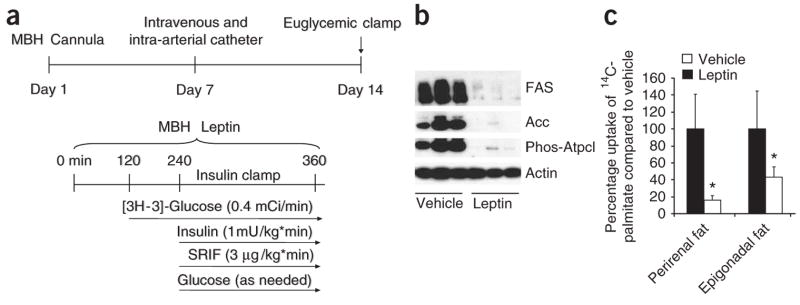
Figure 1
Figure 1
MBH leptin regulates adipose tissue lipogenesis. (a) Experimental protocol for catheter implantation and euglycemic clamp studies. To control for circulating glucose and insulin concentrations, rats underwent pancreatic basal-insulin clamp studies during a 6-h infusion of MBH leptin. (b) Protein expression of key lipogenic enzymes and the activation state of Atpcl, as assessed by a phosphospecific antibody, are reduced by MBH infusion of leptin. (c) 14C-palmitate incorporation is suppressed by MBH leptin in two different visceral WAT depots: the perirenal and epigonadal fat depots. *P < 0.05 versus MBH vehicle–treated group.
Figure 2
Figure 2
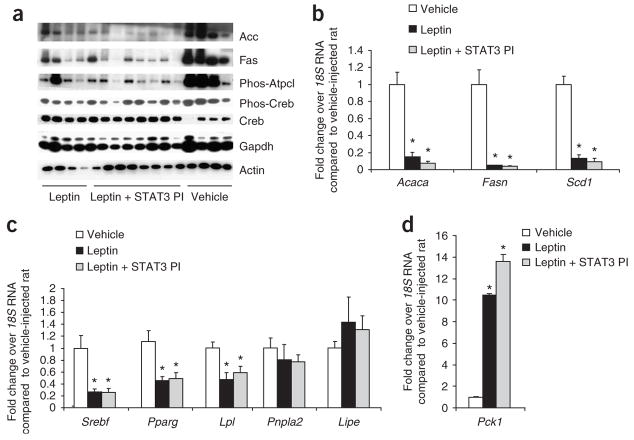
The regulation of adipose tissue lipogenesis by MBH leptin is STAT3 independent. (a) Western blot analysis of WAT protein extracts derived from clamped rats. (b) Fold change in mRNA levels of the SREBP1c gene targets Acaca, Fasn and Scd1 after treatment with leptin, leptin plus STAT3 PI or a vehicle control in WAT as determined by real-time PCR. mRNA levels of each gene were normalized to their respective18S RNA levels and then normalized again to the level of the vehicle control. (c,d) Fold change in mRNA levels in WAT after treatment with leptin, leptin plus STAT3 PI or a vehicle control of Srebf, Pparg and its target gene Lpl and the lipases Pnpla2 and Lipe (c) and of Pck, the rate-limiting enzyme of glyceroneogenesis (d). *P < 0.05 versus MBH vehicle–treated group.
Figure 3
Figure 3
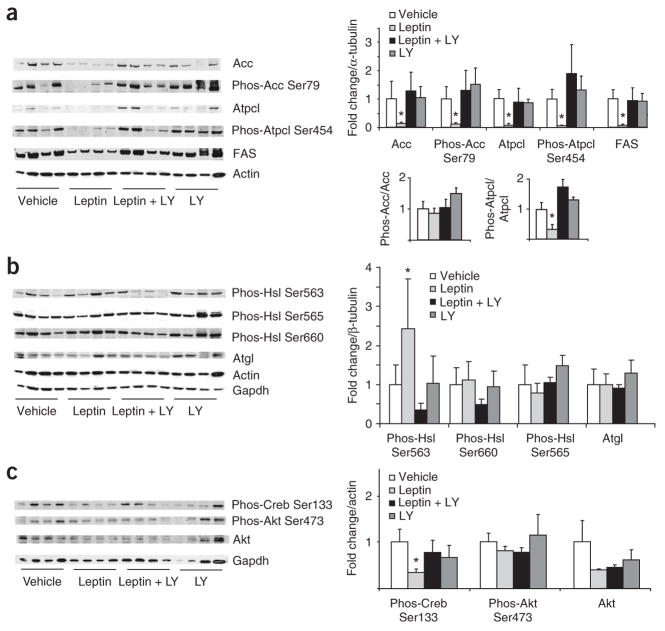
PI3K signaling is required for the central effects of leptin on WAT metabolism. (a) Left, western blot analysis of WAT lysates from rats that received 4-h MBH infusions of either vehicle, leptin, leptin plus the PI3K inhibitor LY294002 (LY) or LY294002 alone. Right, quantification of the infrared scanned images normalized over α-tubulin and expressed as fold change compared to vehicle. Lower right, phospho-Acc is normalized to total Acc and phospho Atpcl is normalized to total Atpcl. (b) Left, western blot analyses of the indicated Hsl phosphorylations, Atgl and the two housekeeping genes actin and Gapdh. Right, the corresponding quantification of the western blot data normalized over alpha tubulin and expressed as fold change compared to vehicle. (c) Left, western blot analysis of Creb and Akt activation, as assessed by phosphospecific antibodies. Right, quantification of western blot analysis. *P < 0.05 versus MBH vehicle–treated group.
Figure 4
Figure 4
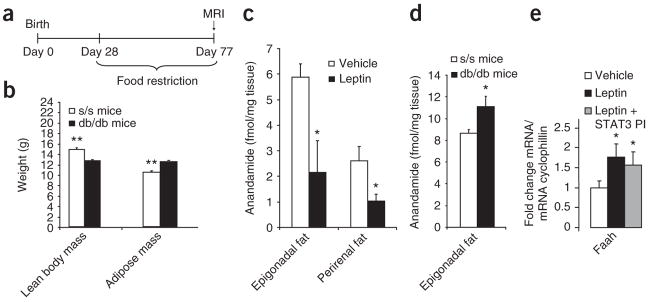
Leptin regulates adiposity and WAT anadamide independently of Stat3 signaling. (a) Experimental protocol for pair-feeding of db/db and s/s mice. (b) Body composition of pair-fed db/db and s/s mice, as assessed by MRI. (c) Anandamide abundance in epidydimal and perirenal fat depots from rats that were infused with MBH leptin or vehicle for 4 h. *P < 0.05. (d) Anandamide levels in epidydimal adipose tissue from clamped db/db and s/s mice as previously described. (e) Faah mRNA expression in epidydimal fat from clamped rats treated with MBH vehicle, leptin or leptin plus STAT3 inhibitor. MBH leptin induces FAAH in WAT, an effect that is not blocked by inhibition of STAT3 signaling. *P < 0.05, **P < 0.01.
Figure 5
Figure 5
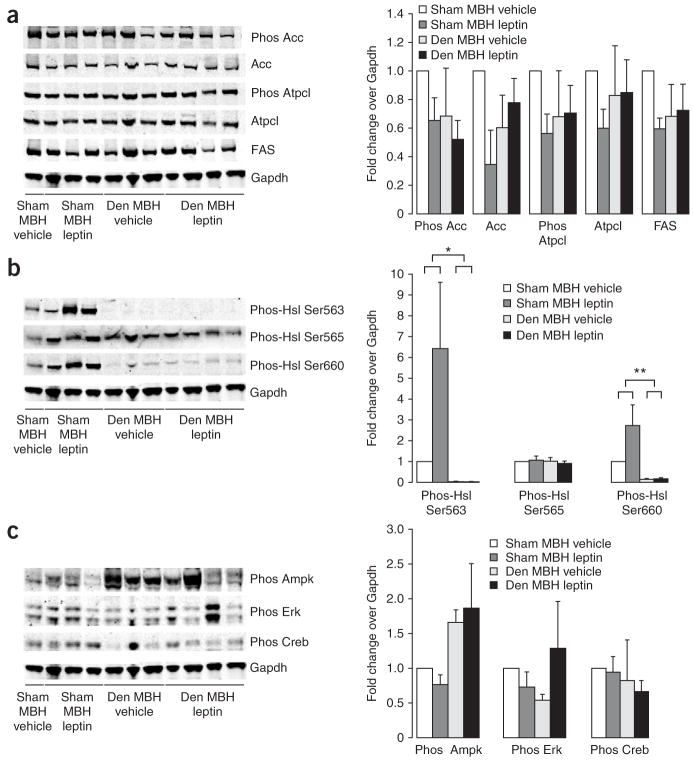
Control of WAT lipogenesis by MBH leptin requires intact autonomic innervation. (a) Lipogenic protein expression in denervated WAT of rats that were infused with either MBH vehicle or leptin as assessed by western blot analyses. MBH leptin failed to suppress lipogenic protein expression in denervated (Den) epidydimal fat pads, as compared to those in rats that had undergone sham surgery. (b) Hsl activation after MBH vehicle and leptin infusions in sham and denervated WAT. (c) MBH leptin did not affect Ampk activation in the sham group, whereas Ampk phosphorylation was upregulated in the denervated fat pads. Neither Creb phosphorylation nor Erk phosphorylation were affected by MBH leptin or by denervation. *P < 0.05, **P < 0.01.
Figure 6
Figure 6
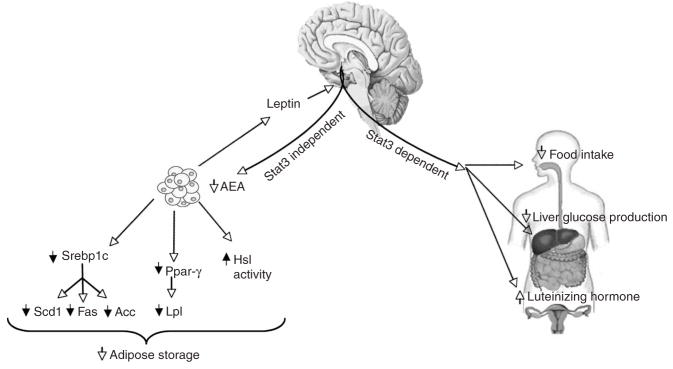
STAT3-dependent and STAT3-independent pathways of leptin signaling. Our previous data show that the effects of central leptin on the regulation of food intake, liver glucose production and luteinizing hormone secretion are STAT3-dependent. MBH leptin controls adipose tissue metabolism and anandamide levels independently of STAT3 signaling, leading to a decrease in body adiposity.

Comment in

  • The long reach of leptin.
    Maratos-Flier E. Maratos-Flier E. Nat Med. 2008 Jun;14(6):604-6. doi: 10.1038/nm0608-604. Nat Med. 2008. PMID: 18535571 No abstract available.

References

    1. Bluher M, et al. Dysregulation of the peripheral and adipose tissue endocannabinoid system in human abdominal obesity. Diabetes. 2006;55:3053–3060. - PMC - PubMed
    1. Matias I, et al. Regulation, function, and dysregulation of endocannabinoids in models of adipose and β-pancreatic cells and in obesity and hyperglycemia. J Clin Endocrinol Metab. 2006;91:3171–3180. - PubMed
    1. Woods SC. The endocannabinoid system: mechanisms behind metabolic homeostasis and imbalance. Am J Med. 2007;120:S9–S17. - PubMed
    1. Barzilai N, et al. Leptin selectively decreases visceral adiposity and enhances insulin action. J Clin Invest. 1997;100:3105–3110. - PMC - PubMed
    1. Halaas JL, et al. Physiological response to long-term peripheral and central leptin infusion in lean and obese mice. Proc Natl Acad Sci USA. 1997;94:8878–8883. - PMC - PubMed

Publication types