. 2008 Summer;7(2):175-83.
doi: 10.1187/cbe.07-07-0049.

Nanocourses: a short course format as an educational tool in a biological sciences graduate curriculum

Affiliations

Nanocourses: a short course format as an educational tool in a biological sciences graduate curriculum

Anna M Bentley et al. CBE Life Sci Educ. 2008 Summer.

Abstract

Traditional courses for graduate students in the biological sciences typically span a semester, are organized around the fundamental concepts of a single discipline, and are aimed at the needs of incoming students. Such courses demand significant time commitment from both faculty and course participants; thus, they are avoided by a subset of the academic science community. Course length and the high barrier to course development are inhibitory to the creation of new courses, especially in emerging areas of biology that may not merit a full-semester approach. Here, we describe the implementation of a new, graduate-level course format, created to allow for rapid development of courses, provide meaningful educational experiences for both junior and senior graduate students and other members of our community, and increase the breadth of faculty involvement in teaching. These courses are greatly abbreviated, and thus termed "nanocourses." Based on experience from the first three semesters, nanocourses seem to accomplish the initial goals that we set. Importantly, nanocourses engaged students, postdoctoral fellows, faculty, and others, thus providing a new mechanism to educate our community in response to rapid advances in biology. In our view, nanocourses are a useful tool that can supplement graduate-level curricula in varied ways.


Figures
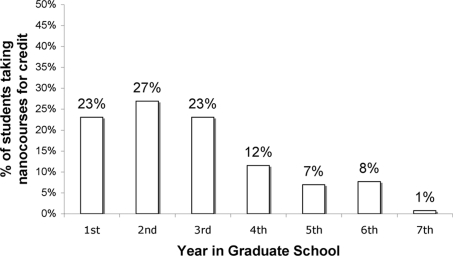
Figure 1.
Figure 1.
One-half of the students taking nanocourses for credit were in their third year of graduate school or above. During the first session of each nanocourse, attendees were asked to report their name, job title, year in graduate school if applicable, and their level of expertise with the topic on an attendance sheet. This graph includes the combined attendance data of all students taking nanocourses for credit during Spring 2006, Fall 2006, and Spring 2007 semesters, who reported their attendance and year of graduate training on the attendance sheet.
Figure 2.
Figure 2.
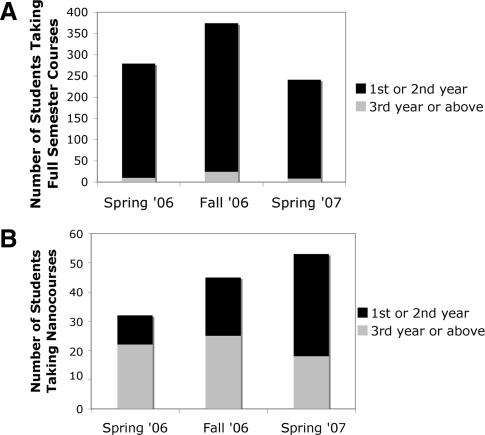
A greater fraction of the students taking full nanocourses were upper-year students compared with students taking full-semester courses for credit in the same three semesters. (A) Data are from all full-semester graduate-level courses offered by DMS during Spring 2006, Fall 2006, and Spring 2007 semesters (from DMS course registration records). Data were reported as the number of junior and senior students taking individual full-semester courses each semester. These numbers were combined, and are reported here as absolute numbers of students taking all full-semester courses each semester. Note that individual students who took more than one full-semester course are represented more than once, because we did not have access to the records indicating which specific students took these courses. Black bars represent the absolute number of students in their first and second year of graduate school taking full-semester courses for credit, while gray bars represent the absolute number of students in their third year or above. (B) This graph includes data from all nanocourses offered in the same semesters as were reported in A. Data are reported here as numbers of individual students taking nanocourses during each semester. Because we did have access to the records of individual students taking each of these courses, individual students are only represented once in each of the columns of this graph. Note that the scale of the two graphs is different.
Figure 3.
Figure 3.
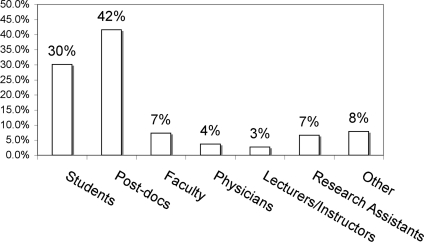
Nanocourses attract members of our community other than students. As described in Figure 1, during the first session of each nanocourse, attendees were asked to report demographic data on an attendance sheet. This graph includes the combined attendance data of all nanocourse attendees during Spring 2006, Fall 2006, and Spring 2007 semesters, who reported their attendance and job title on the attendance sheet. “Other” refers to a variety of job titles that were indicated on the survey forms.

References

    1. Birch J. B. Ten suggestions for effectively teaching short courses to heterogeneous groups. Am. Stat. 1995;49:190.
    1. Ebersole J. The future of graduate education. Univ. Bus. 2004;7:15–16.
    1. Gaff J. G. the disconnect between graduate education and faculty realities. Lib. Educ. 2002;88:6–8.
    1. Griffiths P. A. Reshaping graduate education. Issues Sci. Technol. 1995;11:74.
    1. Kleinbaum D. G. Teaching short courses in biostatistics and epidemiology. Am. Stat. 1995;49:200.

Publication types

LinkOut - more resources