Comment
doi: 10.1084/jem.20081057.
Epub 2008 Jun 2.
Sheepish B cells: evidence for antigen-independent antibody diversification in humans and mice
Affiliations
- PMID: 18519651
- PMCID: PMC2413022
- DOI: 10.1084/jem.20081057
Item in Clipboard
Comment
Sheepish B cells: evidence for antigen-independent antibody diversification in humans and mice
J Exp Med.
.
Abstract
Antibody diversity is first generated by rearrangement of immunoglobulin (Ig) genes during B cell development in the bone marrow, and later by antigen-driven diversification in germinal centers (GCs). New data in humans and mice now identify specific B cell populations that may have undergone antigen-independent hypermutation outside GCs.
Figures
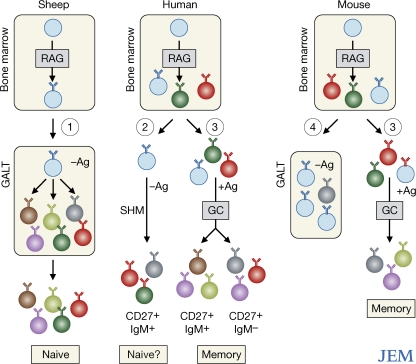
Comparison of proposed and proven mechanisms of B cell diversification in different species. Early B cell development in all species occurs in the bone marrow, where diversification is generated by recombination activating gene (RAG)–mediated combinatorial joining of the Ig gene segments. In sheep (pathway 1), immature B cells seed the ileal Peyer's patches, where they undergo further repertoire diversification by SHM. This is independent of antigen (Ag) binding to the BCR. These cells then enter the peripheral pool, where they are available for immune responses. An overall similar scheme is followed by rabbits and chickens (see The “generation of diversity” question). The study by Weller et al. (pathway 2; reference 4) proposes an unconventional pathway of diversification in which immature B cells undergo repertoire diversification by SHM in an antigen-independent manner. The location at which this process may occur is uncertain. These B cells appear within the CD27+IgM+ population. Conventional B cell development in humans and mice (pathway 3) relies on antigen-driven diversification in GCs to produce CD27+IgM+ and CD27+IgM− memory B cells. Shimomura et al. (pathway 4) find a distinct subset of B cells that completes its phenotypic maturation in the GALT. There is evidence of SHM among these cells, but it is at a low frequency and of uncertain timing in their development.
Comment on
-
Somatic diversification in the absence of antigen-driven responses is the hallmark of the IgM+ IgD+ CD27+ B cell repertoire in infants.J Exp Med. 2008 Jun 9;205(6):1331-42. doi: 10.1084/jem.20071555. Epub 2008 Jun 2. J Exp Med. 2008. PMID: 18519648 Free PMC article.
-
A unique B2 B cell subset in the intestine.J Exp Med. 2008 Jun 9;205(6):1343-55. doi: 10.1084/jem.20071572. Epub 2008 Jun 2. J Exp Med. 2008. PMID: 18519649 Free PMC article.
References
-
- Neuberger, M.S., J.M. Di Noia, R.C. Beale, G.T. Williams, Z. Yang, and C. Rada. 2005. Somatic hypermutation at A.T pairs: polymerase error versus dUTP incorporation. Nat. Rev. Immunol. 5:171–178. - PubMed
-
- Weller, S., M.C. Braun, B.K. Tan, A. Rosenwald, C. Cordier, M.E. Conley, A. Plebani, D.S. Kumararatne, D. Bonnet, O. Tournilhac, et al. 2004. Human blood IgM “memory” B cells are circulating splenic marginal zone B cells harboring a prediversified immunoglobulin repertoire. Blood. 104:3647–3654. - PMC - PubMed