


How do patient expectancies, quality of life, and postchemotherapy nausea interrelate?
- PMID: 18521919
- PMCID: PMC3079444
- DOI: 10.1002/cncr.23594
How do patient expectancies, quality of life, and postchemotherapy nausea interrelate?
Abstract
Background: Increasing evidence suggests a relation between patient expectancies and chemotherapy-induced nausea. However, this research has often failed to adequately control for other possible contributing factors. In the current study, the contribution of patient expectancies to the occurrence and severity of postchemotherapy nausea was examined using more stringent statistical techniques (namely hierarchical regression) than other similar studies that have relied on bivariate correlations, chi-square tests, and stepwise regression, and further extended upon previous research by including quality of life (QoL) in the analysis.
Methods: In all, 671 first-time chemotherapy patients taking part in a trial comparing antiemetic regimens answered questions regarding their expectancies for experiencing nausea. Patients then completed a diary assessing both the occurrence and severity of their nausea in the 4 days after their first infusion.
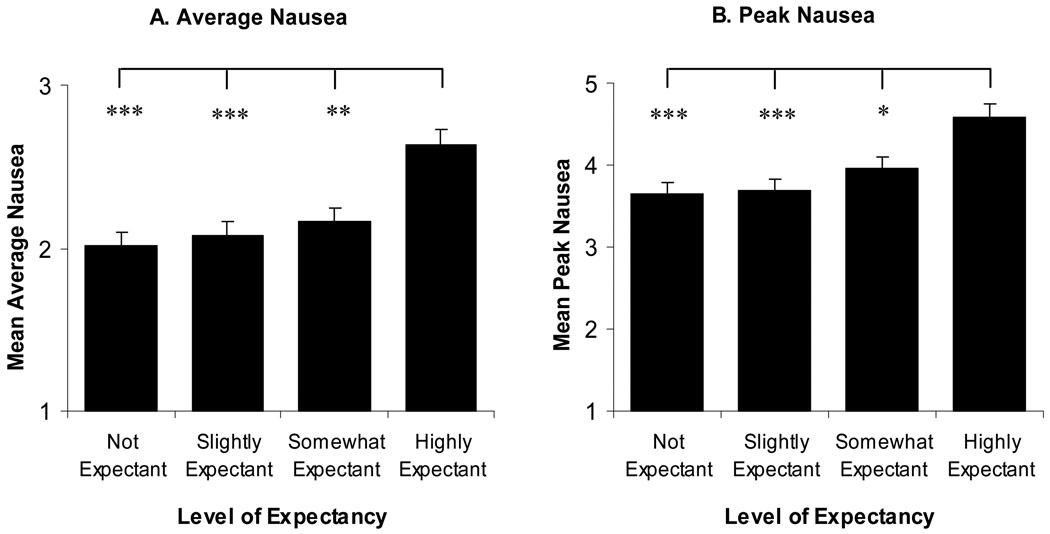
Results: Stronger expectancies for nausea corresponded with greater average and peak nausea after chemotherapy and this was after controlling for age, sex, susceptibility to motion sickness, diagnosis, and QoL. Interestingly, patients classified as highly expectant (first quartile) experienced significantly greater average and peak nausea than those classified as somewhat expectant, slightly expectant, and not expectant (second, third, and fourth quartiles, respectively), whereas there were no significant differences between these lower levels of expectancy. Furthermore, increases in average nausea led to a significant reduction in QoL after chemotherapy.
Conclusions: Patient expectancies appear to contribute to postchemotherapy nausea and patients that are highly expectant of experiencing nausea appear to be at particular risk. Interventions that target these patients should reduce the burden of nausea and may also improve QoL.
(c) 2008 American Cancer Society
Figures
References
-
- Roscoe JA, Hickok JT, Morrow GR. Patient expectations as predictor of chemotherapy-induced nausea. Ann Behav Med. 2000;22:121–126. - PubMed
-
- Hickok JT, Roscoe JA, Morrow GR, et al. Nausea and emesis remain significant problems of chemotherapy despite prophylaxis with 5-hydroxytryptamine-3 antiemetics: a University of Rochester James P. Wilmot Cancer Center Community Clinical Oncology Program Study of 360 cancer patients treated in the community. Cancer. 2003;97:2880–2886. - PubMed
-
- Carelle N, Piotto E, Bellanger A, et al. Changing patient perceptions of the side effects of cancer chemotherapy. Cancer. 2002;95:155–163. - PubMed
-
- Griffin AM, Butow PN, Coates AS, et al. On the receiving end. V: Patient perceptions of the side effects of cancer chemotherapy in 1993. Ann Oncol. 1996;7:189–195. - PubMed
Publication types
MeSH terms
Grants and funding
LinkOut - more resources
Full Text Sources
Medical
