. 2008 Jun;49 Suppl 2(0 2):180S-95S.
doi: 10.2967/jnumed.107.045971.

Noninvasive imaging of cell-mediated therapy for treatment of cancer

Affiliations

Noninvasive imaging of cell-mediated therapy for treatment of cancer

Elizabeth J Akins et al. J Nucl Med. 2008 Jun.

Abstract

Cell-mediated therapy (immunotherapy) for the treatment of cancer is an active area of investigation in animal models and clinical trials. Despite many advances, objective responses to immunotherapy are observed in a small number of cases, for certain tumor types. To better understand differences in outcomes, it is critical to develop assays for tracking effector cell localization and function in situ. The fairly recent use of molecular imaging techniques to track cell populations has presented researchers and clinicians with a powerful diagnostic tool for determining the efficacy of cell-mediated therapy for the treatment of cancer. This review highlights the application of whole-body noninvasive radioisotopic, magnetic, and optical imaging methods for monitoring effector cells in vivo. Issues that affect sensitivity of detection, such as methods of cell marking, efficiency of cell labeling, toxicity, and limits of detection of imaging modalities, are discussed.


Figures

FIGURE 1
FIGURE 1
“Best-case” scenario. CD8+ T cells are activated in draining lymph node (LN) by DCs expressing tumor antigen peptides on class I MHC (HLA-A, HLA-B, and HLA-C). Once activated, CD8+ T cells home to site of tumor, invading stroma to gain access to tumor cells. Antigen-expressing tumor cells are recognized and lysed by CD8+ T cells. HEV = high endothelial venule.
FIGURE 2
FIGURE 2
Passive immunotherapy strategies for treatment of cancer. Subsets of effector or regulatory cells are isolated from spleen or peripheral blood (PBL) of animals or patients, respectively (top left). Cells are amplified in cultures by stimulation with antibodies or tumor antigens. During in vitro culturing, effector cells can be modified by viral introduction of cloned T-cell receptor genes, cytokines, and other factors. Amplified cell population is transferred back into animal or patient. Alternatively, graft-vs.-leukemia strategies use hematopoietic cells from murine or human bone marrow. To prevent potentially lethal graft-vs.-host (GvH) effect, bone marrow cells may be depleted of effector CD8+ T cells or may be mixed with regulatory T cells to inhibit GvH while accentuating graft-vs.-leukemia effect. These approaches could be monitored by optical imaging, MRI, and radioisotopic imaging modalities.
FIGURE 3
FIGURE 3
Immune evasion strategies. (A) Local inhibitory mechanisms initiated by tumors can prevent effector cell function. Tumor cells may downregulate MHC (shown in white line) or antigen expression and therefore be unrecognizable to CD8+ T cells. Tumor cells can also secrete cytokines, such as transforming growth factor-β (TGF-β) (green dots), and inhibit effector cell function. (B) (Left) T cells may not be properly activated in lymph node (LN). Immature DCs (e.g., improperly process antigen or fail to upregulate costimulatory molecules) transmit tolerance-inducing (inactivating) signals to T cells. (Right) Regulatory T cells (Tr) can inhibit CD8+ and CD4+ effector cell responses. Regulatory T-cell inhibition may be mediated by direct contact with effector cells or by secretion of inhibitory cytokines, such as TGF-β, that prevent T-cell function.
FIGURE 4
FIGURE 4
MRI for determination of accurate delivery of therapeutic injections of DCs. Ultrasound-guided injections of SPIO-labeled DCs intended to be intranodal were detected in surrounding fatty tissue by MRI. This study is example of clinical use of molecular imaging to assess therapeutic efficacy. Black arrows denote lymph node (A). White arrow indicates location of injected DCs in surrounding fatty tissue (B). (Reprinted with permission of (27).)
FIGURE 5
FIGURE 5
Localization of antigen-specific T cells visualized by small-animal PET. T cells from immunized mice were labeled with HSV1-sr39TK and adoptively transferred into animal bearing antigen-positive tumor (left) and antigen-negative tumor (right). Trafficking of T cells to antigen-positive tumor was detected by injection of 18F-FHBG and small-animal PET. % ID/g = percentage injected dose per gram. (Reprinted with permission of (61).)
FIGURE 6
FIGURE 6
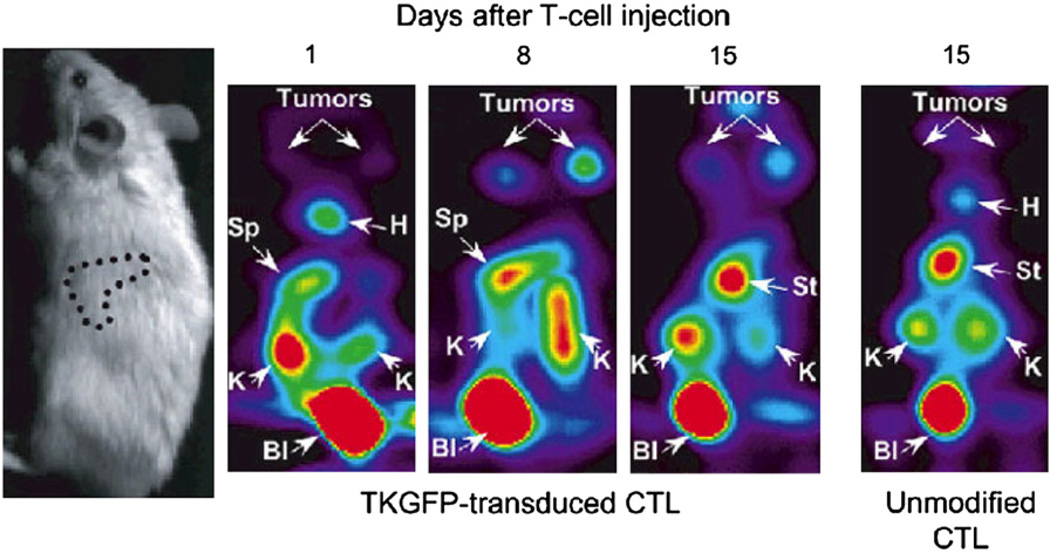
Trafficking of EBV-specific T lymphocytes marked with TK–GFP. Human T lymphocytes transduced with HSV1-TK–GFP fusion protein were adoptively transferred into animals bearing EBV-positive tumors. T-cell localization was detected with tracer 124I-FIAU and small-animal PET imaging. B = bladder; H = heart; K = kidney; S = spleen; St = stomach. (Reprinted with permission of (62).)
FIGURE 7
FIGURE 7
Trafficking of cytokine-induced killer cells to tumor site, as revealed by bioluminescent imaging. Luciferase-expressing cytokine-induced killer cells were isolated and transferred into mice bearing palpable subcutaneous A20 tumors. Marked cells were detected primarily at tumor site as early as 3 d (d3) after adoptive transfer. (Reprinted with permission of (65).)
FIGURE 8
FIGURE 8
Dual-modality imaging provides anatomic localization of PET signals. In murine model of experimental autoimmune encephalomyelitis, investigators used PET/CT to localize areas of inflammation to specific regions of vertebrae. Visualization of vertebrae by small-animal CT allowed quantification of inflammation detected by 18F-FDG PET in cervical, thoracic, and lumbar regions. B = brain; BL = bladder; H = heart; K = kidney; l = lymph node; %ID/g = percentage injected dose per gram; ROI = region of interest; SC = spinal column; 3D = 3-dimensional. (Reprinted with permission of (82).)
FIGURE 9
FIGURE 9
Monitoring of T-cell activation in vivo. Human T-cell tumor (Jurkat) transduced with NF-AT–inducible construct shows strong upregulation of HSV1-TK and GFP after stimulation with anti-CD3 and anti-CD28 antibodies. (A) Small-animal PET imaging with 124I-FIAU after injection of anti-CD3/anti-CD28 antibodies. (B) Fluorescent imaging for detection of GFP after injection of anti-CD3/anti-CD28 antibodies. (Adapted from (106) and reprinted with permission of (106).)
FIGURE 10
FIGURE 10
Activation-dependent expression of firefly luciferase in primary murine splenocytes. (A) Bone marrow from C57BL/6 mice was infected with lentivirus driving expression of GFP–Luc fusion reporter under control of NF-AT enhancer element. Bone marrow cells were then transferred to lethally irradiated syngeneic mice. (B) After reconstitution, mice were injected with activating anti-CD3 or control antibody. All animals were injected intraperitoneally with d-luciferin at 150 mg/kg and, after 15 min of uptake, were imaged with IVIS100 system (Xenogen) (left mouse, no antibody; middle mouse, control hamster antibody; right mouse, anti-CD3 antibody). In mice injected with activating anti-CD3 antibody, strong signal from area corresponding to spleen was detected beginning 2 h after antibody treatment. (C) Regions of interest (ROI) encompassing spleen area were quantified with Living Image software (Xenogen). Fold change over background was calculated by dividing ROI at each time point by background ROI at time zero (triangle, animal on left; square, animal in the middle; diamond, animal on the right) (Elizabeth J. Akins, M. Moore, and P. Dubey, unpublished data, January 2007). CD8α = α-chain of CD8 molecule; cPPT = central polypurine tract; eGFP = enhanced GFP; NFAT(4) = nuclear factor of activated T-cells; WPRE = woodchuck hepatitis posttranscriptional regulatory element.
FIGURE 11
FIGURE 11
Challenge of making cell subset–specific reporter constructs for imaging of T cells. T cells express genes at various specificities. Although some genes are predominantly expressed on specific subsets of cells, others are expressed more widely. Indirect imaging labels can be targeted to cells via regulatory elements of tissue-specific genes, such as cytokines (blue), intracellular signaling molecules (yellow), cell surface proteins, or effector cell proteins (pink). DNA response elements for transcription factors (green) can drive transcription of reporter genes. Cells can also be labeled directly with labeled antibodies or receptor ligands. Cell localization can be monitored by labeling constitutively expressed factors, and activation status can be monitored by marking inducible factors. IFN-γ = interferon-γ; LCK = lck (signaling molecule); TCR = T-cell receptor.

References

    1. Jemal A, Siegel R, Ward E, et al. Cancer statistics, 2006. CA Cancer J Clin. 2006;56:106–130. - PubMed
    1. Dunn GP, Old LJ, Schreiber RD. The three Es of cancer immunoediting. Annu Rev Immunol. 2004;22:329–360. - PubMed
    1. Paul WE, editor. Fundamental Immunology. 5th ed. Philadelphia, PA: Lippincott, Williams & Wilkins; 2003.
    1. Dudley ME, Wunderlich JR, Robbins PF, et al. Cancer regression and autoimmunity in patients after clonal repopulation with antitumor lymphocytes. Science. 2002;298:850–854. - PMC - PubMed
    1. Yee C, Thompson JA, Byrd D, et al. Adoptive T cell therapy using antigen-specific CD8+ T cell clones for the treatment of patients with metastatic melanoma: in vivo persistence, migration, and antitumor effect of transferred T cells. Proc Natl Acad Sci USA. 2002;99:16168–16173. - PMC - PubMed

Publication types

LinkOut - more resources