Discordance between patient-predicted and model-predicted life expectancy among ambulatory patients with heart failure
- PMID: 18523222
- PMCID: PMC3623529
- DOI: 10.1001/jama.299.21.2533
Discordance between patient-predicted and model-predicted life expectancy among ambulatory patients with heart failure
Abstract
Context: Patients with chronic heart failure have impaired long-term survival, but their own expectations regarding prognosis have not been well studied.
Objectives: To quantify expectations for survival in patients with heart failure, to compare patient expectations to model predictions, and to identify factors associated with discrepancies between patient-predicted and model-predicted prognosis.
Design, setting, and participants: Prospective face-to-face survey of patients from the single-center Duke Heart Failure Disease Management Program between July and December 2004, with follow-up through February 2008. Patient-predicted life expectancy was obtained using a visual analog scale. Model-predicted life expectancy was calculated using the Seattle Heart Failure Model. Actuarial-predicted life expectancy, based on age and sex alone, was calculated using life tables. Observed survival was determined from review of medical records and search of the Social Security Death Index.
Main outcome measure: Life expectancy ratio (LER), defined as the ratio of patient-predicted to model-predicted life expectancy.
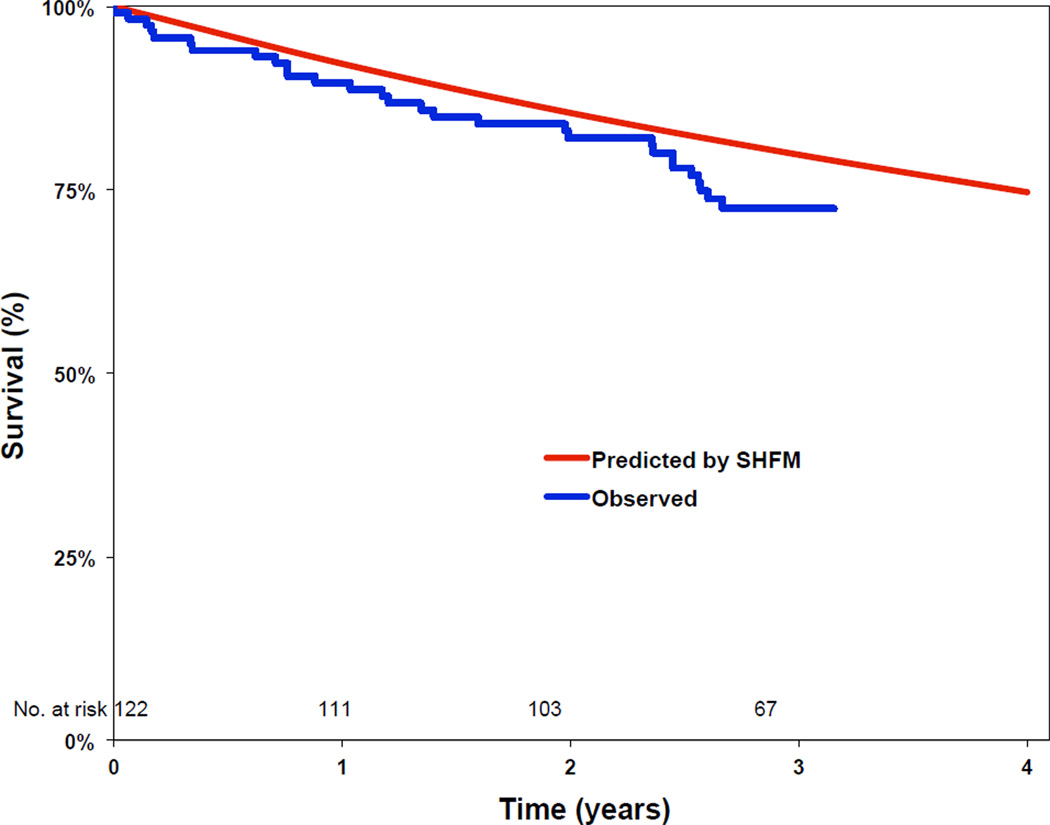
Results: The cohort consisted of 122 patients (mean age, 62 years; 47% African American, 42% New York Heart Association [NYHA] class III or IV). On average, patients overestimated their life expectancy relative to model-predicted life expectancy (median patient-predicted life expectancy, 13.0 years; model-predicted expectancy, 10.0 years). Median LER was 1.4 (interquartile range, 0.8-2.5). Younger age, increased NYHA class, lower ejection fraction, and less depression were the most significant predictors of higher LER. During a median follow-up of 3.1 years, 29% of the original cohort died. There was no association between higher LER and improved survival (adjusted hazard ratio for overestimated compared with concordant LER, 1.05; 95% confidence interval, 0.46-2.42).
Conclusions: Ambulatory patients with heart failure tended to substantially overestimate their life expectancy compared with model-based predictions for survival. Because differences in perceived survival could affect decision making regarding advanced therapies and end-of-life planning, the causes of these discordant predictions warrant further study.
Figures




Comment in
-
Predicting life expectancy in heart failure.JAMA. 2008 Jun 4;299(21):2566-7. doi: 10.1001/jama.299.21.2566. JAMA. 2008. PMID: 18523227 No abstract available.
-
Patient-predicted life expectancy among ambulatory patients with heart failure.JAMA. 2008 Nov 12;300(18):2116-7; author reply 2117. doi: 10.1001/jama.2008.551. JAMA. 2008. PMID: 19001619 No abstract available.
References
-
- Rosamond W, Flegal K, Friday G, et al. Heart disease and stroke statistics-2007 update: a report from the American Heart Association Statistics Committee and Stroke Statistics Subcommittee. Circulation. 2007 Feb 6;115(5):e69–e171. - PubMed
-
- Stewart S, MacIntyre K, Hole DJ, Capewell S, McMurray JJ. More 'malignant' than cancer? Five-year survival following a first admission for heart failure. Eur J Heart Fail. 2001 Jun;3(3):315–322. - PubMed
-
- Hershberger RE, Nauman D, Walker TL, Dutton D, Burgess D. Care processes and clinical outcomes of continuous outpatient support with inotropes (COSI) in patients with refractory endstage heart failure. J Card Fail. 2003 Jun;9(3):180–187. - PubMed
-
- Rose EA, Gelijns AC, Moskowitz AJ, et al. Long-term mechanical left ventricular assistance for end-stage heart failure. N Engl J Med. 2001 Nov 15;345(20):1435–1443. - PubMed
-
- Mozaffarian D, Anker SD, Anand I, et al. Prediction of mode of death in heart failure: the Seattle Heart Failure Model. Circulation. 2007 Jul 24;116(4):392–398. - PubMed
Publication types
MeSH terms
Grants and funding
LinkOut - more resources
Full Text Sources
Medical