Comparative Study
. 2008 Jun 15;180(12):8102-8.
doi: 10.4049/jimmunol.180.12.8102.

Histone acetylation facilitates rapid and robust memory CD8 T cell response through differential expression of effector molecules (eomesodermin and its targets: perforin and granzyme B)

Affiliations
Comparative Study

Histone acetylation facilitates rapid and robust memory CD8 T cell response through differential expression of effector molecules (eomesodermin and its targets: perforin and granzyme B)

Yasuto Araki et al. J Immunol. .

Abstract

To understand the mechanism regulating the effector function of memory CD8 T cells, we examined expression and chromatin state of a key transcription factor (eomesodermin, EOMES) and two of its targets: perforin (PRF1) and granzyme B (GZMB). Accessible chromatin associated histone 3 lysine 9 acetylation (H3K9Ac) was found significantly higher at the proximal promoter and the first exon region of all three genes in memory CD8 T cells than in naive CD8 T cells. Correspondingly, EOMES and PRF1 were constitutively higher expressed in memory CD8 T cells than in naive CD8 T cells at resting and activated states. In contrast, higher expression of GZMB was induced in memory CD8 T cells than in naive CD8 T cells only after activation. Regardless of their constitutive or inducible expression, decreased H3K9Ac levels after treatment with a histone acetyltransferase inhibitor (Curcumin) led to decreased expression of all three genes in activated memory CD8 T cells. These findings suggest that H3K9Ac associated accessible chromatin state serves as a corner stone for the differentially high expression of these effector genes in memory CD8 T cells. Thus, epigenetic changes mediated via histone acetylation may provide a chromatin "memory" for the rapid and robust transcriptional response of memory CD8 T cells.


Conflict of interest statement

Disclosures

The authors have no financial conflict of interest.

Figures

FIGURE 1
FIGURE 1
EOMES is expressed at higher levels in memory CD8 T cells than in naive CD8 T cells. A, The levels of EOMES expression in naive and memory CD8 T cells before and after stimulation in vitro. Sorted naive and memory CD8 T cells were stimulated with anti-CD3/CD28 Abs for 0, 4, 8, 16, 32, and 72 h. The level of EOMES expression was determined by quantitative real-time PCR at each time point. The data are presented as mean ± SEM (n = 9). B, The relative expression levels of EOMES in naive and memory CD8 T cells. The data are presented as the ratio of each time point to freshly isolated naive cells in mean ± SEM (n = 9). Values of p are indicated by asterisks (*, p < 0.05; **, p < 0.01; ***, p < 0.001) used in all figures.
FIGURE 2
FIGURE 2
High levels of H3K9Ac are found in the EOMES locus of memory CD8 T cells. The relative levels of H3K9Ac in the proximal promoter and the first exon in the EOMES locus in naive and memory CD8 T cells at rest and after stimulation were presented. Sorted naive and memory CD8 T cells were stimulated with anti-CD3/CD28 Abs and were used for ChIP assay. The primer pairs 9 and 10 were used for quantitative real-time PCR (same conditions used in the Fig. 3), and the data are presented as the average ratio of the sum of these products at each time point to freshly isolated naive cells in mean ± SEM (n = 7).
FIGURE 3
FIGURE 3
Inducing hypoacetylation of H3K9 in the EOMES locus decreases EOMES expression in memory CD8 T cells. A, The relative levels of H3K9Ac in the proximal promoter and the first exon in the EOMES locus in curcumin-treated and curcumin-untreated memory CD8 T cells after stimulation, and resting naive CD8 T cells. The data are presented as the ratio to curcumin-untreated memory CD8 T cells in mean ± SEM (n = 4). The relative levels of H3K9Ac in the proximal promoter of the GAPDH locus in curcumin-treated and curcumin-untreated memory CD8 T cells are also shown. B, The relative levels of EOMES expression of curcumin-treated and curcumin-untreated memory CD8 T cells after stimulation, and resting naive CD8 T cells. The levels of EOMES and GAPDH expression are presented as the ratio to curcumin-untreated memory CD8 T cells in mean ± SEM (n = 5).
FIGURE 4
FIGURE 4
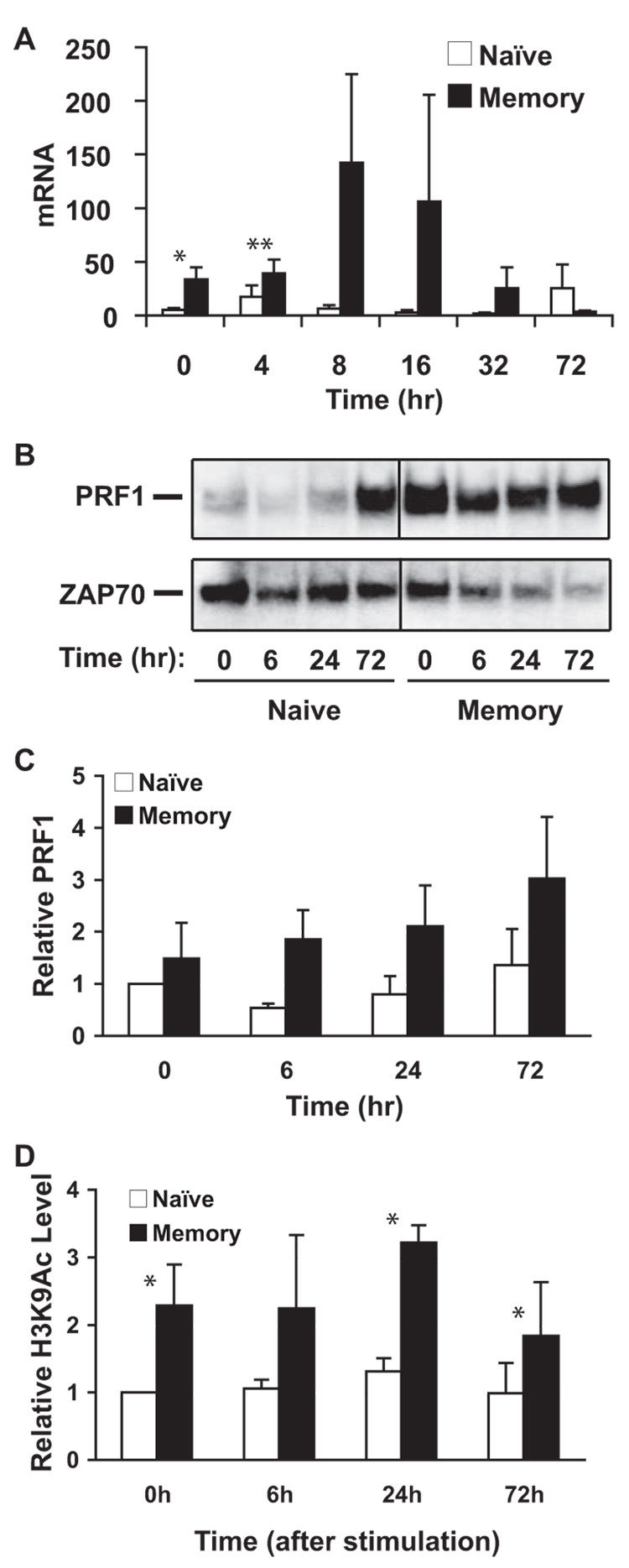
High levels of perforin expression are associated with high levels of H3K9Ac in the PRF1 locus in memory CD8 T cells. A, The mRNA levels of PRF1 expression in naive and memory CD8 T cells before and after stimulation. The levels of PRF1 expression are presented as mean ± SEM (n = 9). B, The protein levels of perforin in naive and memory CD8 T cells before and after stimulation. ZAP70 levels were used as the loading control. C, The quanitified data of B are presented as mean ± SEM (n = 3). The intensity of perforin was normalized based on ZAP70 (same as in Fig. 5). D, The relative levels of H3K9Ac in the PRF1 locus in naive and memory CD8 T cells before and after stimulation. The primer pairs 9 and 10 were used for quantitative real-time PCR (same conditions used in the Fig. 6) and the data are presented as the average ratio of the sum of these two products at each time point to freshly isolated naive cells (n = 7).
FIGURE 5
FIGURE 5
Rapid increase of GZMB expression after stimulation is associated with high levels of H3K9Ac in the GZMB locus in memory CD8 T cells. A, The mRNA levels of GZMB expression in naive and memory CD8 T cells before and after stimulation. The levels of GZMB expression are presented as mean ± SEM (n = 9). B, The protein levels of GZMB expression in naive and memory CD8 T cells before and after stimulation. C, The quanitified data of B are presented as mean ± SEM (n = 4). D, The relative levels of H3K9Ac in the GZMB locus in naive and memory CD8 T cells at rest and after stimulation. The primer pairs 8 and 9 were used for quantitative real-time PCR (same conditions used in the Fig. 7) and the data are presented as the average ratio of the sum of these two products at each time point to freshly isolated naive cells (n = 5).
FIGURE 6
FIGURE 6
Inducing hypoacetylation of H3K9 in the PRF1 locus results in decreased PRF1 expression in memory CD8 T cells. A, The relative levels of H3K9Ac in the PRF1 locus in curcumin-treated and curcumin-untreated memory CD8 T cells after stimulation, and resting naive CD8 T cells. The data are presented as the average ratio to curcumin-untreated memory CD8 T cells (n = 4). B, The relative levels of PRF1 expression of curcumin-untreated and curcumin-treated memory CD8 T cells, and resting naive CD8 T cells. The levels of PRF1 and GAPDH expression are presented as the average ratio to curcuminun-treated memory CD8 T cells (n = 5). C, Perforin protein levels in curcumin-treated and curcumin-untreated memory CD8 T cells after stimulation.
FIGURE 7
FIGURE 7
Inducing hypoacetylation of H3K9 in the GZMB locus results in decreased GZMB expression in memory CD8 T cells. A, The relative levels of H3K9Ac in the GZMB locus in curcumin-treated and curcumin-untreated memory CD8 T cells after stimulation, and resting naive CD8 T cells. The data are presented as the average ratio to curcumin-untreated memory CD8 T cells (n = 4). The relative levels of H3K9Ac in the proximal promoter in the GAPDH locus are also shown. B, The relative levels of GZMB expression of curcumin-treated and curcumin-untreated memory CD8 T cells after stimulation, and resting naive CD8 T cells. The levels of GZMB and GAPDH expressions are presented as the average ratio to curcumin-untreated memory CD8 T cells (n = 5). C, GZMB protein levels in curcumin-treated and curcumin-untreated memory CD8 T cells after stimulation.
FIGURE 8
FIGURE 8
Model for epigenetic regulation of differential gene expression associated with effector functions of CD8 T cells. In naive CD8 T cells, the EOMES, PRF1, and GZMB loci contain repressive (“not primed”) chromatin with low level of H3K9Ac in naive CD8 T cells corresponding to low levels of mRNA. In memory CD8 T cells, the EOMES, PRF1, and GZMB loci contain accessible chromatin as shown by the high levels of H3K9Ac corresponding to either high levels of mRNA (EOMES and PRF1) or low levels of mRNA (GZMB) until activation. Due to the differences of chromatin structure and transcription activator(s), memory CD8 T cells have a much more rapid and strong transcription response than do naive cells upon antigenic stimulation.

References

    1. Dutton RW, Bradley LM, Swain SL. T cell memory. Annu. Rev. Immunol. 1998;16:201–223. - PubMed
    1. Kaech SM, Wherry EJ, Ahmed R. Effector and memory T-cell differentiation: implications for vaccine development. Nat. Rev. Immunol. 2002;2:251–262. - PubMed
    1. Williams MA, Bevan MJ. Effector and memory CTL differentiation. Annu. Rev. Immunol. 2007;25:171–192. - PubMed
    1. Pearce EL, Mullen AC, Martins GA, Krawczyk CM, Hutchins AS, Zediak VP, Banica M, DiCioccio CB, Gross DA, Mao CA, et al. Control of effector CD8+ T cell function by the transcription factor Eomesodermin. Science. 2003;302:1041–1043. - PubMed
    1. Intlekofer AM, Takemoto N, Wherry EJ, Longworth SA, Northrup JT, Palanivel VR, Mullen AC, Gasink CR, Kaech SM, Miller JD, et al. Effector and memory CD8+ T cell fate coupled by T-bet and eomesodermin. Nat. Immunol. 2005;6:1236–1244. - PubMed

Publication types

MeSH terms