


A randomized, placebo-controlled trial of the bivalent killed, whole-cell, oral cholera vaccine in adults and children in a cholera endemic area in Kolkata, India
- PMID: 18523643
- PMCID: PMC2396289
- DOI: 10.1371/journal.pone.0002323
A randomized, placebo-controlled trial of the bivalent killed, whole-cell, oral cholera vaccine in adults and children in a cholera endemic area in Kolkata, India
Abstract
Objectives: An effective vaccine against cholera has been used for public health purposes in Vietnam since the 1990s. This vaccine was reformulated to meet WHO requirements. We assessed the safety and immunogenicity of the reformulated bivalent (Vibrio cholerae 01 and 0139) killed whole cell oral vaccine in a cholera endemic area in Kolkata, India.
Design: Double-blind, randomized, placebo controlled trial.
Setting: The trial was conducted in the clinical trial ward of the Infectious Diseases Hospital in Kolkata, India.
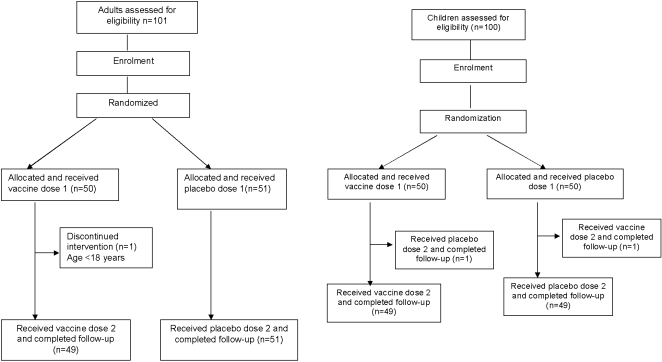
Participants: The participants were 101 healthy adults (males and non-pregnant females) aged 18-40 years and 100 healthy children (males and non-pregnant females) aged 1-17 years.
Interventions: Participants were randomized to receive either the bivalent killed whole cell oral cholera vaccine or placebo (killed oral Escherichia coli K12).
Outcome measures: For safety: proportion of subjects with adverse events during the duration of study participation. For immunogenicity: Proportion of subjects who had a > or = 4-fold rise in serum vibriocidal antibody titers 14 days after the second dose of vaccine or placebo.
Results: Adverse reactions were observed with similar frequency among vaccine and placebo recipients in both age groups. Among adults 4% of vaccine and 8% of placebo recipients and among children 4% of vaccine and 2% of placebo recipients had at least one adverse event within 28 days of the first dose of the vaccine. Following immunization, 53% of adult and 80% of children vaccinees showed a > or = 4 fold rise in serum V. cholerae O1 vibriocidal antibody titers. A less pronounced response to V. cholerae O139 vibriocidal antibody titers post-immunization was noted among vaccinees.
Conclusions: We found the vaccine to be safe and immunogenic in a cholera-endemic area in India.
Trial registration: ClinicalTrials.gov NCT00119197.
Conflict of interest statement
Figures
References
-
- World Health Organization Global Task Force on Cholera Control. Cholera Vaccines: A new public health tool? 2002. Report of a WHO meeting, 10–11 December Geneva, Switzerland: World Health Organization.
-
- Trach DD, Clemens JD, Ke NT, Thuy HT, Son ND, et al. Field trial of a locally produced, killed, oral cholera vaccine in Vietnam. Lancet. 1997;349:231–235. - PubMed
-
- Thiem VD, Deen JL, von Seidlein L, Canh do G, Anh DD, et al. Long-term effectiveness against cholera of oral killed whole-cell vaccine produced in Vietnam. Vaccine. 2006;24:4297–4303. - PubMed
-
- Vu DT, Hossain MM, Nguyen DS, Nguyen TH, Rao MR, et al. Coverage and costs of mass immunization of an oral cholera vaccine in Vietnam. J Health Popul Nutr. 2003;21:304–308. - PubMed
Publication types
MeSH terms
Substances
Associated data
LinkOut - more resources
Full Text Sources
Medical
