


Role of interferon in the replication of human parainfluenza virus type 1 wild type and mutant viruses in human ciliated airway epithelium
- PMID: 18524813
- PMCID: PMC2519580
- DOI: 10.1128/JVI.02263-07
Role of interferon in the replication of human parainfluenza virus type 1 wild type and mutant viruses in human ciliated airway epithelium
Abstract
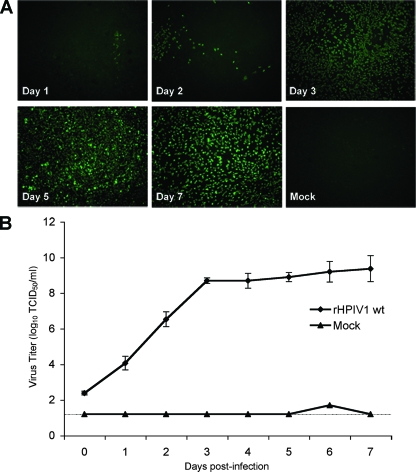
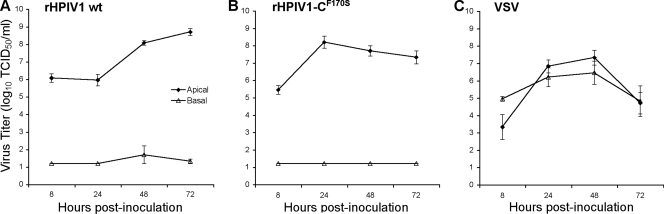
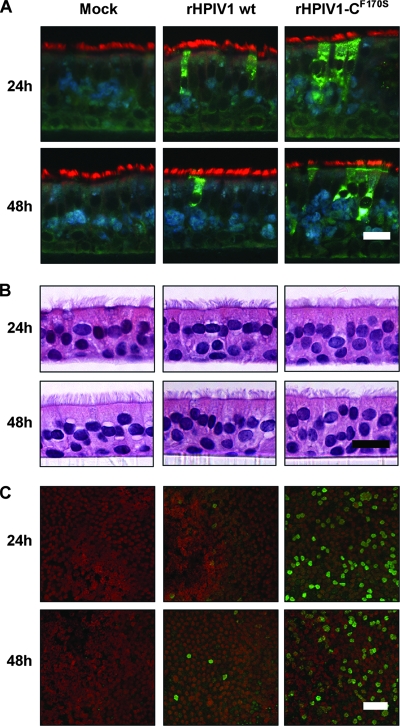
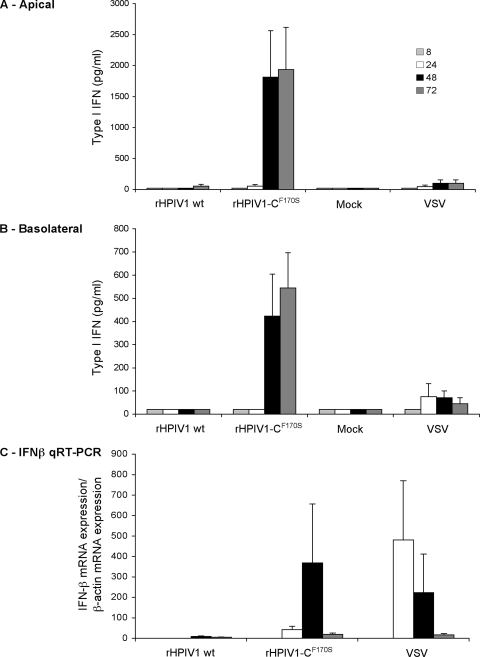
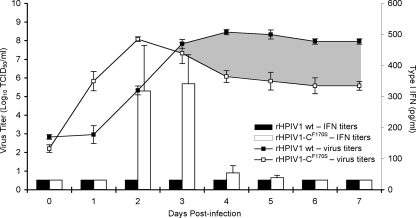
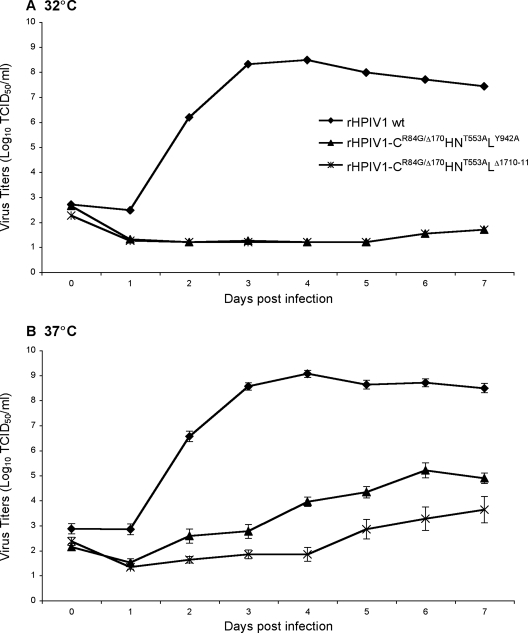
Human parainfluenza virus type 1 (HPIV1) is a significant cause of pediatric respiratory disease in the upper and lower airways. An in vitro model of human ciliated airway epithelium (HAE), a useful tool for studying respiratory virus-host interactions, was used in this study to show that HPIV1 selectively infects ciliated cells within the HAE and that progeny virus is released from the apical surface with little apparent gross cytopathology. In HAE, type I interferon (IFN) is induced following infection with an HPIV1 mutant expressing defective C proteins with an F170S amino acid substitution, rHPIV1-C(F170S), but not following infection with wild-type HPIV1. IFN induction coincided with a 100- to 1,000-fold reduction in virus titer, supporting the hypothesis that the HPIV1 C proteins are critical for the inhibition of the innate immune response. Two recently characterized live attenuated HPIV1 vaccine candidates expressing mutant C proteins were also evaluated in HAE. The vaccine candidates, rHPIV1-C(R84G/Delta170)HN(T553A)L(Y942A) and rHPIV1-C(R84G/Delta170)HN(T553A)L(Delta1710-11), which contain temperature-sensitive (ts) attenuating (att) and non-ts att mutations, were highly restricted in growth in HAE at permissive (32 degrees C) and restrictive (37 degrees C) temperatures. The viruses grew slightly better at 37 degrees C than at 32 degrees C, and rHPIV1-C(R84G/Delta170)HN(T553A)L(Y942A) was less attenuated than rHPIV1-C(R84G/Delta170)HN(T553A)L(Delta1710-11). The level of replication in HAE correlated with that previously observed for African green monkeys, suggesting that the HAE model has potential as a tool for the preclinical evaluation of HPIV1 vaccines, although how these in vitro data will correlate with vaccine virus replication in seronegative human subjects remains to be seen.
Figures
References
-
- Bartlett, E. J., E. Amaro-Carambot, S. R. Surman, P. L. Collins, B. R. Murphy, and M. H. Skiadopoulos. 2006. Introducing point and deletion mutations into the P/C gene of human parainfluenza virus type 1 (HPIV1) by reverse genetics generates attenuated and efficacious vaccine candidates. Vaccine 242674-2684. - PubMed
-
- Bartlett, E. J., E. Amaro-Carambot, S. R. Surman, J. T. Newman, P. L. Collins, B. R. Murphy, and M. H. Skiadopoulos. 2005. Human parainfluenza virus type I (HPIV1) vaccine candidates designed by reverse genetics are attenuated and efficacious in African green monkeys. Vaccine 234631-4646. - PubMed
-
- Beutler, B. 2004. Inferences, questions and possibilities in Toll-like receptor signalling. Nature 430257-263. - PubMed
Publication types
MeSH terms
Substances
Grants and funding
LinkOut - more resources
Full Text Sources
