


Historical contingency and the evolution of a key innovation in an experimental population of Escherichia coli
- PMID: 18524956
- PMCID: PMC2430337
- DOI: 10.1073/pnas.0803151105
Historical contingency and the evolution of a key innovation in an experimental population of Escherichia coli
Abstract
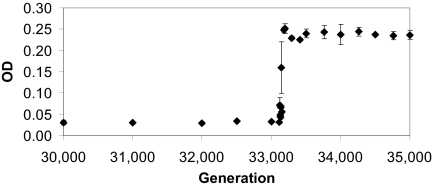
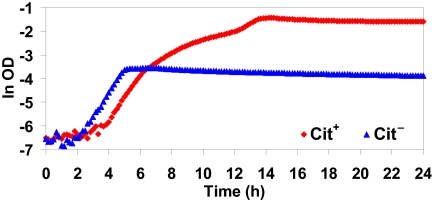
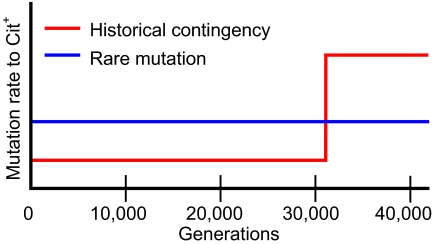
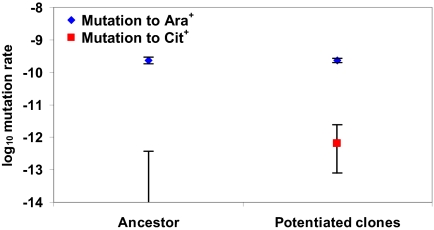
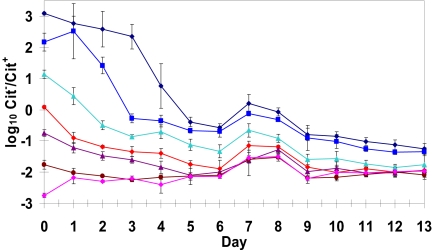
The role of historical contingency in evolution has been much debated, but rarely tested. Twelve initially identical populations of Escherichia coli were founded in 1988 to investigate this issue. They have since evolved in a glucose-limited medium that also contains citrate, which E. coli cannot use as a carbon source under oxic conditions. No population evolved the capacity to exploit citrate for >30,000 generations, although each population tested billions of mutations. A citrate-using (Cit+) variant finally evolved in one population by 31,500 generations, causing an increase in population size and diversity. The long-delayed and unique evolution of this function might indicate the involvement of some extremely rare mutation. Alternately, it may involve an ordinary mutation, but one whose physical occurrence or phenotypic expression is contingent on prior mutations in that population. We tested these hypotheses in experiments that "replayed" evolution from different points in that population's history. We observed no Cit+ mutants among 8.4 x 10(12) ancestral cells, nor among 9 x 10(12) cells from 60 clones sampled in the first 15,000 generations. However, we observed a significantly greater tendency for later clones to evolve Cit+, indicating that some potentiating mutation arose by 20,000 generations. This potentiating change increased the mutation rate to Cit+ but did not cause generalized hypermutability. Thus, the evolution of this phenotype was contingent on the particular history of that population. More generally, we suggest that historical contingency is especially important when it facilitates the evolution of key innovations that are not easily evolved by gradual, cumulative selection.
Conflict of interest statement
The authors declare no conflict of interest.
Figures
References
-
- Mani GS, Clarke BC. Mutational order: A major stochastic process in evolution. Proc R Soc London B. 1990;240:29–37. - PubMed
-
- Lenski RE, Rose MR, Simpson SC, Tadler SC. Long-term experimental evolution in Escherichia coli. I. Adaptation and divergence during 2,000 generations. Am Nat. 1991;138:1315–1341.
-
- Cooper VS, Lenski RE. The population genetics of ecological specialization in evolving E. coli populations. Nature. 2000;407:736–739. - PubMed
-
- Jacob F. Evolution and tinkering. Science. 1977;196:1161–1166. - PubMed
Publication types
MeSH terms
Substances
LinkOut - more resources
Full Text Sources
Other Literature Sources
