


The effect of exercise training in improving motor performance and corticomotor excitability in people with early Parkinson's disease
- PMID: 18534554
- PMCID: PMC2989816
- DOI: 10.1016/j.apmr.2008.01.013
The effect of exercise training in improving motor performance and corticomotor excitability in people with early Parkinson's disease
Abstract
Objectives: To obtain preliminary data on the effects of high-intensity exercise on functional performance in people with Parkinson's disease (PD) relative to exercise at low and no intensity and to determine whether improved performance is accompanied by alterations in corticomotor excitability as measured through transcranial magnetic stimulation (TMS).
Design: Cohort (prospective), randomized controlled trial.
Setting: University-based clinical and research facilities.
Participants: Thirty people with PD, within 3 years of diagnosis with Hoehn and Yahr stage 1 or 2.
Interventions: Subjects were randomized to high-intensity exercise using body weight-supported treadmill training, low-intensity exercise, or a zero-intensity education group. Subjects in the 2 exercise groups completed 24 exercise sessions over 8 weeks. Subjects in the zero-intensity group completed 6 education classes over 8 weeks.
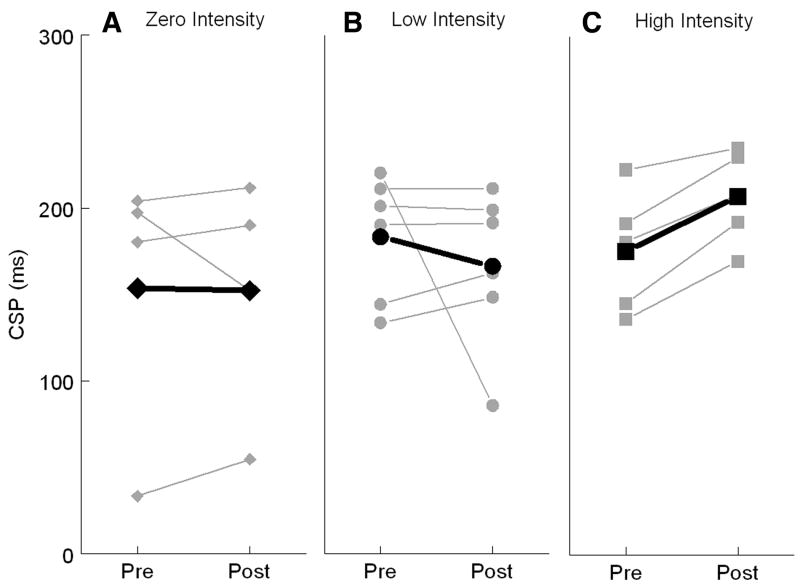
Main outcome measures: Unified Parkinson's Disease Rating Scales (UPDRS), biomechanic analysis of self-selected and fast walking and sit-to-stand tasks; corticomotor excitability was assessed with cortical silent period (CSP) durations in response to single-pulse TMS.
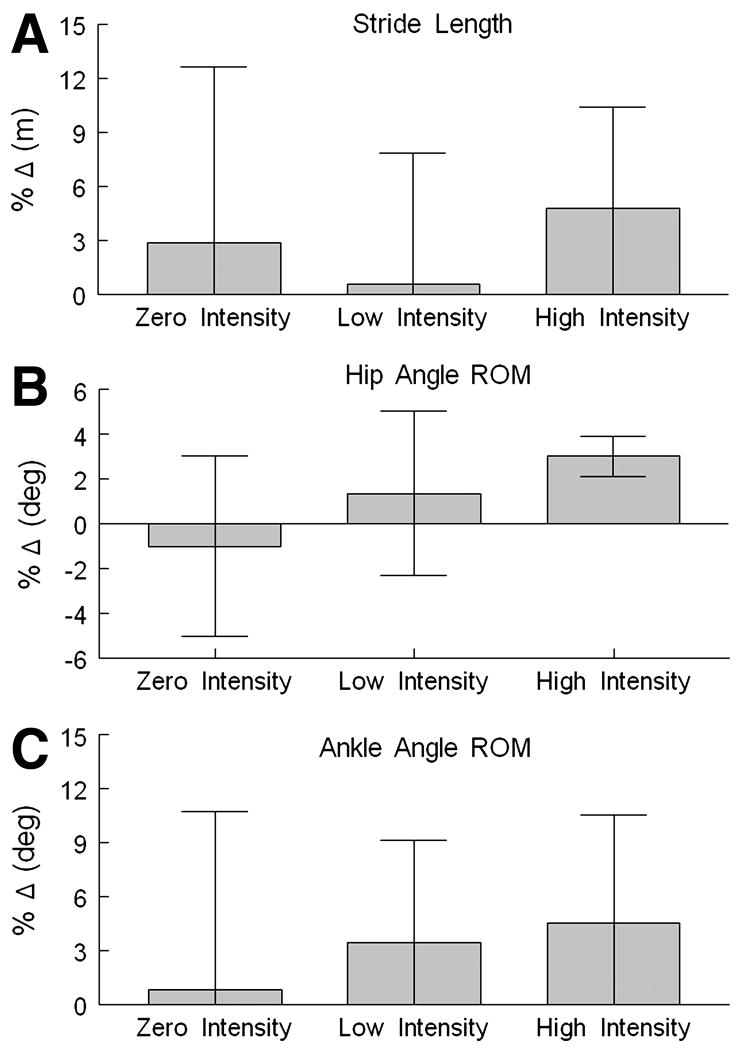
Results: A small improvement in total and motor UPDRS was observed in all groups. High-intensity group subjects showed postexercise increases in gait speed, step and stride length, and hip and ankle joint excursion during self-selected and fast gait and improved weight distribution during sit-to-stand tasks. Improvements in gait and sit-to-stand measures were not consistently observed in low- and zero-intensity groups. The high-intensity group showed lengthening in CSP.
Conclusions: The findings suggest the dose-dependent benefits of exercise and that high-intensity exercise can normalize corticomotor excitability in early PD.
Conflict of interest statement
No commercial party having a direct financial interest in the results of the research supporting this article has or will confer a benefit on the authors or on any organization with which the authors are associated.
Figures
References
-
- Fisher BE, Petzinger GM, Nixon K, et al. Exercise-induced behavioral recovery and neuroplasticity in the 1-methyl-4-phenyl-1,2,3,6-tetrahydropyridine-lesioned mouse basal ganglia. J Neurosci Res. 2004;77:378–90. - PubMed
-
- Adkins DL, Boychuk J, Remple MS, Kleim JA. Motor training induces experience-specific patterns of plasticity across motor cortex and spinal cord. J Appl Physiol. 2006;101:1776–82. - PubMed
-
- Miyai I, Fujimoto Y, Ueda Y, et al. Treadmill training with body weight support: its effect on Parkinson's disease. Arch Phys Med Rehabil. 2000;81:849–52. - PubMed
-
- Miyai I, Fujimoto Y, Yamamoto H, et al. Long-term effect of body weight-supported treadmill training in Parkinson's disease: a randomized controlled trial. Arch Phys Med Rehabil. 2002;83:1370–3. - PubMed
Publication types
MeSH terms
Grants and funding
LinkOut - more resources
Full Text Sources
Medical
