. 2008 Aug;154(7):1465-73.
doi: 10.1038/bjp.2008.229. Epub 2008 Jun 9.

Torcetrapib-induced blood pressure elevation is independent of CETP inhibition and is accompanied by increased circulating levels of aldosterone

Affiliations

Torcetrapib-induced blood pressure elevation is independent of CETP inhibition and is accompanied by increased circulating levels of aldosterone

M J Forrest et al. Br J Pharmacol. 2008 Aug.

Abstract

Background and purpose: Inhibition of cholesteryl ester transfer protein (CETP) with torcetrapib in humans increases plasma high density lipoprotein (HDL) cholesterol levels but is associated with increased blood pressure. In a phase 3 clinical study, evaluating the effects of torcetrapib in atherosclerosis, there was an excess of deaths and adverse cardiovascular events in patients taking torcetrapib. The studies reported herein sought to evaluate off-target effects of torcetrapib.

Experimental approach: Cardiovascular effects of the CETP inhibitors torcetrapib and anacetrapib were evaluated in animal models.

Key results: Torcetrapib evoked an acute increase in blood pressure in all species evaluated whereas no increase was observed with anacetrapib. The pressor effect of torcetrapib was not diminished in the presence of adrenoceptor, angiotensin II or endothelin receptor antagonists. Torcetrapib did not have a contractile effect on vascular smooth muscle suggesting its effects in vivo are via the release of a secondary mediator. Treatment with torcetrapib was associated with an increase in plasma levels of aldosterone and corticosterone and, in vitro, was shown to release aldosterone from adrenocortical cells. Increased adrenal steroid levels were not observed with anacetrapib. Inhibition of adrenal steroid synthesis did not inhibit the pressor response to torcetrapib whereas adrenalectomy prevented the ability of torcetrapib to increase blood pressure in rats.

Conclusions and implications: Torcetrapib evoked an acute increase in blood pressure and an acute increase in plasma adrenal steroids. The acute pressor response to torcetrapib was not mediated by adrenal steroids but was dependent on intact adrenal glands.


Figures
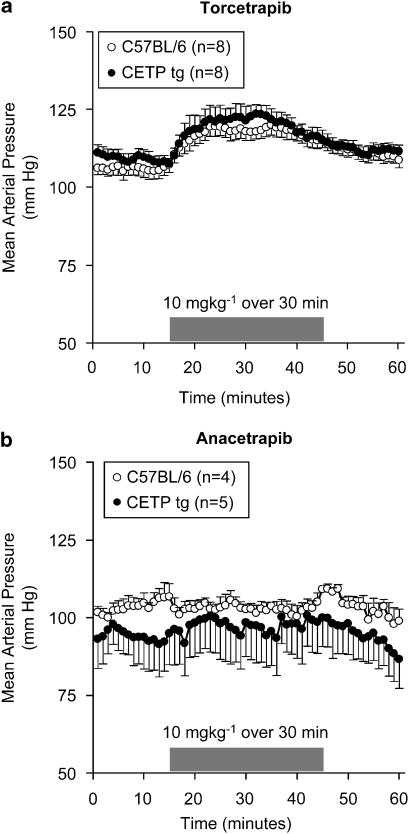
Figure 1
Figure 1
Torcetrapib increased blood pressure in normal and CETP transgenic mice. Mean arterial blood pressure was measured in conscious B6 mice and B6-Tg(CETP) transgenic mice. Torcetrapib (10 mg kg−1) or anacetrapib (10 mg kg−1) was administered as an i.v. infusion of 30 min duration. Blood pressure was monitored continuously and is shown as average values at 1 min intervals. Each point represents the mean, and vertical lines represent the s.e. Numbers of animals per group are shown in parentheses. CETP, cholesteryl ester transfer protein.
Figure 2
Figure 2
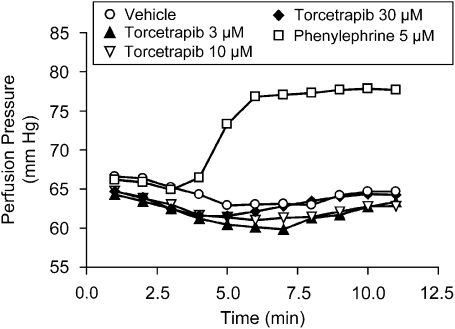
Torcetrapib did not increase perfusion pressure in the isolated perfused rat hindlimb. The effects of torcetrapib or vehicle on perfusion pressure were evaluated in urethane (800 mg kg−1, i.p.)- and α-chloralose (40 mg kg−1, i.p.)-anaesthetized rats. The femoral artery was cannulated and connected to a perfusion pump at a rate that produced a resting perfusion pressure of ∼65 mm Hg. Subsequently, animals were infused sequentially with torcetrapib (3–30 μM) followed by phenylephrine (5 μM). Each data point is the mean of determinations made in two animals.
Figure 3
Figure 3
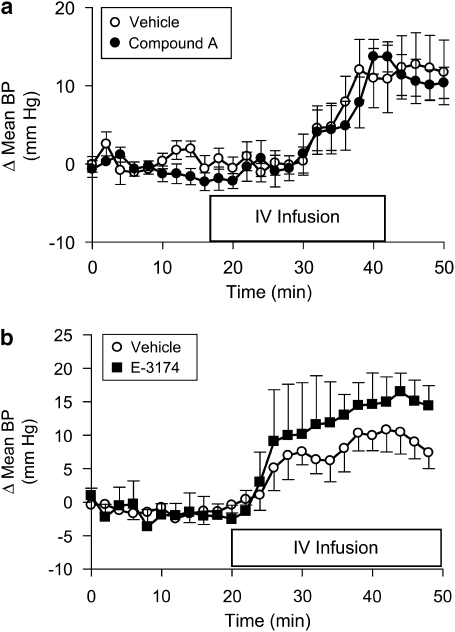
Effects of endothelin or angiotensin II receptor antagonists. Mean arterial blood pressure was measured in pentobarbital (55 mg kg−1, i.p.)-anaesthetized rats. (a) Separate groups of animals were given either the ETA/ETB antagonist, compound A (3 mg kg−1, i.v.) or vehicle (saline) 60 min prior to the i.v. infusion of torcetrapib (10 mg kg−1) in a volume of 1 mL per rat, over 30 min. Data are expressed as the change in pressure from the baseline period 20–40 min prior to test compound infusion. Each point represents the mean, and vertical lines represent the s.e. for groups of five rats each. (b) Mean arterial blood pressure was measured in pentobarbital (55 mg kg−1, i.p.)-anaesthetized rats. Separate groups of animals were given either the AT1 receptor antagonist, E-3174 (1 mg kg−1, i.v.) or vehicle (saline) 60 min prior to the i.v. infusion of torcetrapib (10 mg kg−1) in a volume of 1 mL per rat over 30 min. Data are expressed as the change in blood pressure from the baseline period 20–40 min (Δ mean BP) prior to giving test compounds. Each point represents the mean, and vertical lines represent the s.e. for groups of four rats each.
Figure 4
Figure 4
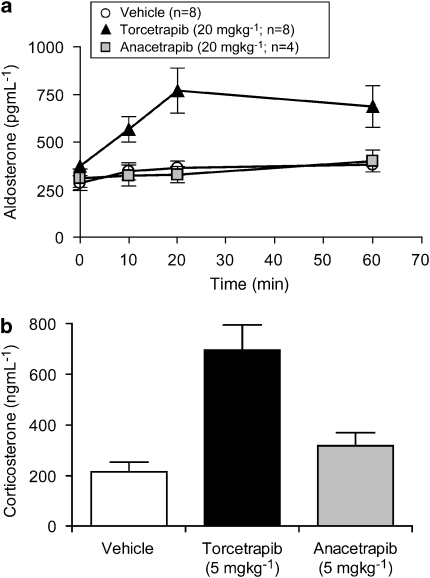
Measurement of adrenal steroids. (a) Plasma levels of aldosterone were measured in plasma from conscious rats prior to and at the indicated times following the i.v. infusion of compounds at 20 mg kg−1 or vehicle (50% dimethylacetamide:50% polyethylene glycol 200) for 20 min. Each data point is the mean and vertical lines represent the s.e. for the numbers of animals indicated in parentheses. (b) Plasma levels of corticosterone were measured in plasma from conscious rats 20 min following the i.v. infusion of compounds at 5 mg kg−1 or vehicle (50% dimethylacetamide:50% polyethylene glycol 200) for 20 min. Each data point is the mean and vertical lines represent the s.e. for the numbers of animals indicated in parentheses.
Figure 5
Figure 5
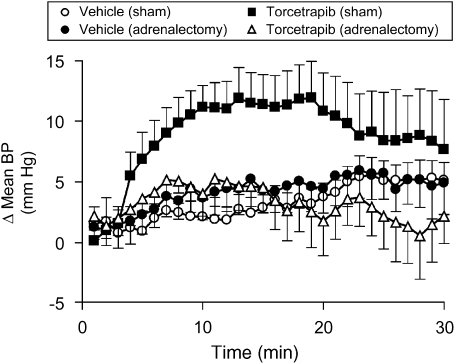
Adrenalectomy prevented the pressor response to torcetrapib. The effects of torcetrapib infusion (5 mg kg−1 × 20 min) or vehicle (2% DMSO:4% Cremophor EL:94% saline) on mean arterial pressure were evaluated in pentobarbital (55 mg kg−1, i.p.)-anaesthetized rats following acute adrenalectomy or in animals that were sham-operated. Data are expressed as the change in blood pressure (Δ mean BP) from the baseline period 20 min prior to giving test compounds. Each point represents the mean and vertical lines represent the s.e. for groups of six to nine animals. DMSO, dimethyl sulphoxide.
Figure 6
Figure 6
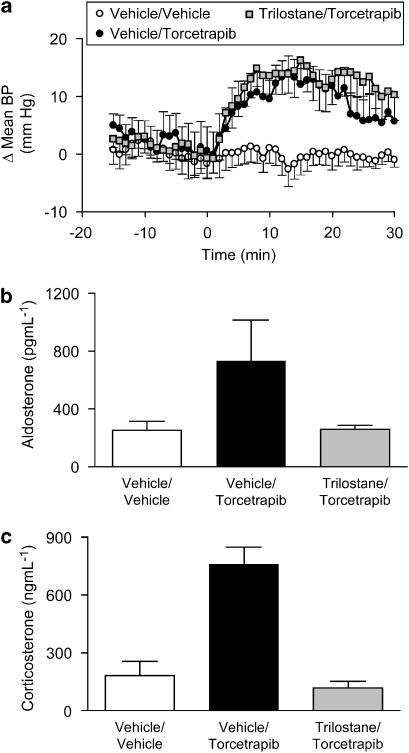
3β-hydroxysteroid dehydrogenase inhibition does not block the pressor effect of torcetrapib. (a) The effects of torcetrapib infusion (5 mg kg−1 × 30 min) or vehicle (2% DMSO:4% Cremophor EL:94% saline) on mean arterial pressure were evaluated in conscious rats 60 min after the administration of trilostane (10 mg kg−1, i.v.) or an equivalent volume (1 mL kg−1) of vehicle (50% dimethylacetamide:50% polyethylene glycol 200). Data are expressed as the change in blood pressure (Δ mean BP) from the baseline period 15–30 min prior to giving test compounds. Each point represents the mean and vertical lines represent the s.e. for groups of eight animals. (b) Plasma levels of aldosterone were measured in a subgroup (n=4) of the animals in (a). Plasma samples were prepared from blood obtained at the conclusion of the infusion of torcetrapib or vehicle. (c) Plasma levels of corticosterone were measured in a subgroup (n=4) of the animals in (a). Plasma samples were prepared from blood obtained at the conclusion of the infusion of torcetrapib or vehicle. DMSO, dimethyl sulphoxide.
Figure 7
Figure 7
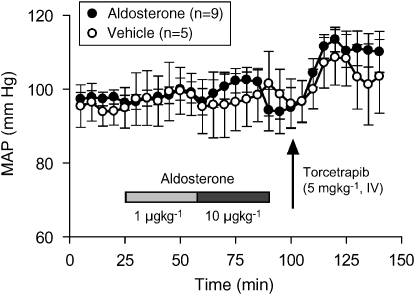
Exogenous aldosterone did not increase blood pressure. Mean arterial blood pressure was measured in pentobarbital (55 mg kg−1, i.p.)-anaesthetized rats that were administered aldosterone as sequential 30 min infusions at 1 and 10 μg kg−1 or equivalent volumes of vehicle (saline). Fifteen minutes later, both groups of animals were administered torcetrapib (5 mg kg−1) as an i.v. infusion of 30 min duration. Each point represents the mean and vertical lines represent the s.e. for the numbers of animals indicated in parentheses.
Figure 8
Figure 8
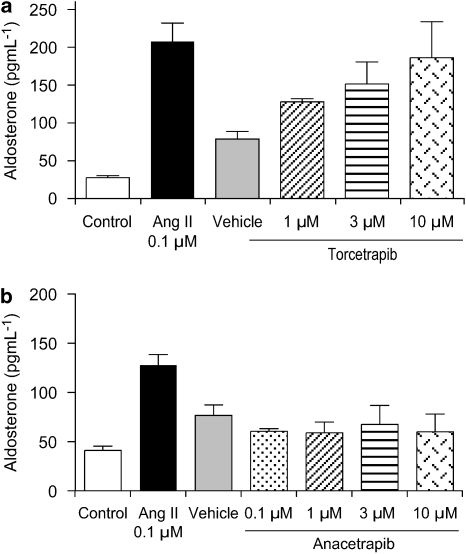
Torcetrapib released aldosterone from isolated rat adrenal cells. Aldosterone release was measured from primary adrenocortical cells isolated from rat adrenal glands. Cells (∼200 000 per sample) were incubated with angiotensin II (0.1 μM), torcetrapib (1–30 μM), anacetrapib (0.1–10 μM) or appropriate vehicle for 2 h at 37 °C. Following centrifugation, supernatants were assayed for aldosterone by an enzyme-linked immunoassay. Each bar represents the mean and vertical lines represent the s.e. for four samples.

Comment in

References

    1. Assmann G, Schulte H. Relation of high density lipoprotein cholesterol and triglycerides to incidence of atherosclerotic coronary artery disease (the PROCAM experience) Am J Cardiol. 1992;70:733–737. - PubMed
    1. Barter PJ, Brewer HB, Jr, Chapman MJ, Hennekens CH, Rader DJ, Tall AR. Cholesteryl ester transfer protein: a novel target for raising HDL and inhibiting atherosclerosis. Arterioscler Thromb Vasc Biol. 2003;23:160–167. - PubMed
    1. Barter PJ, Caulfield M, Eriksson M, Grundy SM, Kastelein JJP, Komajda M, et al. Effects of torcetrapib in patients at high risk for coronary events. N Engl J Med. 2007;357:2109–2122. - PubMed
    1. Brousseau ME, Schaefer EJ, Wolfe ML, Bloedon LT, Digenio AG, Clark RW, et al. Effects of an inhibitor of cholesteryl ester transfer protein on HDL cholesterol. N Engl J Med. 2004;350:1505–1515. - PubMed
    1. Clark RW, Sutfin TA, Ruggeri RB, Willauer AT, Sugarman ED, Magnus-Aryitey G, et al. Raising high-density lipoprotein in humans through inhibition of cholesteryl ester transfer protein: an initial multidose study of torcetrapib. Arterioscler Thromb Vasc Biol. 2004;24:490–497. - PubMed

MeSH terms