Pharmacokinetics of intravenous and oral midazolam in plasma and saliva in humans: usefulness of saliva as matrix for CYP3A phenotyping
- PMID: 18537963
- PMCID: PMC2561102
- DOI: 10.1111/j.1365-2125.2008.03201.x
Pharmacokinetics of intravenous and oral midazolam in plasma and saliva in humans: usefulness of saliva as matrix for CYP3A phenotyping
Abstract
Aims: To compare midazolam kinetics between plasma and saliva and to find out whether saliva is suitable for CYP3A phenotyping.
Methods: This was a two way cross-over study in eight subjects treated with 2 mg midazolam IV or 7.5 mg orally under basal conditions and after CYP3A induction with rifampicin.
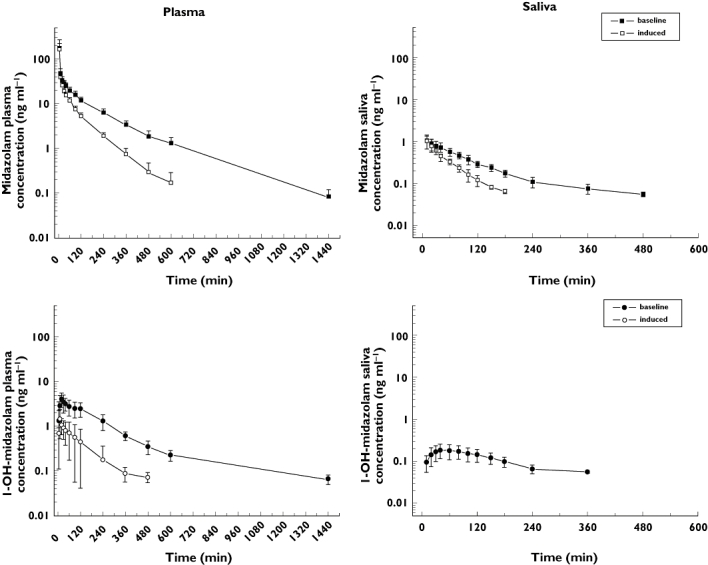
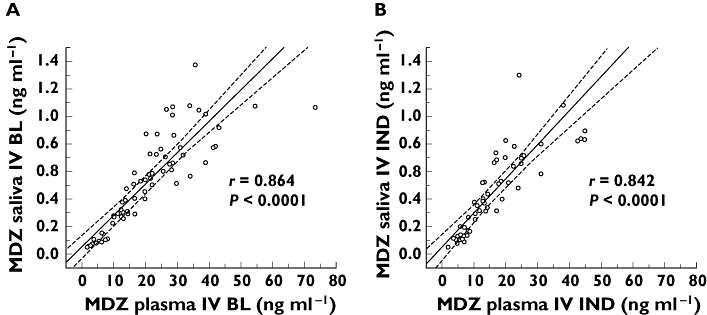
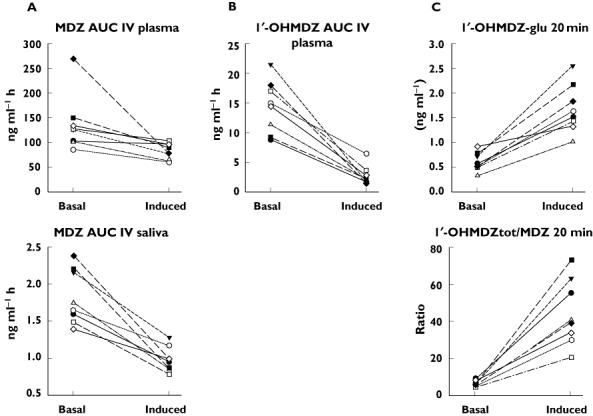
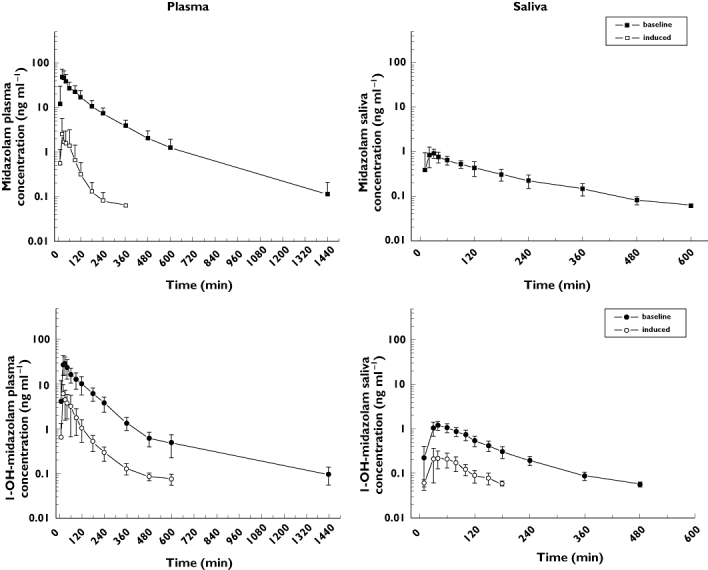
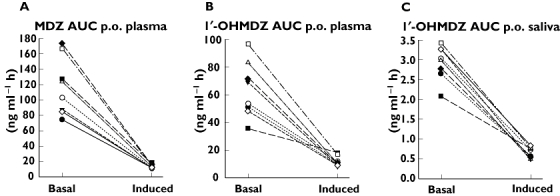
Results: Under basal conditions and IV administration, midazolam and 1'-hydroxymidazolam (plasma, saliva), 4-hydroxymidazolam and 1'-hydroxymidazolam-glucuronide (plasma) were detectable. After rifampicin, the AUC of midazolam [mean differences plasma 53.7 (95% CI 4.6, 102.9) and saliva 0.83 (95% CI 0.52, 1.14) ng ml(-1) h] and 1'-hydroxymidazolam [mean difference plasma 11.8 (95% CI 7.9 , 15.7) ng ml(-1) h] had decreased significantly. There was a significant correlation between the midazolam concentrations in plasma and saliva (basal conditions: r = 0.864, P < 0.0001; after rifampicin: r = 0.842, P < 0.0001). After oral administration and basal conditions, midazolam, 1'-hydroxymidazolam and 4-hydroxymidazolam were detectable in plasma and saliva. After treatment with rifampicin, the AUC of midazolam [mean difference plasma 104.5 (95% CI 74.1, 134.9) ng ml(-1) h] and 1'-hydroxymidazolam [mean differences plasma 51.9 (95% CI 34.8, 69.1) and saliva 2.3 (95% CI 1.9, 2.7) ng ml(-1) h] had decreased significantly. The parameters separating best between basal conditions and post-rifampicin were: (1'-hydroxymidazolam + 1'-hydroxymidazolam-glucuronide)/midazolam at 20-30 min (plasma) and the AUC of midazolam (saliva) after IV, and the AUC of midazolam (plasma) and of 1'-hydroxymidazolam (plasma and saliva) after oral administration.
Conclusions: Saliva appears to be a suitable matrix for non-invasive CYP3A phenotyping using midazolam as a probe drug, but sensitive analytical methods are required.
Figures
References
-
- Nordt SP, Clark RF. Midazolam: a review of therapeutic uses and toxicity. J Emerg Med. 1997;15:357–65. - PubMed
-
- Streetman DS, Bertino JS, Jr, Nafziger AN. Phenotyping of drug-metabolizing enzymes in adults: a review of in-vivo cytochrome P450 phenotyping probes. Pharmacogenetics. 2000;10:187–216. - PubMed
-
- Bauer TM, Ritz R, Haberthur C, Ha HR, Hunkeler W, Sleight AJ, Scollo-Lavizzari G, Haefeli WE. Prolonged sedation due to accumulation of conjugated metabolites of midazolam. Lancet. 1995;346:145–7. - PubMed
-
- Heizmann P, Ziegler WH. Excretion and metabolism of 14C-midazolam in humans following oral dosing. Arzneimittelforschung. 1981;31:2220–3. - PubMed
-
- Kronbach T, Mathys D, Umeno M, Gonzalez FJ, Meyer UA. Oxidation of midazolam and triazolam by human liver cytochrome P450IIIA4. Mol Pharmacol. 1989;36:89–96. - PubMed
Publication types
MeSH terms
Substances
LinkOut - more resources
Full Text Sources
Other Literature Sources