Comparative Study
. 2008 Jun 6:8:9.
doi: 10.1186/1471-2210-8-9.

Antagonist affinity measurements at the Gi-coupled human histamine H3 receptor expressed in CHO cells

Affiliations
Comparative Study

Antagonist affinity measurements at the Gi-coupled human histamine H3 receptor expressed in CHO cells

Jillian G Baker. BMC Pharmacol. .

Abstract

Background: The H3 histamine receptor is a Gi-coupled GPCR that has been proven to exist in different agonist-induced states, including that defined by the protean agonist proxyfan. Several GPCRs are now known to exist in different states. For some of these, antagonist affinity measurement remain constant regardless of the state of the receptor, for others e.g. the beta-adrenoceptors, the antagonist affinity measurements vary considerably depending on which agonist-dependent state is being identified. The purpose of this study was to examine the antagonist affinity measurements at the Gi-coupling human H3 receptor, paying particular attention to measurements made in the presence of full agonists, partial agonists and the proxyfan protean agonist-induced state of the receptor.

Results: CHO cells stably expressing the human histamine H3 receptor and a CRE-SPAP reporter were used. Measurements of CRE-gene transcription and 3H-cAMP accumulation were made. A range of ligands of different agonist efficacies were determined, including some partial agonists e.g. VUF 5681. Unlike other Gi-coupled receptors, no Gs-coupled state of the receptor was detected with these ligands. Antagonist affinity measurements were constant, whether the measurements were made in the presence of a full agonist, a partial agonist or the protean agonist proxyfan.

Conclusion: In contrast to all three subtypes of the beta-adrenoceptors, but in keeping with the traditional pharmacological dogma, antagonist affinity measurements remained constant at the human H3 receptor, including the medium-efficacy proxyfan-induced state of the receptor and the VUF5681-induced state of the receptor.


Figures
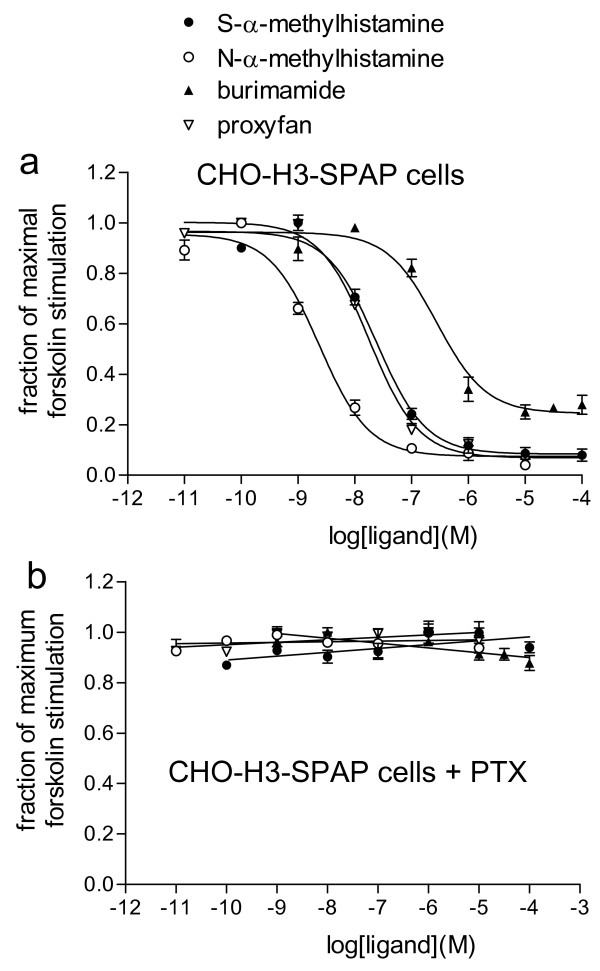
Figure 1
Figure 1
a) and b) CRE-SPAP production in forskolin-stimulated CHO-H3-SPAP cells in response to S-α-methylhistamine, N-α-methylhistamine and burimamide in the absence a) and following pre-incubation with PTX b). The figures are normalised to maximum forskolin stimulation where basal = 0 and maximum forskolin stimulation = 1. Data points are mean ± s.e.m. of triplicate values from a single experiment and are representative of a) 6 and b) 3 separate experiments.
Figure 2
Figure 2
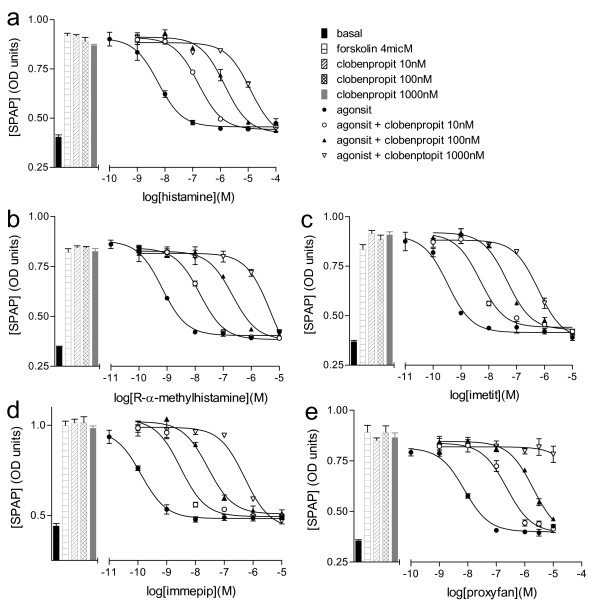
CRE-SPAP production in forskolin-stimulated CHO-H3-SPAP cells in response to a) histamine, b) R-α-methylhistamine, c) imetit, d) immepip and e) proxyfan in the absence and presence of 10 nM, 100 nM or 1000 nM clobenpropit. Bars show basal CRE-SPAP production and that in response to 4 μM forskolin alone, and 10 nM, 100 nM or 1000 nM clobenpropit in the presence of 4 μM forskolin. Data points are mean ± s.e.m. of triplicate values from a single experiment and are representative of a) 3, b) 4, c) 4, d) 4 and e) 4 separate experiments.
Figure 3
Figure 3
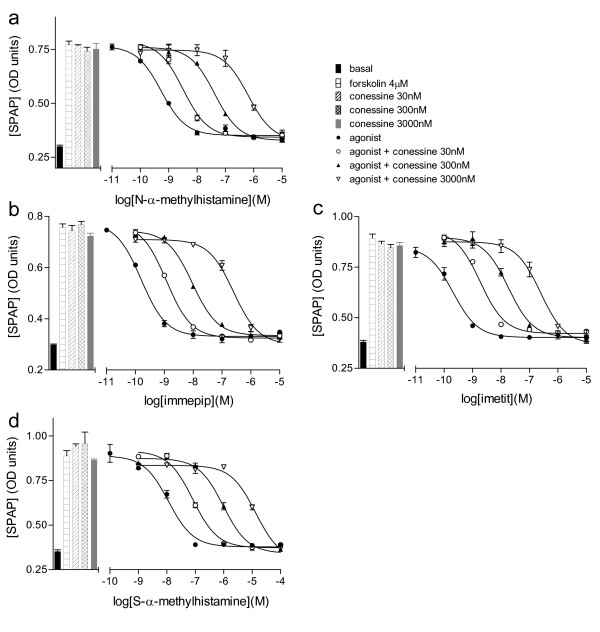
CRE-SPAP production in forskolin-stimulated CHO-H3-SPAP cells in response to a) N-α-methylhistamine, b) immepip c) imetit and d) S-α-methylhistamine in the absence and presence of 30 nM, 300 nM or 3000 nM conessine. Bars show basal CRE-SPAP production and that in response to 4 μM forskolin alone, and 30 nM, 300 nM or 3000 nM conessine in the presence of 4 μM forskolin. Data points are mean ± s.e.m. of triplicate values from a single experiment and are representative of 4 separate experiments in each case.
Figure 4
Figure 4
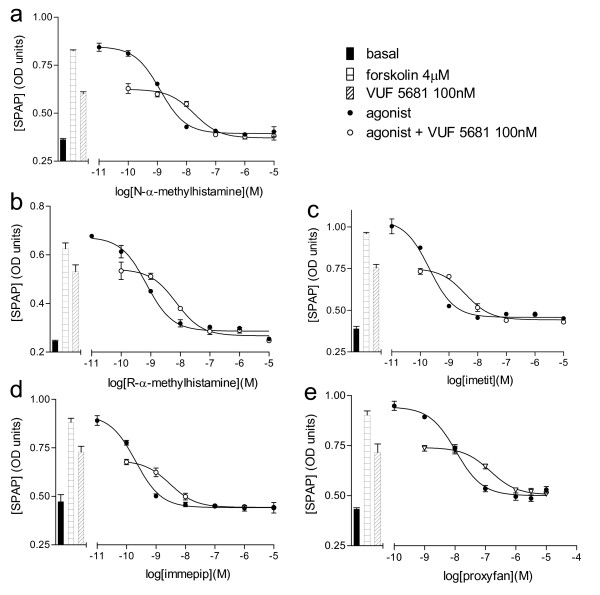
CRE-SPAP production in forskolin-stimulated CHO-H3-SPAP cells in response to a) N-α-methylhistamine, b) R-α-methylhistamine, c) imetit, d) immepip and e) proxyfan in the absence and presence of 100 nM VUF 5681. Bars show basal CRE-SPAP production and that in response to 4 μM forskolin alone and 100 nM VUF 5681 in the presence of 4 μM forskolin. Data points are mean ± s.e.m. of triplicate values from a single experiment and are representative of a) 4, b) 4, c) 4, d) 3 and e) 3 separate experiments.
Figure 5
Figure 5
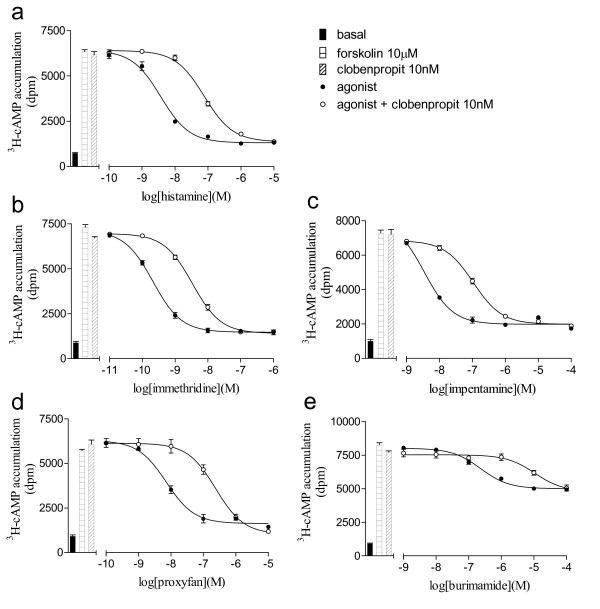
Forskolin-stimulated 3H-cAMP accumulation in CHO-H3-SPAP cells in response to a) histamine, b) immethridine, c) impentamine d) proxyfan and e) burimamide in the absence and presence of 10 nM clobenpropit. Bars show basal 3H-cAMP accumulation, that in response to 10 μM forskolin alone and that in response to 10 nM clobenpropit in the presence of 10 μM forskolin. Data points are mean ± s.e.m. of triplicate values from single experiments that are representative of a) 5, b) 5, c) 4, d) 5 and e) 4 separate experiments.
Figure 6
Figure 6
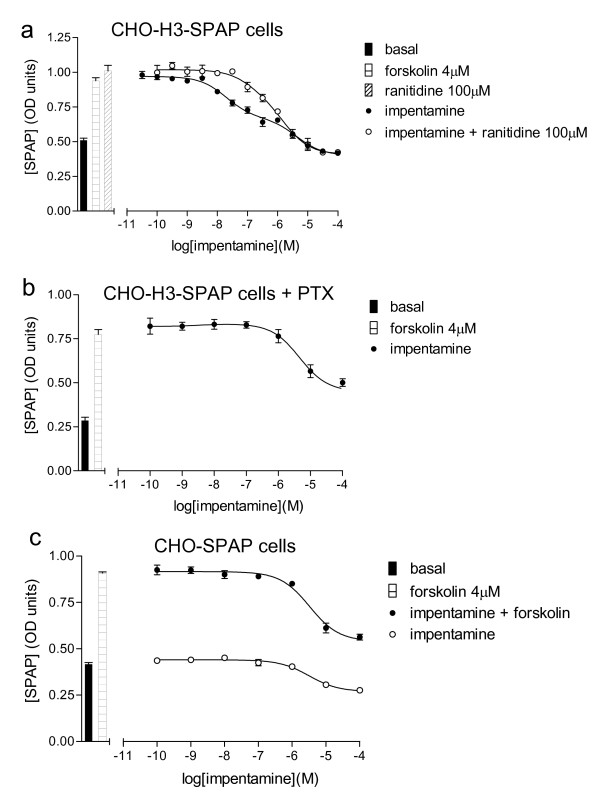
a) CRE-SPAP production in forskolin-stimulated CHO-H3-SPAP cells in response to impentamine in the absence and presence of 100 μM ranitidine. Bars show basal CRE-SPAP production, that in response to 4 μM forskolin alone and to 100 μM ranitidine in the presence of 4 μM forskolin. b) CRE-SPAP production in forskolin-stimulated CHO-H3-SPAP cells in response to impentamine following 24 hours pre-incubation with PTX. Bars show basal CRE-SPAP production, that in response to 4 μM forskolin alone following pre-incubation with PTX. c) CRE-SPAP production in CHO-SPAP cells in response to impentamine either alone or in the presence of 4 μM forskolin. Bars show basal CRE-SPAP production, that in response to 4 μM forskolin alone. Data points are mean ± s.e.m. of triplicate values from a single experiment and are representative of a) 5, b) 3 and c) 3 separate experiments.
Figure 7
Figure 7
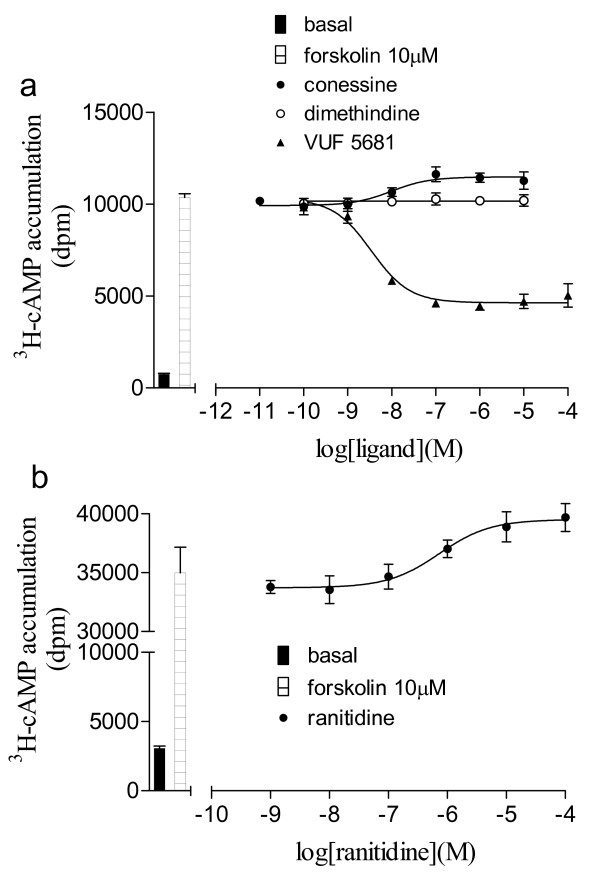
Forskolin-stimulated 3H-cAMP accumulation in CHO-H3-SPAP cells in response to a) conessine, dimethindine and VUF 5681 and b) ranitidine following 5 hours ligand stimulation. Bars show basal 3H-cAMP accumulation and that in response to 10 μM forskolin alone. Data points are mean ± s.e.m. of triplicate values from single experiments that is representative of 4 separate experiments in each case.

References

    1. Arunlakshana O, Schild HO. Some quantitative uses of drug antagonists. Br J Pharmacol Chemother. 1959;14:48–58. - PMC - PubMed
    1. Ash ASF, Schild HO. Receptors mediating some actions of histamine. Br J Pharmacol Chemother. 1966;27:427–439. - PMC - PubMed
    1. Hill SJ. G protein-coupled receptors: past, present and future. Br J Pharmacol. 2006;147:S27–S37. doi: 10.1038/sj.bjp.0706455. - DOI - PMC - PubMed
    1. Black JW, Duncan WAM, Shanks RG. Comparison of some Properties of pronethalol and propranolol. Br J Pharmacol. 1965;25:577–591. - PMC - PubMed
    1. Black JW, Duncan WA, Durant CJ, Ganellin CR, Parsons ME. Definition and antagonism of histamine H2-receptors. Nature. 1972;236:385–390. doi: 10.1038/236385a0. - DOI - PubMed

Publication types

MeSH terms

Substances