


First- vs second-trimester ultrasound: the effect on pregnancy dating and perinatal outcomes
- PMID: 18538160
- PMCID: PMC2603611
- DOI: 10.1016/j.ajog.2008.03.034
First- vs second-trimester ultrasound: the effect on pregnancy dating and perinatal outcomes
Abstract
Objective: The objective of the study was to examine the effect of first-trimester obstetric ultrasound (OBUS) on the measurement of the effect of complications ascribed to postterm pregnancies.
Study design: We conducted a retrospective cohort study of all term, singleton pregnancies delivered at our institution who had an OBUS at a gestation of 24 weeks or less. Those women who underwent an OBUS at a gestation of 12 weeks or less (OBUS12) were compared with those who had an OBUS at 13-24 weeks of gestation (OBUS13-24). The primary outcome measures were the rates of postterm pregnancies greater than 41 or 42 weeks' gestation. Secondary outcomes were the differences between the postterm and term gestations in maternal and neonatal outcomes.
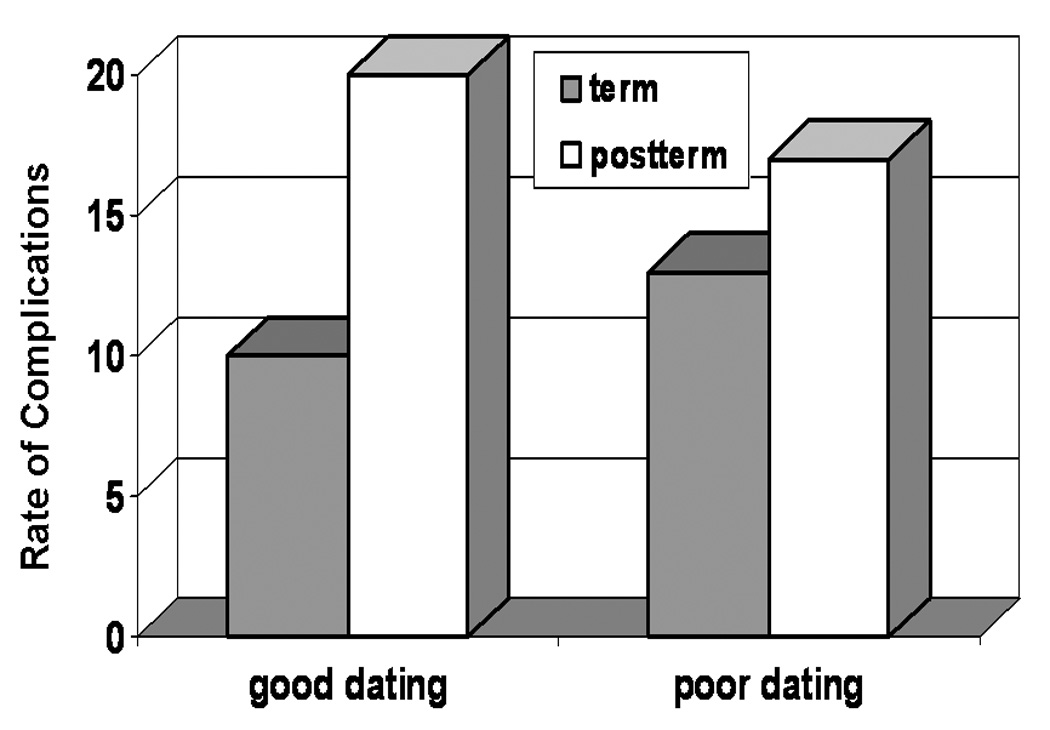
Results: In the OBUS12 group, the rate of postterm pregnancy 42 weeks or longer was lower (2.7%) as compared with the OBUS13-24 group (3.7%, P = .022). With regard to reaching 41 weeks of gestation, the OBUS12 group was again lower (18.2%) as compared with the OBUS13-24 group (22.1%, P < .001). There were also fewer postterm inductions at 42 weeks or longer in the OBUS12 group (1.8%) as compared with the OBUS13-24 group (2.6%, P = .017). When comparing perinatal outcomes between those women who reached 41 weeks of gestation and those prior to 41 weeks of gestation, the OBUS12 group demonstrated greater differences between these 2 groups.
Conclusion: Our findings suggest that earlier obstetric ultrasound, which leads to better pregnancy dating, reduces the rate of estimated postterm pregnancies. This may, in turn, reduce unnecessary intervention and lead to better identification of postterm pregnancies at greater risk of complications.
Figures
References
-
- American College of Obstetricians and Gynecologists. Management of postterm pregnancy, ACOG Practice Bulletin No. 55. Washington, D.C.: ACOG; 2004.
-
- Hauth J, Goodman MT, Gilstrap LC, et al. Post-Term Pregnancy. Obstet Gynecol. 1980;56:467. - PubMed
-
- Lucas WE, Anctil AO, Callagan DA. The Problem of Postterm Pregnancy. Am J Obstet Gynecol. 1965 Jan 15;91:241–250. - PubMed
-
- Naeye RL. Causes of perinatal mortality excess in prolonged gestations. Am J Epidemiol. 1978;108:429–433. - PubMed
-
- Caughey AB, Musci TJ. Complications of term pregnancies beyond 37 weeks of gestation. Obstet Gynecol. 2004;103:57–62. - PubMed
Publication types
MeSH terms
Grants and funding
LinkOut - more resources
Full Text Sources
